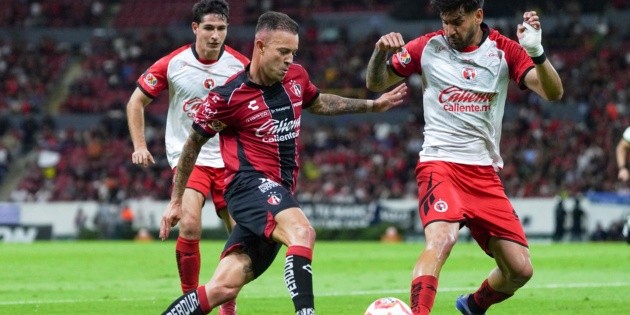
The Apertura 2026 campaign reaches a mathematical inflection point as Jornada 10 begins. Club Tijuana and Atlas are currently entangled in a high-density competitive cluster, sharing a 14-point deadlock with Querétaro, León, and Puebla. This statistical parity elevates the fixture from a mid-season encounter to a high-stakes strategic battle where a single result dictates a multi-position swing toward direct Liguilla qualification or the volatility of the Play-in tournament.
Strategic Significance of the Mid-Table Congestion
For Tijuana (7th) and Atlas (9th), the current standings reflect divergent momentums despite identical point totals. Tijuana enters the match with a significant administrative advantage: a game in hand. This latent potential allows Sebastian ‘Loco’ Abreu’s squad to approach the fixture with tactical aggression, knowing a victory provides a mathematical buffer against future scheduling congestion. Conversely, Atlas is experiencing a performance plateau. After a robust start of four wins in five matches, the Rojinegros have failed to secure a victory for 30 days, managing only two points from their last 12 available.
The institutional pressure to secure a top-six finish is driven by the physical and financial overhead of the Play-in round. For both organizations, avoiding the extra elimination phase is paramount to preserving squad depth for the high-intensity quarter-final stage.
The Mictlán: An Environmental and Tactical Barrier
The Estadio Caliente—the Mictlán—functions as a formidable operational asset for Tijuana. Its artificial turf and the logistical fatigue inherent in border travel create a historical barrier for visiting teams. Statistical records indicate Atlas has secured only one victory in their last ten regular-season visits to the venue. This historical underperformance forces Hernán Crespo to recalibrate his away-game strategy, prioritizing ball retention to mitigate the faster pace of the synthetic surface.
Tijuana’s objective is to leverage this familiarity to maintain their near-perfect home record. Following a 2-2 draw against Pachuca where they displayed offensive resilience but lacked defensive closure, Abreu has refined a high-press system designed to disrupt opponents accustomed to natural grass. This system places immense pressure on the Atlas backline, which has recently shown vulnerability to rapid transitions.
Managerial Friction: Abreu vs. Crespo
The tactical confrontation highlights contrasting managerial pressures. Abreu is tasked with converting Tijuana’s home dominance into a sustainable post-season run. His integration of Mora and Gómez into a high-intensity scoring unit has been effective, yet the squad’s tendency to drop points in winnable scenarios remains a point of institutional scrutiny.
In contrast, Hernán Crespo faces a crisis of confidence. The winless streak has exposed a lack of roster depth and potential fatigue in physical conditioning. The recent 1-1 draw against Pumas demonstrated resilience but underscored a lack of clinical execution. A defeat in the Mictlán would extend the winless streak to five matches, likely forcing the Atlas board to re-evaluate the long-term viability of his project ahead of the final third of the season.
The High-Performance Toll: Managing ‘Bajas’
A critical underlying factor in this matchup is the physical demand of the modern 90-minute game. The transition of players into high-performance athletes has increased match intensity but also heightened the risk of soft-tissue injuries—the ‘bajas’ currently affecting both rosters. The density of the Liga MX calendar, coupled with international breaks, leaves minimal windows for recovery.
These absences force sub-optimal squad rotations. For Atlas, the quality gap between the starting XI and the bench has limited Crespo’s ability to influence games through second-half tactical shifts. Tijuana’s ability to manage their roster health will be the deciding factor in whether they can capitalize on their game in hand and solidify their standing among the league’s elite.
Institutional and Commercial Implications
Beyond the pitch, the result carries financial weight. In the Liga MX model, Liguilla qualification is the primary driver of broadcast revenue and sponsorship valuation. For Tijuana, operating in a unique binational market, post-season success is essential for attracting cross-border investment. For Atlas, protecting ‘La Academia’s’ brand equity requires breaking the cycle of mid-table mediocrity to ensure season ticket renewals and commercial leverage.
As Jornada 10 kicks off, the 14-point logjam serves as a microcosm of the league’s parity. The ability to handle the specific environmental challenges of the Mictlán and the physical attrition of the mid-season grind will determine which club emerges as a genuine title contender.