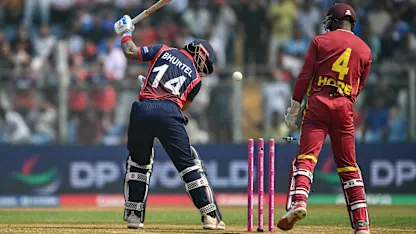
The Group C fixture between the West Indies and Nepal at Mumbai’s Wankhede Stadium serves as a critical diagnostic of competitive readiness in the ICC Men’s T20 World Cup 2026. For the West Indies, the match functions as a stabilization phase following a high-leverage victory over England. Conversely, Nepal faces a survival imperative, requiring a strategic upset to arrest a two-match losing streak and maintain institutional relevance in the tournament hierarchy.
Atmospheric Variables and the Strategic Toss
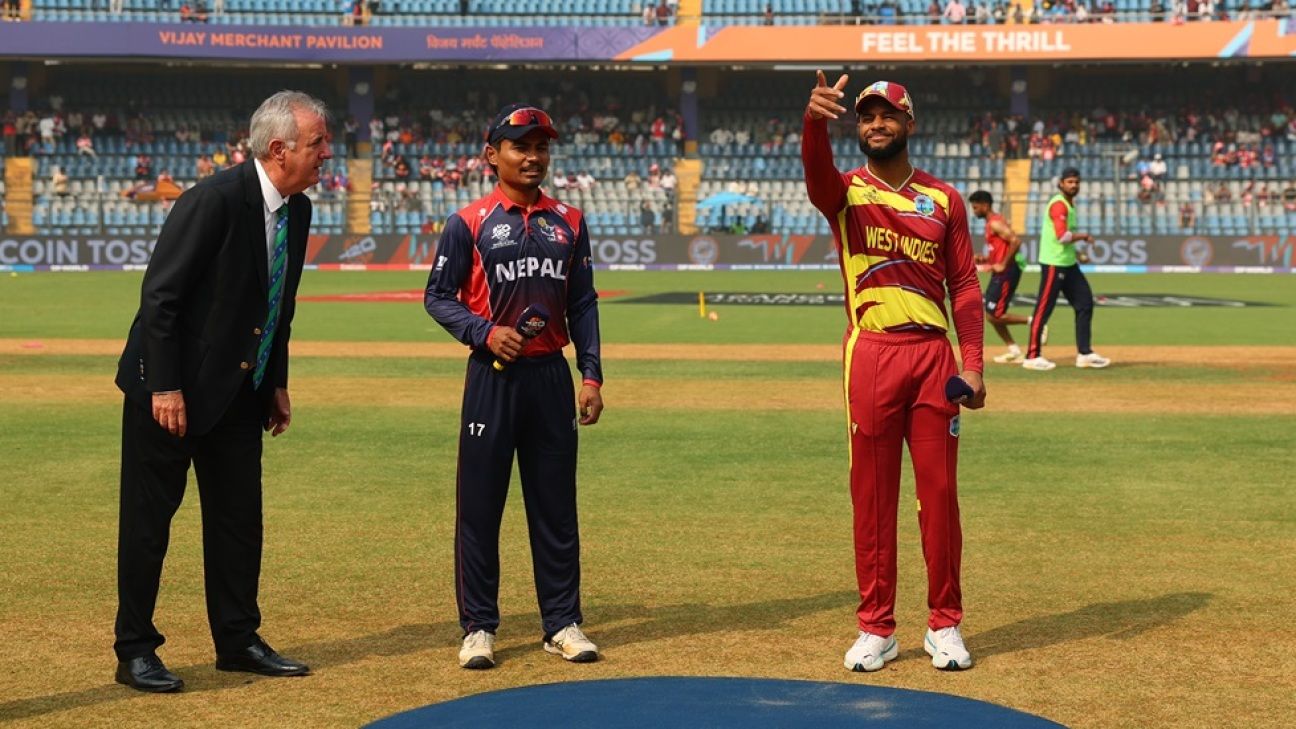
Captain Shai Hope’s decision to bowl first reflects a precise calibration to Wankhede’s localized environmental conditions. The identification of atypical surface dampness suggests a departure from the venue’s traditional high-scoring, desiccated profile. This moisture increases the coefficient of friction, enhancing lateral movement and seam presentation during the initial powerplay. By electing to bowl, the West Indies aim to exploit this transient window of volatility, neutralizing Nepal’s top-order before the surface stabilizes under solar exposure.
This tactical choice also incorporates risk-mitigation regarding the Net Run Rate (NRR). In a format where qualification frequently hinges on secondary tiebreakers, chasing a target provides the batting side with a definitive mathematical framework, allowing for the controlled aggression necessary to optimize their standing within Group C.
Roster Depth and Injury Management
The omission of Romario Shepherd due to a minor physical ailment—a ‘niggle’—underscores the necessity of squad redundancy in a condensed tournament schedule. The introduction of Matthew Forde as a like-for-like replacement maintains the team’s structural equilibrium while shielding a high-value asset for the Super 8 stage. This selection philosophy demonstrates the West Indies’ developmental maturity, prioritizing long-term physiological preservation without compromising immediate bowling variety.
Nepal’s Tactical Pivot: Pace Over Spin
Nepal’s personnel shift—replacing left-arm spinner Lalit Rajbanshi with fast-bowling all-rounder Sompal Kami—is a reactive adjustment to the Wankhede’s bounce profile. Captain Rohit Paudel’s decision to favor a pace-heavy attack aims to disrupt the West Indies’ established proficiency against spin. For Nepal, this transition represents a steep learning curve in venue adaptation; their success depends on Kami’s ability to utilize the early-innings dampness to restrict a West Indian middle-order known for explosive power-hitting.
Institutional Stakes and Performance Leverage
Beyond the immediate scorecard, this encounter is a test of Nepal’s institutional resilience. For Associate nations, fixtures against Full Members are high-visibility opportunities to demonstrate technical parity and justify global investment. For the West Indies, the objective is the maintenance of professional standards. The psychological momentum gained from defeating Tier-1 opposition like England can be eroded by a lapse in tactical discipline; thus, approaching Nepal with analytical rigor is essential for sustained championship momentum.
Conclusion: The Path to Super 8
The outcome at Wankhede will fundamentally reshape the Group C landscape. The West Indies’ decision to bowl and Nepal’s shift toward seam-centric defense are logical responses to empirical data. As the tournament progresses toward the Super 8s, the ability to synthesize environmental awareness with operational efficiency will distinguish the title contenders from the rest of the field.