The semi-final landscape at Wimbledon has undergone a rigorous structural realignment following Jannik Sinner’s clinical dismissal of Novak Djokovic. Sinner, as the top seed, executed a 6-4, 6-4, 6-4 victory that was notable for its lack of the traditional volatility associated with the Serbian veteran’s high-stakes defensive play. This result validates the current ATP ranking trajectory, demonstrating a quantifiable gap in operational efficiency between the ascending generation and the established order.
Tactical Execution and Performance Metrics
Sinner’s performance was defined by kinematic consistency and a high-leverage service game. The symmetry of the 6-4 scorelines suggests a controlled tactical environment where Sinner maintained a consistent break-point conversion rate while suppressing Djokovic’s ability to establish a defensive baseline rhythm. For the world number one, the victory reinforces his position as the primary architect of the tour’s new power era, leveraging superior lateral speed and baseline aggression against an opponent whose physiological recovery protocols are increasingly tested by the demands of five-set tennis.
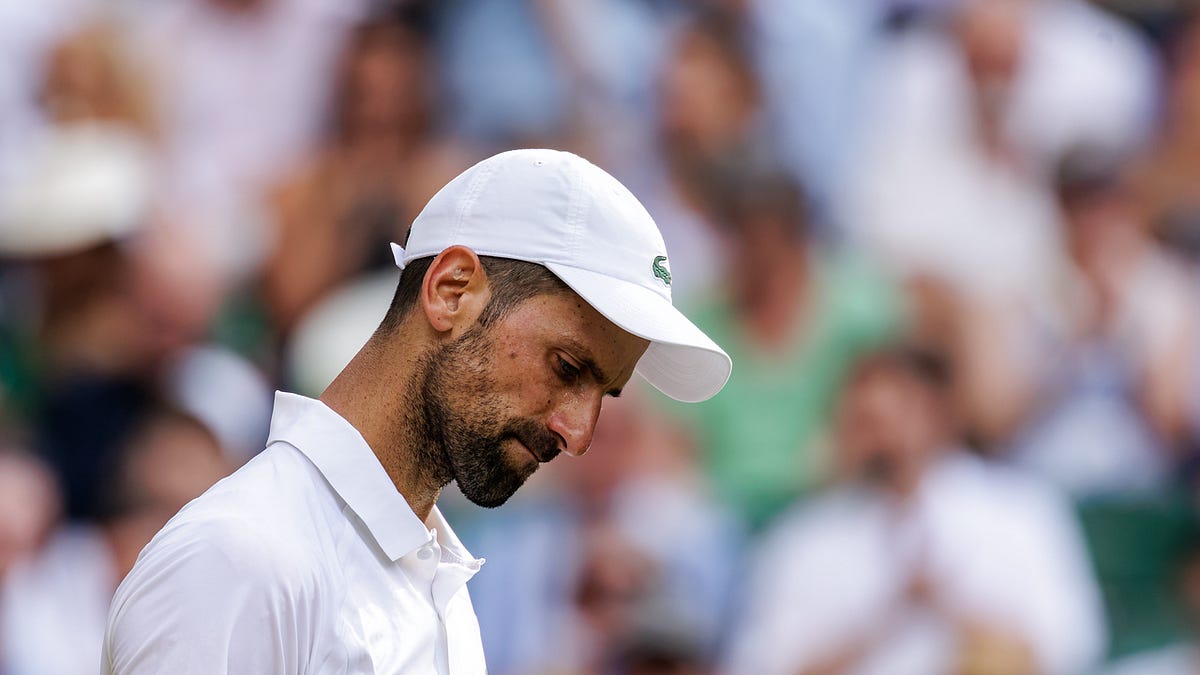
Novak Djokovic’s performance trajectory is now subject to intensive strategic scrutiny. Remaining distanced from his last major title, the 24-time champion faces a critical inflection point. At this stage of his career, the discrepancy between historical standards and current performance output suggests a decline in match-day stamina and the psychological leverage that previously allowed him to dominate high-pressure tie-breaks on grass.
The Psychology of Narrative Control
The post-match press environment highlighted a shift from court-side performance to narrative management. Djokovic’s combative interaction with the media regarding his performance decline reflects an attempt to retain institutional agency. By disputing the premise of his competitive erosion, he seeks to stabilize his brand value, which remains intrinsically tied to his status as a contender rather than a ceremonial participant. The distinction between his domestic and international communication strategies indicates a nuanced approach to stakeholder management, preserving a core support base while challenging the global consensus on his longevity.
Institutional and Economic Implications
The transition toward a Sinner-led hierarchy has profound implications for Wimbledon’s long-term commercial strategy. The rise of a technically precise generation offers a different value proposition compared to the iconic ‘Big Three’ era. This shift impacts ticket pricing models, broadcasting rights negotiations, and sponsorship alignments as the market recalibrates for a post-Djokovic competitive landscape. The efficiency displayed by top-tier seeds like Sinner and Alexander Zverev ensures a high-value final, protecting the tournament’s broadcast integrity and prestige.
Strategic Outlook for the Final
As the focus shifts to the final, the tactical matchup between the top seeds represents the current peak of professional tennis. Both finalists have demonstrated an ability to minimize time on court, preserving metabolic resources for the championship match. The final will serve as a definitive audit of Sinner’s ability to consolidate his ranking with a Wimbledon title, a milestone that would institutionalize his leadership of the new era. The margins in this upcoming encounter are expected to be exceptionally thin, driven by serve placement accuracy and return-of-serve efficiency.
Conclusion
The conclusion of the semi-final phase signals the end of the era where Djokovic’s historical dominance could supersede current form. The 6-4, 6-4, 6-4 data point is a stark metric of the sport’s operational reality. Industry stakeholders must now calibrate their strategies for a future where the generational transition is a documented fact. The focus remains on the ‘New Guard’ as they redefine the technical and athletic parameters of the grass-court season.