Adelaide: Competitive Equity Hinges on Procedural Precedent
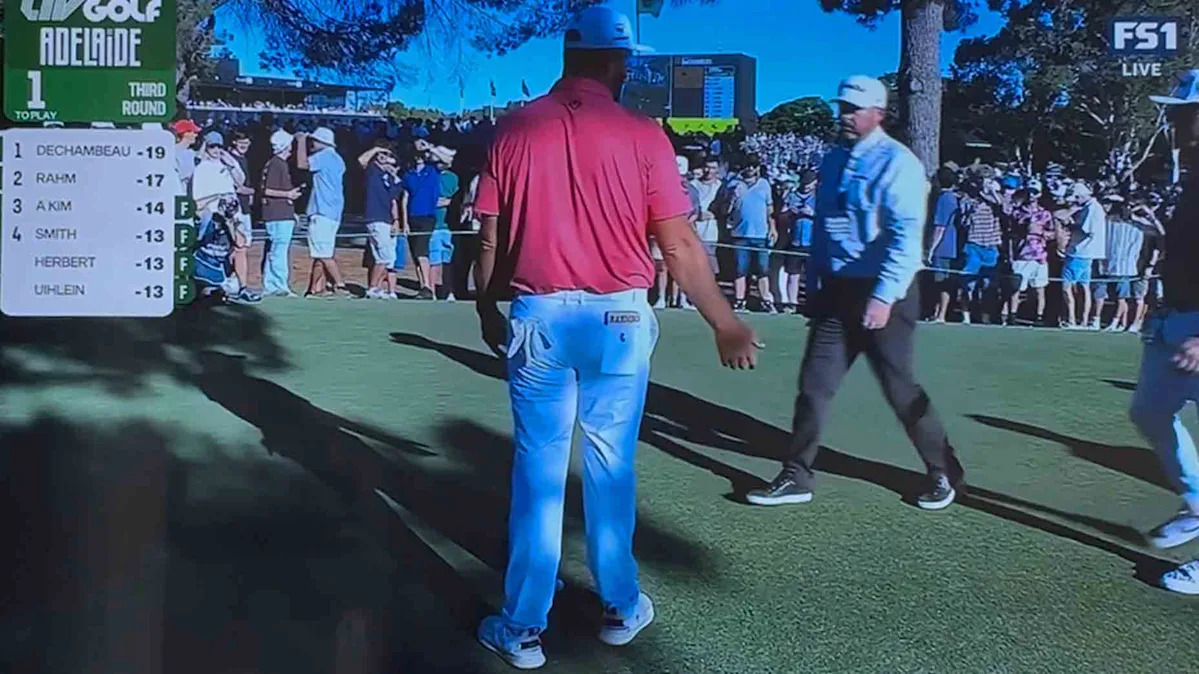
The critical sequence involving Jon Rahm on the 18th hole at The Grange Golf Club during LIV Adelaide’s third round instantaneously redefined the competitive leverage, forging a high-stakes final pairing with Bryson DeChambeau. Rahm’s reaction following his drive, which landed adjacent to the 10th tee box, centered on the ambiguous status of the perimeter fencing separating the two areas.
The core analytical density revolves around the **Temporary Immovable Obstruction (TIO)** rule application. Rahm successfully sought relief based on the precedent established by his own prior ruling on Friday concerning the same boundary fencing. This highlights a dynamic where course architecture, particularly temporary staging elements, directly influences strategic options based on real-time administrative classification.
Interpretive Leverage and Competitive Impact
DeChambeau’s visible reaction underscored the competitive advantage Rahm secured by navigating this perceived ambiguity. Rahm’s decision appears to be a calculated resort to immediate situational memory regarding the previous day’s favorable ruling, suggesting a high-risk, high-reward assessment of the localized interpretation.
This incident exposes an operational vulnerability in real-time adjudication: when localized features (like event-specific fencing) shift classification status, competitive equity relies heavily on player recall and prompt administrative clarification, rather than uniform on-course demarcation.
Performance Trajectory and Momentum Decoupling
Rahm’s closing surge—a 5-under sequence over the final five holes, including a dramatic hole-out eagle on 18—functionally decoupled DeChambeau’s mid-round dominance. DeChambeau had engineered an 8-birdie stretch (Holes 6–14), suggesting a runaway scenario, only to falter with a crucial bogey on the 17th, his first since the 14th hole of Round 2.
This late-round contraction by DeChambeau contrasts sharply with Rahm’s demonstrated ability to convert frustration (evidenced by earlier bogeys and visible distress) into maximum scoring efficiency under duress. Rahm’s closing 66 matched DeChambeau’s pace over the final stretch, neutralizing a five-shot deficit.
Broadcast Value and Ecosystem Reinforcement
The Rahm-DeChambeau final pairing, the first for these stars since LIV Las Vegas 2024, maximizes the event’s narrative density and broadcast valuation. The controversy fuels immediate media engagement across FOX Sports platforms, serving as critical content currency that validates the league’s star acquisition model.
The focus on high drama—the procedural confusion followed by the spectacular recovery—aligns with entertainment-centric sports models, ensuring wide distribution of compelling visual content and reinforcing audience engagement metrics.
Operational Scrutiny on Course Management
The proximity of the 18th green complex to the 10th tee box highlights inherent challenges in multi-loop course design hosting high-profile events. Tournament officials face increased scrutiny regarding the precise demarcation and consistent ruling enforcement for temporary immovable structures.
This event implies a directive for future event preparation: preemptive, documented clarification of the regulatory status of temporary boundary elements is necessary to minimize reliance on subjective, high-leverage memory recall during play.
Financial Leverage and Team Implications
The tie at 19 under places the outcome of the individual purse and associated team capital distribution for Legion XIII and Crushers GC squarely on final round execution. Rahm’s recovery from early-round deficits (including consecutive bogeys last seen at Chicago 2025) highlights superior psychological reset capacity.
This competitive intensity validates the significant capital outlay for securing marquee talent, as direct confrontation between these figures generates disproportionate media value and sets a high performance floor for future title contention.