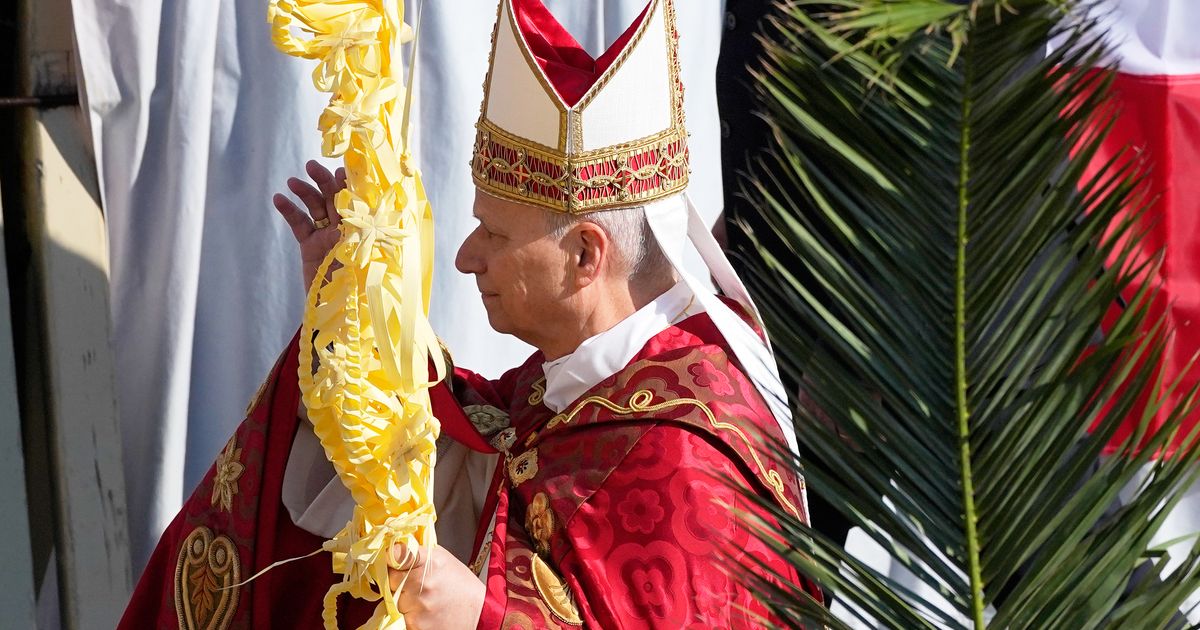
Pope Leo XIV’s inauguration of his first Holy Week with the Palm Sunday Mass in St. Peter’s Square signifies an immediate, deliberate institutional pivot, juxtaposing his robust presence against the visible decline and delegated authority characterizing the closing phase of Pope Francis’s pontificate.
Strategic Liturgical Framing and Contrast
The selection of the Palm Sunday rite by Leo XIV functions as a calculated statement of operational intent. It anchors the new pontificate in established, high-visibility tradition, serving as a direct contrast to the recent period defined by Pope Francis’s mandated delegation due to failing health.
The procession itself—involving the hierarchical distribution of olive branches and intricately woven palms—physically enacts the transference of liturgical command. Leo XIV’s presiding role over this mass public ritual immediately restores the visible executive function that had been partially ceded during Francis’s final months.
This vibrant commencement critically distances the new administration from the emotionally charged benchmark set by Pope Francis’s last public appearance—the poignant, physically constrained popemobile circuit the previous Easter Monday. This contrast shapes stakeholder perceptions regarding the Holy See’s immediate stability and leadership vigor.
Obelisk Ceremony: Anchoring Authority in Spatial Symbolism
The procession’s deliberate choreography centers around the 85-foot Egyptian obelisk, an architectural anchor in St. Peter’s Square. This is not mere setting; it is a reinforcement of papal authority spanning deep historical and geopolitical contexts.
The obelisk, an ancient monument relocated through high-stakes Renaissance logistics, provides a fixed reference point contrasting the temporal nature of papal leadership with the enduring physical infrastructure of the Vatican. Leo XIV’s commencement ritual at its base implicitly links his mandate to the resilience symbolized by this repurposed relic.
By explicitly recalling early Christian martyrdom during the liturgy, the new Pope frames contemporary challenges within a context of enduring, historical spiritual struggle, strategically leveraging ancient sacrifice to underscore institutional longevity over immediate administrative pressures.
Operational Stability and Hierarchical Assurance
The complex choreography of the Palm Sunday entrance—the precise roles assigned to youth, clergy, and laity—demonstrates meticulous adherence to established liturgical protocols. This signals operational stability to the global Catholic constituency, affirming that core administrative and spiritual mechanisms remain fully functional despite the recent change in leadership.
The ceremonial blessing administered during the circuit around the obelisk functions as a symbolic consecration of the physical space, an essential administrative precursor to the solemnities of the Triduum, particularly following the high visibility of the papal transition.
Stakeholder Validation: Curia and Faithful
For the College of Cardinals and the Roman Curia, the flawless execution of this complex opening rite validates their procedural governance during the conclave, minimizing potential internal friction points that often follow a papal demise.
The mass congregation represents a critical constituency whose immediate affirmation validates the new pontiff’s mandate. The visual success of the Mass is thus paramount for cementing the new administration’s reputational capital both internally and externally.
Navigating the Shadow of Pope Francis’s Final Days
Analytical scrutiny of Leo XIV’s first Holy Week is inevitably measured against the preceding year, when Pope Francis’s recovery necessitated significant delegation of major liturgical functions.
Francis’s brief, emotionally resonant appearance on the loggia following his hospitalization established a powerful benchmark for the conclusion of his ministry, characterized by visible physical constraint.
Leo XIV’s successful, uninterrupted presiding over the Palm Sunday Mass must decisively shift the narrative focus from the preceding pontiff’s suffering to the active governance and vitality of the present leadership.
Metrics of Active Governance vs. Endurance
In evaluating papal performance metrics, the transition from Francis’s physically constrained final appearances to Leo XIV’s command over a massive public event redefines immediate success from endurance to active executive control.
This contrast starkly highlights the operational risk in the papacy: the leader’s physical capacity dictates the visible scope of ministry. Leo XIV must proactively manage this visibility to prevent any perception of institutional vulnerability recurring.
Historical Logistics: The Obelisk as a Metaphor for Governance
The presence of the ancient Egyptian obelisk, brought to the Vatican through the decisive logistical feat of a Renaissance “sea captain,” introduces a narrative of high-stakes, pragmatic execution into the Vatican’s symbolic framework.
This historical validation of bold, non-clerical action suggests an endorsement of decisive administrative capability—a vital quality for Leo XIV navigating complex geopolitical and internal Church reforms.
Circling this granite monument reinforces the message of the Church’s structural immovability, offering essential assurance to stakeholders invested in the long-term stability of the institutional patrimony.
Visibility, Capital, and Administrative Capacity
The mobilization of tens of thousands of attendees for Palm Sunday, facilitated by the square’s architecture, is a key metric of the Vatican’s sustained capacity to command global media attention and mobilize human capital.
This high level of visibility directly underpins the Holy See’s ongoing financial leverage and diplomatic efficacy. Orderly, large-scale events serve as an implicit guarantee of administrative reliability to international partners and donors.
Media Ecosystem and Narrative Control
The reporting structure, spanning specialized religious services (CNS) to general wire services (AP) and regional outlets, subjects Leo XIV’s actions to a multi-layered interpretative filter, where the narrative of continuity will be tested against visual data.
The subtle differentiation in symbolic objects—simple olive branches versus complex woven palms—is a critical marker of hierarchical stratification within the procession, reassuring observers of adherence to established lines of ecclesiastical rank.
Strategic Implications for Holy Week Trajectory
The operational success of Palm Sunday sets the expectation level for the entire Triduum, culminating in Leo XIV’s first full Easter. Any opening operational failure would disproportionately amplify perceived administrative weakness.
Conversely, the strong opening allows the Vatican to pivot the central narrative focus toward the profound theological weight of the Passion, effectively superseding discussions surrounding the mortality of Pope Francis with enduring theological principles.