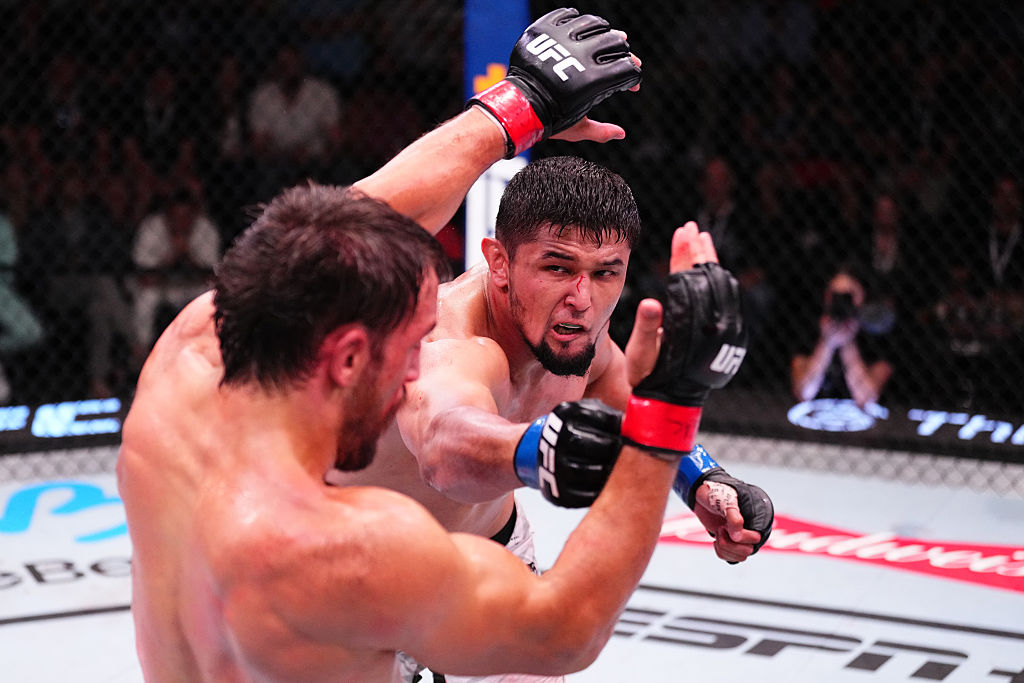
Strategic Realignments and Market Dynamics at UFC Baku
The UFC Baku middleweight bout between Nursulton Ruziboev and Andrey Pulyaev signifies a critical strategic pivot for the promotion’s expansion into the Caucasian and Central Asian markets. This event anchors the UFC’s regional presence, leveraging Ruziboev’s established profile in Uzbekistan to enhance viewership and engagement metrics in a high-growth territory.
Ruziboev’s Weight Class Odyssey: From Welter to Middleweight
Ruziboev’s return to the 185-pound division follows a deliberate but ultimately unsuccessful foray into welterweight. This transition addresses the physiological challenges of extreme weight cutting for a fighter with a 6’5″ frame. The move back to middleweight is a strategic realignment aimed at optimizing his power-to-weight ratio and cardiovascular endurance, rather than a mere preference for the division.
The institutional weight of this bout is amplified by Ruziboev’s statistical anomaly: more professional victories (36) than years of age, with a finishing rate exceeding 90%. His presence in the middleweight hierarchy presents a unique challenge for matchmaking and divisional progression.
Physiological Constraints and Weight Class Optimization
Ruziboev’s acknowledgment of his welterweight attempt as a tactical error highlights the intense scrutiny on athlete weight management. For his stature, the metabolic stress of cutting to 170 pounds likely compromised recovery and explosive capacity, as observed in his performance against Joaquin Buckley. Settling at a “working weight” of approximately 185 pounds reflects a shift toward performance longevity over the perceived benefits of size disparity in lower weight classes. This adjustment preserves his structural integrity and the unorthodox wrestling and high-volume striking that defined his early career.
Competitively, middleweight offers a balanced landscape where Ruziboev’s height and reach advantages are less extreme, but his speed and mobility are more pronounced. This equilibrium is crucial for a fighter utilizing calf kicks and long-range counter-striking to control engagement pace.
Eurasian Market Expansion and Regional Leverage
UFC Baku serves as a primary vehicle for capturing the burgeoning combat sports audience in Azerbaijan and neighboring Uzbekistan. Featuring Ruziboev, a prominent Uzbekistani athlete, maximizes local viewership and strengthens regional broadcast negotiations. This event fosters a talent pipeline from Central Asia, historically underrepresented in major promotions, validating regional stars’ transition to the global stage.
The inclusion of Andrey Pulyaev provides a competitive counterpoint, representing the broader Eurasian talent pool the UFC continues to cultivate. This matchmaking strategy ensures local relevance while upholding international broadcast standards.
Tactical Analysis: Strengths, Vulnerabilities, and Underutilized Assets
Ruziboev’s striking is characterized by a high-risk, high-reward approach, leveraging his reach for powerful hands and kicks. However, his tendency towards striking exchanges rather than defensive checking of leg kicks presents an exploitable vulnerability for opponents like Pulyaev. Predictability in close-quarters exchanges remains a concern; while his power can mask defensive lapses, his reliance on counter-punching can lead to static positions, making him susceptible to high-volume pressure fighters.
Conversely, Ruziboev’s unorthodox and effective wrestling remains an underutilized asset. His capacity to leverage long limbs for submissions—evidenced by 20 career tap-outs—adds a significant secondary threat, complicating opponents’ defensive strategies.
Institutional Risk and Fighter Trajectory
For Andrey Pulyaev, this bout is a high-exposure opportunity to rebound and stabilize his promotional standing. As a significant underdog against a veteran with nearly 50 professional fights, Pulyaev faces the structural pressure inherent in the UFC’s developmental matchmaking. The betting market, heavily favoring Ruziboev (-225), reflects a consensus on the skill and physical advantages, yet the middleweight division’s volatility and Ruziboev’s history of becoming predictable under pressure introduce institutional betting risks.
The outcome will likely dictate Ruziboev’s trajectory toward the division’s top fifteen, necessitating more consistent activity than his recent schedule suggests. His last fight in May 2025 indicates a layoff that could impact his timing and rhythm against a more active opponent.
Structural Implications of Finishing Rates
Ruziboev’s record of 25 first-round finishes is a key marketing metric for the UFC, driving engagement and highlight-reel content. This propensity for early stoppages creates a specific type of athlete value that transcends win-loss records. However, a high first-round finish rate can sometimes obscure deficiencies in late-fight conditioning or tactical adjustments. If Pulyaev can extend the fight beyond the initial 1.5-round oddsmaker total, the bout’s structural dynamics could shift.
The institutional emphasis on “stoppage wins” pressures fighters to maintain aggressive pacing, often at the expense of defensive soundness. Ruziboev’s career advancement hinges on balancing offensive output with the technical discipline required to compete at the elite tier of the middleweight division.
Conclusion: A Strategic Crossroads
UFC Baku preliminaries encapsulate the promotion’s broader objectives: regional dominance, talent cultivation, and the resolution of strategic weight class experiments. Ruziboev’s performance will either validate his middleweight return as a career-saving move or intensify questions about his divisional ceiling.
As the UFC expands globally, the success of regional anchors like Ruziboev is paramount for maintaining the momentum of international events. The structural pressures of this bout—from weight management to tactical evolution—will offer definitive insights into Ruziboev’s viability as a long-term contender.
Ultimately, the Baku event highlights the intersection of individual athlete strategy and institutional market goals. The implications of this middleweight clash will resonate throughout the division and the Eurasian market for the remainder of the 2026 season.