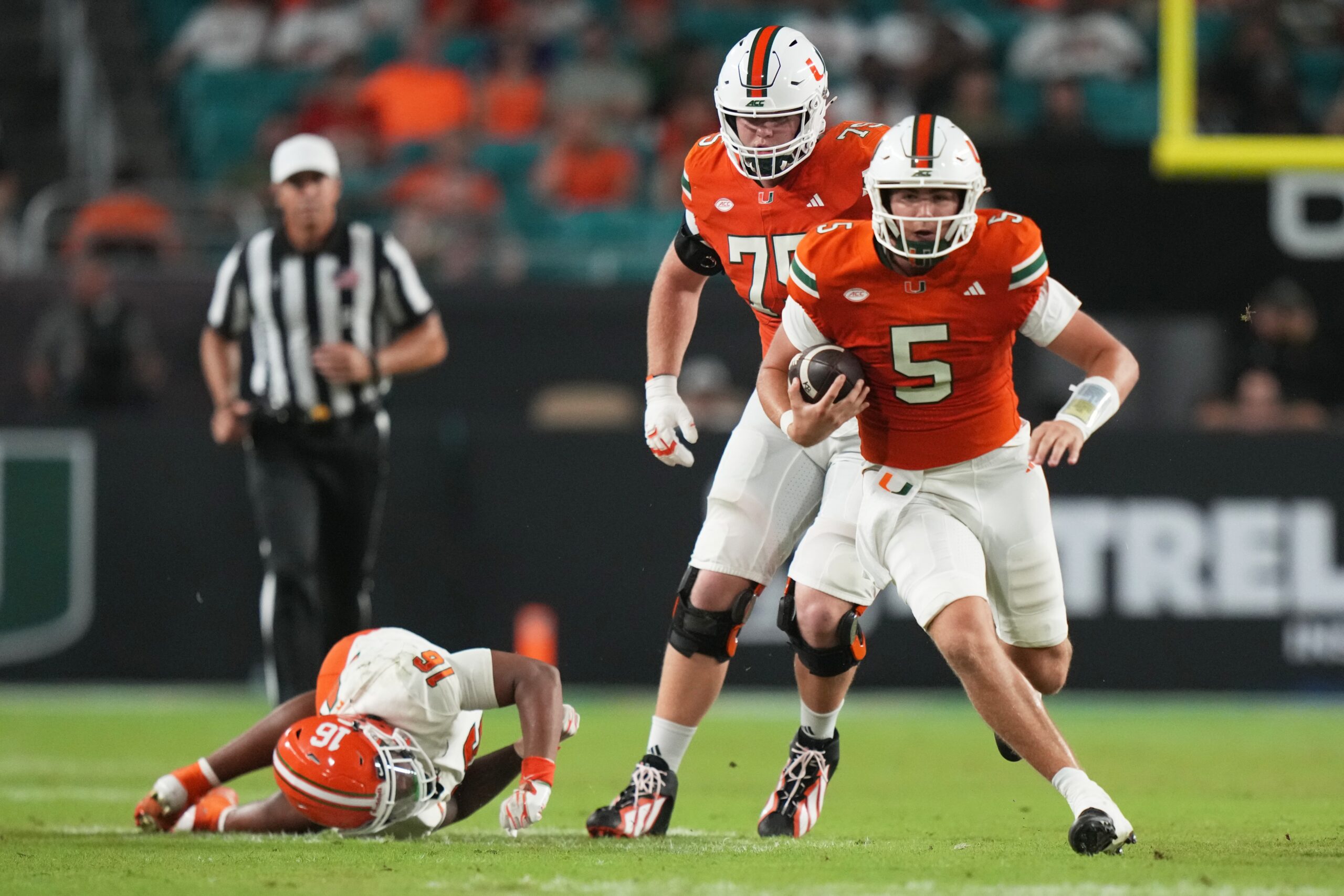
The No. 7 Miami Hurricanes’ 77-7 victory over Florida A&M (FAMU) isn’t just a lopsided score; it’s a stark indicator of college football’s evolving economic and competitive landscape. Tying program records for points and setting new benchmarks for total yardage (856) and first downs (42) underscores an operational dominance that highlights the widening chasm between top-tier FBS programs and FCS opponents, especially in the NIL era. This contest transcended a mere talent gap, illustrating a systemic resource advantage.
The mutual decision by coaching staffs to shorten the fourth quarter speaks volumes, moving beyond concerns of player safety to explicitly acknowledge a profound competitive imbalance. When a scoreboard struggles to track consecutive scores and a team averages 11.7 yards per play, the event ceases to be a fair athletic contest and instead becomes a stark demonstration of resource and talent concentration.
Miami’s offensive explosion, generating 856 total yards and 42 first downs, was not merely opportunistic but a product of highly synchronized tactical execution that systematically exploited every structural weakness in the FAMU defense. Averaging 11.7 yards per play and 9.8 yards per rush indicates that the Hurricanes’ offensive line consistently dominated the line of scrimmage, neutralizing defensive fronts and reaching the second level with alarming efficiency. This sustained pressure prevented FAMU from establishing any defensive rhythm or counter-strategy.
The Hurricanes’ quarterback play exemplifies the program’s current recruiting and developmental leverage. Heisman-hopeful Darian Mensah’s near-perfect performance set the tone, followed by backups who completed nearly every pass attempt. This unprecedented depth, where even the third-string quarterback recorded only a single incompletion, illustrates how the transfer portal and NIL incentives increasingly concentrate elite talent within high-revenue programs. Such a talent floor for Power 4 teams now significantly surpasses the ceiling of most FCS rosters, enabling relentless, high-intensity execution even with rotations.
Defensively, Miami was equally dominant, limiting FAMU to a mere 107 total yards and preventing all but one third-down conversion out of fourteen attempts. This reflects a highly disciplined approach to situational football, effectively stifling any offensive identity FAMU attempted to establish. Pro Football Focus (PFF) metrics corroborate this, assigning Miami grades above 90.0 in nearly every major category, including an exceptional 95.2 overall offensive grade. However, the 43.3 tackling grade, indicating eleven missed tackles, serves as a notable outlier. This lapse in fundamental discipline was likely a byproduct of the game’s early competitive erosion, hinting at a psychological shift in defensive intensity that could be exploited by future, more formidable opponents.
Miami’s ability to score on eleven consecutive full drives underscores a relentless offensive philosophy designed to build momentum and establish a formidable statistical baseline for a team with national championship aspirations. Achieving over 400 rushing yards while maintaining an elite passing efficiency (15.8 yards per completion, exploiting deep passing lanes) creates a potent dual-threat profile. This balance is the hallmark of a program successfully integrating personnel into a cohesive, high-output system, providing valuable data for refinement ahead of tougher conference play.
For Florida A&M, the game represents a significant financial gain—the primary incentive for these “buy games.” Yet, the reputational and profound physical toll is substantial. The visible disparity extends beyond facilities and coaching salaries directly into the physical composition and depth of rosters. The viral nature of physically dominant plays, like the hit on FAMU’s quarterback, intensifies the debate over the ethical and competitive viability of such matchups in a professionalized college football environment. This phenomenon is exacerbated by the transfer portal and NIL, which funnel top-tier athletes to programs with greater financial capital, making it increasingly difficult for FCS programs like FAMU to compete on any level beyond financial necessity.
The 77-7 scoreline is not an anomaly but a symptom of a profound structural shift in college football. As the gap between the “haves” and “have-nots” continues to widen, the frequency of such non-competitive outcomes will force a reevaluation of how these games are scheduled and managed by governing bodies. Miami has asserted its dominance, sending a clear message about its high-level operational proficiency. However, for the broader industry, this game serves as a cautionary tale: the financial and operational incentives for these matchups remain strong, but the escalating competitive and ethical costs are becoming unsustainable, challenging the traditional model of FBS-FCS scheduling.