
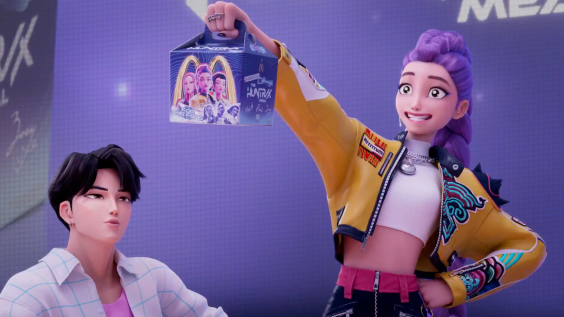
McDonald’s, in strategic partnership with Netflix, has launched a high-leverage promotional campaign centered on the critically acclaimed property, “KPop Demon Hunters.” This initiative segments the adult consumer base via competing meal offerings branded for the fictional groups HUNTR/X and the Saja Boys, embedding narrative conflict directly into the purchasing journey.
Advanced Fandom Segmentation via Binary Choice Architecture
The campaign’s structural core is the presentation of a mandatory binary choice: The Saja Boys Breakfast Meal versus The HUNTR/X Meal. This forces immediate faction alignment during a fast-food transaction, transforming the purchase into an act of consumer affiliation. This transcends passive placement, leveraging the film’s intrinsic narrative tension to deepen engagement and potentially boost visit frequency as consumers aim to align definitively or collect both SKUs.
The inclusion of exclusive, scarce photocards—which unlock gated digital content—introduces a powerful scarcity model. This mechanism compresses the consumer conversion window by directly incentivizing immediate physical redemption via a linked digital reward, shifting transactional value toward access credentials.
Operational Throughput Strain from Dual-SKU Activation
Simultaneously launching two high-profile, distinct adult meal structures, along with the complementary ‘Derpy McFlurry,’ imposes significant pressure on existing supply chain logistics and kitchen throughput velocity, especially during peak demand.
Precise inventory management is critical to mitigate stockouts, which have historically eroded sentiment during Limited-Time Offers (LTOs). Operational complexity increases further due to staff training requirements for managing the distribution and digital authentication of the exclusive photocards, necessitating seamless integration between physical sales and backend digital asset management.
Monetizing Transmedia IP Through Culinary Translation
This collaboration is engineered to bridge cinematic intellectual property success with measurable quick-service restaurant (QSR) revenue streams, capitalizing on the established cultural capital of global K-Pop fandom and the film’s recent critical validation.
McDonald’s CMO, Alyssa Buetikofer, positioned the alliance around shared fan-centric philosophies, aiming to capture the high-engagement, high-spending demographic associated with global entertainment fandom. A key innovation is the integration of specific flavor profiles sourced from McDonald’s South Korean operations, testing the domestic market’s receptivity to authentic, non-standardized regional tastes under a major franchise umbrella.
Culinary Arbitrage: Risk vs. Scalable Model Validation
Introducing South Korean culinary elements is a calculated risk to test the elasticity of the domestic palate. Successful adoption validates a scalable model for future international menu harmonization, enabling the corporation to leverage global trends with reduced friction. Failure exposes the risk of importing complexity that does not resonate, potentially increasing food waste and compressing margins on specialized ingredients.
Market Volatility and Stakeholder Benefit Analysis
The immediate market reaction—characterized by factional division, with segments advocating boycotts while others express high anticipation—underscores the volatility inherent in aligning a legacy brand with highly polarized cultural movements. For McDonald’s, this creates controlled exposure: negative press from detractors often solidifies commitment among the engaged segment.
Netflix leverages this activation to extend the commercial lifecycle of the Oscar-winning IP beyond the initial streaming window, monetizing the cultural conversation through physical goods and experiential activations. The scarcity of the photocards and exclusivity of unlocked content—a proven mechanic in gaming—drives speculative purchasing behavior, creating an artificial urgency that bypasses typical promotional decay curves.
Competitive Benchmarking in QSR Marketing
This IP-driven, deep-integration approach sets a new competitive standard for QSRs targeting digitally native consumers. Competitors must now address a landscape where transactional utility is often secondary to narrative integration and collectible utility derived from premium entertainment partnerships.
The success of this execution will likely drive increased capital allocation across the QSR sector toward securing similar high-tier, multi-platform entertainment licenses to maintain cultural relevance against shifting zeitgeists.
Long-Term Brand Equity Assessment: Execution Dependency
The sustained impact on McDonald’s brand equity is contingent upon flawless execution. Seamless operational integration and compelling digital rewards reinforce the brand’s positioning as a nexus for major cultural events, justifying premium pricing strategies. Conversely, failures in speed or reward quality risk the perception of inauthentic exploitation, alienating the target demographic.
Analysis of the Dual Daypart Strategy
The deliberate creation of two competing meals, one specifically targeting breakfast (Saja Boys), indicates a strategy to maximize daily transaction volume across multiple dayparts, rather than optimizing solely for lunch/dinner peaks. This mitigates risk by not relying exclusively on one faction’s purchase propensity.
The Role of the ‘Derpy McFlurry’ as a Social Amplifier
The standalone ‘Derpy McFlurry’ functions as a visually distinct, low-friction entry point. It captures peripheral interest from casual consumers unaware of or unwilling to commit to the faction-aligned meals, serving as a necessary bridge for organic social media amplification separate from the primary dueling narrative.
Institutional Synergy: Netflix’s Drive for Transactional Revenue
This partnership signals a macro-trend: streaming platforms, facing subscription saturation, are aggressively pursuing transactional revenue via established physical retail infrastructure. For Netflix, utilizing McDonald’s footprint provides a tangible extension of their digital product into the physical realm.
Monetizing Cinematic Prestige and Content Valuation
Leveraging an Academy Award-winning property demonstrates a pivot toward monetizing proven, critically acclaimed content for commercial activation. The documented success of ‘KPop Demon Hunters’ directly enhances Netflix’s leverage in future co-branding negotiations, establishing a precedent for translating cinematic prestige into immediate QSR commercial value. Performance-based licensing assumptions will heavily influence future studio assessments of downstream IP revenue potential.
Operational Imperatives: Speed and Digital Governance
Promotion success hinges on execution speed, especially integrating novel preparation implied by the South Korean flavor profiles. Franchisee profitability during peak traffic is directly correlated with order fulfillment efficiency; delays degrade the perceived value of the LTO novelty.
The promise of gated content via photocards imposes significant governance responsibility on the digital authentication platform. Any failure in the backend stability immediately translates to negative sentiment regarding the physical purchase, inextricably linking QSR operational success to digital infrastructure resilience.
Photo by mirashin1 on Pixabay.