Atmospheric Diagnostics Beyond the Solar System
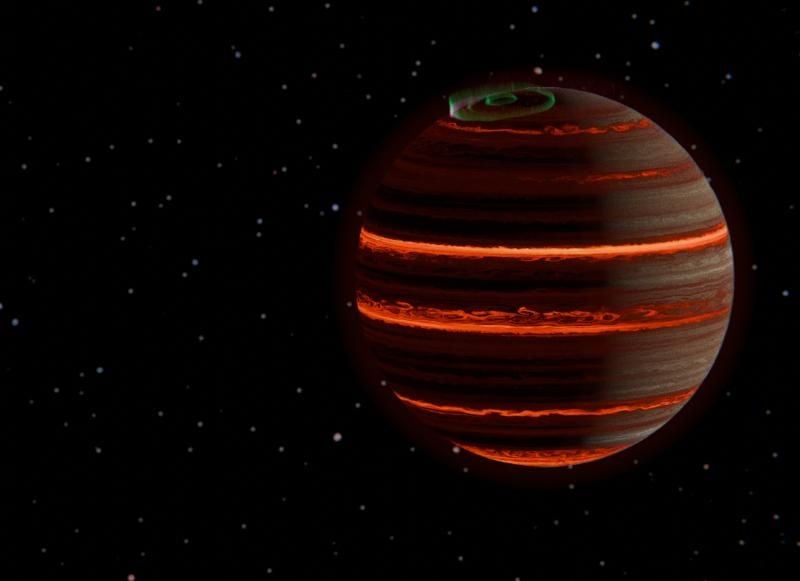
Astronomers have achieved a major methodological advance in exoplanetary meteorology by resolving the atmospheric drivers of an isolated world twenty light-years from Earth. Using observations captured by the James Webb Space Telescope, an international research team analyzed the dynamic atmosphere of SIMP J0136+09, a well-studied brown dwarf situated in the constellation Pisces. The investigation establishes an empirical framework for interpreting weather systems on distant planetary-mass objects where direct resolved imaging remains impossible.
Brown dwarfs occupy a distinct evolutionary niche, being larger and hotter than conventional gas giants yet lacking the requisite mass to initiate core hydrogen fusion. Because SIMP J0136+09 radiates self-generated thermal heat without interference from a host star, it serves as an ideal baseline for evaluating atmospheric mechanisms in isolation. The findings reveal an organized, Jupiter-like meteorological regime dominated by rapid global shifts, transforming long-standing assumptions regarding weather predictability on extrasolar bodies.
High-Precision Instrumentation and Observation Design
The observational campaign was executed under General Observer Program 3548 using the observatory’s Near-Infrared Spectrograph and Mid-Infrared Instrument. By collecting continuous time series observations and low-resolution spectroscopy, researchers monitored the target as it completed axial rotations. This multi-instrument approach captured thermal variations across complementary infrared wavelengths, tracing the transport of energy through several stratified atmospheric altitudes.
Rather than relying solely on static spectroscopic snapshots, the time-series methodology tracked rotational light modulation over precise temporal windows. This continuous monitoring mapped how infrared flux shifts as surface inhomogeneities rotate across the field of view. Consequently, the resulting data stream provides an empirical record of structural atmospheric changes in real time, moving diagnostic capabilities beyond traditional theoretical baselines.
Extracting Signals via Principal Component Analysis
Interpreting unresolved photometric variations presents significant analytical challenges due to atmospheric complexity and instrumental artifacts. To overcome these constraints, scientists led by Trinity College Dublin applied Principal Component Analysis, an advanced multivariate statistical technique. This mathematical model reduces vast observational complexity by identifying co-varying spectroscopic variables while filtering extraneous data points and systematic noise.
Traditional exoplanetary modeling frequently depends on extensive assumptions regarding chemistry, pressure gradients, and equilibrium physics. In contrast, the application of Principal Component Analysis allowed researchers to extract fundamental physical drivers directly from empirical observations. By decoupling real atmospheric modulation from background signal degradation, the analytical framework exposed the core mechanisms governing the brown dwarf’s atmospheric variations.
The Two Core Drivers of Weather
The findings, detailed in Astronomy & Astrophysics, demonstrate that the weather patterns on SIMP J0136+09 are governed primarily by two interacting mechanisms: lateral temperature differentials and vertical cloud architecture. Thermal contrasts generate substantial variations in outgoing infrared flux across the surface of the object. Simultaneously, variations in cloud thickness, vertical altitude, and opacity continuously reconfigure the emitted radiation profile as the atmosphere circulates.
These mechanisms operate within immense, planet-sized cloud structures that reshape what astronomical instruments record over dynamic rotational cycles. While previously identified as hosting aurora-like energetic phenomena, the target exhibits an atmospheric circulation pattern structurally comparable to the organized convective bands seen on Jupiter. The identification of vertical cloud stratification confirms that complex microphysics and dynamic cloud decks persist even in high-temperature sub-stellar environments.
Methodological Implications for Exoplanetary Science
Resolving planetary atmospheres across interstellar distances requires analytical pipelines that maximize signal extraction from single-point light sources. Because astronomers cannot capture spatially resolved photographs of distant exoplanets, they must infer geographic and vertical distribution from integrated hemispheric light curves. The validation of Principal Component Analysis on JWST spectroscopy confirms that statistical decomposition can reconstruct weather patterns without excessive model-dependent bias.
This analytical success alters how observational time may be scheduled on premier space platforms. By isolating the dominant components of spectral variability, researchers can optimize exposure times and reduce reliance on unverified atmospheric models. These computational workflows establish a standardized methodology for dissecting rotational light curves from next-generation observatories.
Strategic Path Toward Terrestrial Characterization
The operational framework demonstrated on SIMP J0136+09 provides a critical foundation for studying cooler, smaller worlds. While currently deployed on a massive, isolated brown dwarf with high thermal output, the data pipeline is directly transferable to gas giants and super-Earths orbiting distant stars. Perfecting atmospheric retrieval techniques on proximate, luminous targets ensures that processing pipelines are calibrated before confronting lower signal-to-noise spectra.
Ultimately, decoding weather systems and vertical cloud dynamics is essential for identifying chemical equilibria and biosignatures on potentially habitable exoplanets. Unaccounted cloud formations and localized thermal anomalies can disguise or mimic atmospheric gases, complicating the search for life. By establishing how cloud decks and temperature fluctuations behave in alien environments, researchers advance closer to characterizing true planetary habitability across the galaxy.