Strategic Defensive Rigor as a Differentiator
The Vegas Golden Knights’ narrow Game 1 victory in the 2026 Stanley Cup Final highlights a rigid adherence to defensive accountability. A pivotal block by Mitch Marner in the dying seconds against the Carolina Hurricanes serves as a benchmark for the team’s operational discipline under pressure.
This maneuver prevented a late-game equalizer, illustrating how individual defensive commitment dictates outcomes in championship-level hockey. By neutralizing high-pressure offensive sequences through superior spatial positioning, Vegas effectively disrupts opponent momentum.
Institutional Continuity and Tactical Momentum
Entering Game 2 with a seven-game winning streak, Vegas is capitalizing on both tactical cohesion and psychological leverage. Head coach John Tortorella’s focus on sustained intensity serves to minimize the recovery window for opponents after a defeat.
Vegas’s postseason trajectory—including a dominant sweep of the Colorado Avalanche—demonstrates a repeatable road-success model. By securing early victories in hostile environments, the Golden Knights force opponents to recalibrate their strategies under the immediate scrutiny of a series deficit.
Divergent Roster Philosophies
This Final showcases a structural contrast between the Golden Knights and the Hurricanes. While both organizations have reached the league’s summit, their developmental paths differ significantly. Carolina, under the leadership of Rod Brind’Amour and Eric Tulsky, prioritizes long-term cultural development. In contrast, the Vegas model emphasizes high-impact acquisitions to exploit championship windows, a strategy currently driving their bid for a second title in four years.
Execution Under Elite Pressure
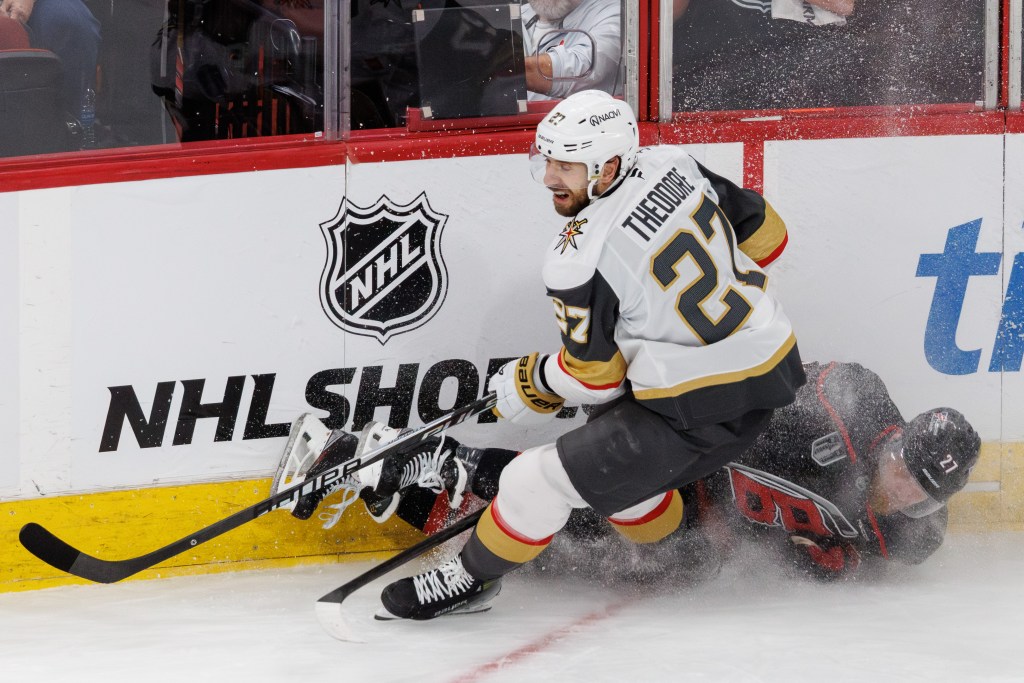
The frantic closing sequences of Game 1, featuring interactions between Logan Stankoven and Alexander Nikishin, emphasize the volatility of high-stakes play. While Carolina relied on the technical shot-power of young defensemen to penetrate the crease, their failure to convert underscores the efficacy of the Golden Knights’ defensive metrics.
Technical skill is proven insufficient against a disciplined, system-based defensive structure. The Golden Knights’ success is rooted in the institutional ability to force high-leverage blocks, effectively turning defensive play into a core offensive strategy.
Institutional Implications
This Stanley Cup Final serves as a case study in managing performance leverage. For stakeholders, the goaltending of Frederik Andersen and the defensive contributions of Jalen Chatfield and Sean Walker are not merely singular statistics; they are critical components of a comprehensive organizational strategy designed to maximize win probability in narrow-margin scenarios.
Coaching and Tactical Calibration
Tortorella’s emphasis on consecutive game victories is designed to combat complacency. By framing each match as a discrete competitive challenge, the coaching staff maintains the operational focus required to mitigate the cumulative physical and mental fatigue of a deep playoff run.
Synthesis of Competitive Dynamics
The 2026 Stanley Cup Final represents a collision of distinct organizational philosophies. As the series moves to Game 2, the primary narrative remains whether the Hurricanes can adapt their offensive tactics to dismantle the Golden Knights’ defensive barrier, or if Vegas’s momentum-based execution will prove insurmountable.