
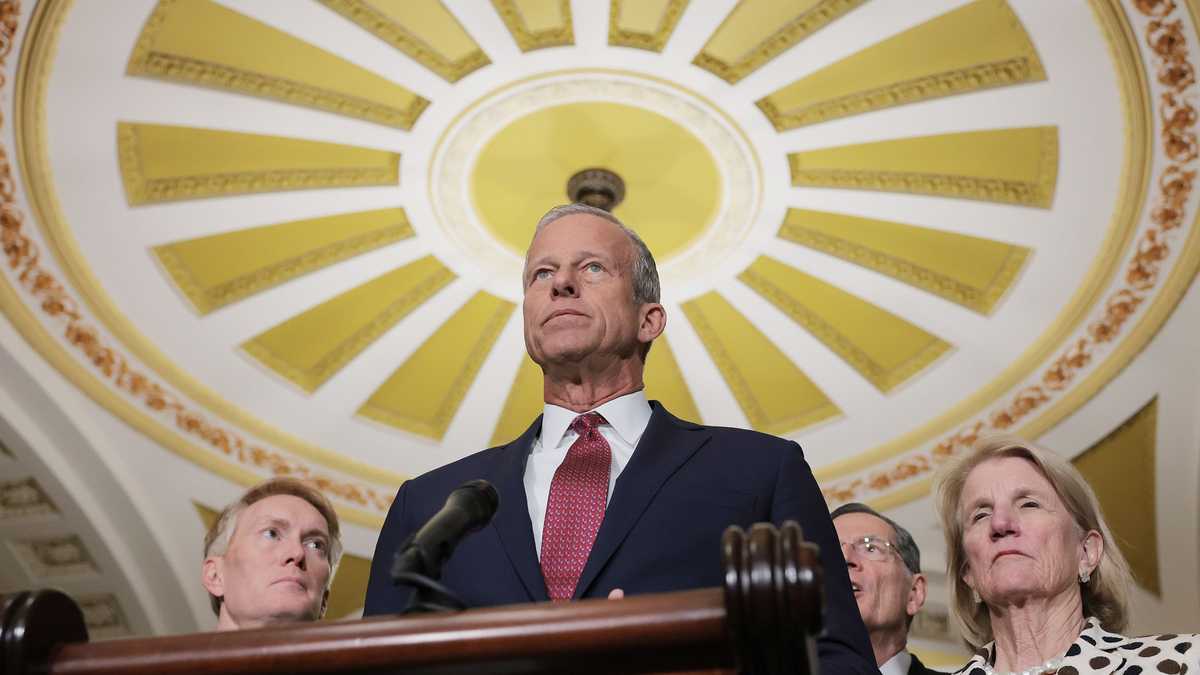
Strategic Bottlenecks in the Reconciliation 3.0 Framework
The legislative trajectory of Budget Reconciliation 3.0 has reached a critical structural impasse within the Senate Republican conference. While the House of Representatives utilized its majoritarian mechanics to advance the $95 billion framework, the Senate’s institutional constraints and internal caucus fragmentation have stalled the 51-vote path required for passage.
Majority Leader John Thune’s pragmatic assessment of the current whip count reveals a widening delta between the House GOP’s aggressive fiscal posture and the Senate’s more cautious deliberation. This friction is not merely procedural but reflects a deepening ideological divide regarding federal mandates and the long-term implications of utilizing reconciliation to bypass the 60-vote filibuster threshold.
Institutional Mechanics and the 51-Vote Ceiling
The strategic pivot to a third reconciliation process underscores an attempt to streamline the GOP’s legislative agenda. However, the reduction of the voting threshold has not mitigated intra-party friction. With Senate Democrats maintaining a unified opposition, the burden of governance falls entirely on a narrow Republican majority, where even marginal dissent neutralizes the party’s legislative leverage.
This deadlock highlights the vulnerability of leadership when executive influence—specifically from Donald Trump—fails to harmonize with the localized political interests of individual senators. The inability to consolidate 51 votes before the August recess indicates a breakdown in party discipline and a lack of consensus on the bill’s core fiscal components.
Defense Industrial Base and Procurement Uncertainty
A primary pillar of the $95 billion package is directed toward defense appropriations, a sector vital for maintaining technological superiority and readiness. The current delay introduces significant market risk for the defense industrial base, as procurement cycles and long-term contract stability are contingent upon predictable federal funding streams.
Traditional hawks within the caucus are now forced to weigh the bill’s substantial fiscal expansion against the strategic necessity of modernization. For stakeholders, this legislative stasis threatens to disrupt capital allocation and stall critical upgrades to global security infrastructure during a period of heightened geopolitical volatility.
Agricultural Volatility and Rural Policy Stakes
The inclusion of farm aid was intended to secure support from senators in agricultural-dependent states. However, the specific allocation of these funds has become a point of contention. Agricultural producers, currently navigating global commodity fluctuations and rising input costs, face increased exposure as the anticipated federal safety net remains caught in legislative limbo.
The political stakes are particularly high for representatives of rural constituencies. Failure to deliver the promised aid package prior to the August recess could erode voter confidence in regions where economic stability is inextricably linked to federal agricultural policy decisions.
Election Grants and the Federalism Debate
The bill’s provisions for election-related grants have emerged as a significant ideological flashpoint. Critics within the Senate GOP view these grants through the lens of federal overreach, arguing that increased federal funding in state elections undermines the constitutional principle of subsidiarity and state-level autonomy.
This concern over federalism is a primary driver of the current vote deficit. The debate reflects a broader strategic disagreement on how the party should approach election administration, with members balancing national party objectives against the institutional independence of their respective states.
Leadership Dynamics: The Thune-Trump Decoupling
The impasse provides a clear signal regarding the evolving power dynamics between Senate leadership and the party’s executive figurehead. Despite Donald Trump’s public endorsement, the bill’s failure to gain traction suggests a growing preference for legislative independence among certain Senate factions.
Majority Leader Thune’s role is increasingly defined by this balancing act—managing executive priorities while navigating the diverse fiscal demands of his caucus. The outcome of this impasse will likely set the tone for the executive-legislative relationship for the remainder of the session, signaling whether the Senate GOP will function as a unified bloc or a collection of distinct ideological cohorts.
The August Recess and Market Implications
The looming August recess serves as a hard deadline for legislative momentum. Historically, bills that fail to clear the chamber before this break face a diminished probability of success in the crowded fall calendar. For the markets, this inaction translates to a risk premium, particularly for sectors like defense and agriculture that rely on the bill’s projected $95 billion injection.
Failure to move the bill may necessitate a shift toward fragmented, short-term continuing resolutions. Such stopgap measures often result in inefficient capital deployment and increased administrative burdens for federal agencies, further complicating the fiscal landscape as the new fiscal year approaches.

Photo by DaveDavidsoncom on Pixabay.