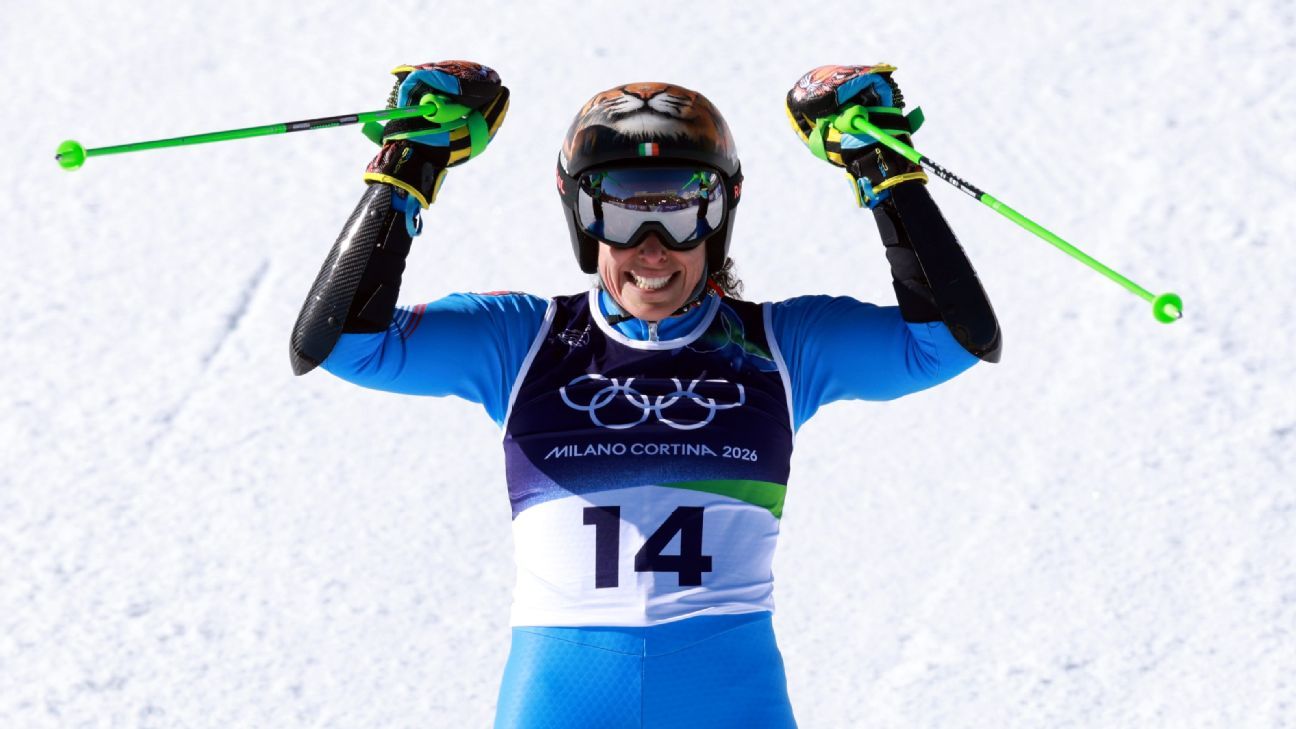
The 2026 Winter Olympics in Cortina d’Ampezzo have been structurally defined by the kinetic and psychological resurgence of Federica Brignone. Her dual gold-medal performances in the Super G and Giant Slalom represent more than individual victory; they signify a disruption of established recovery paradigms for veteran athletes. Following a 2025 injury that left her leg structurally compromised, Brignone’s return to peak performance challenges the biological and logistical limitations traditionally associated with late-career trauma in high-impact disciplines.
During the opening ceremony, the physical reality of her rehabilitation was manifested in a logistical necessity: 6’6″ teammate Amos Mosaner provided physical stabilization as she carried the flag. This moment highlighted the narrow margin between ceremonial duty and the preservation of athletic viability for an individual who, only twelve months prior, faced a three-month period of complete immobility. This vulnerability stands in stark contrast to the technical dominance exhibited on the Tofane slopes.
The Calculus of High-Performance Recovery
Brignone’s self-assessment—operating at roughly 80% physiological capacity—reveals a sophisticated reliance on technical efficiency and environmental familiarity to compensate for diminished physical raw output. By prioritizing tactical precision over maximal exertion, she navigated the acute discomfort of a ‘shredded’ leg to secure a Super G title she described as cinematic. This momentum catalyzed her Giant Slalom campaign, where a commanding 0.34-second lead in the opening run forced competitors into high-risk, low-yield strategies.
The technical demands of the Dolomite courses favored Brignone’s deep institutional knowledge of the terrain. Her ability to maintain a clean second run under intense home-nation pressure demonstrates a cognitive composure that often eludes younger rivals. The resulting 0.62-second margin of victory is a testament to the efficacy of integrated sports medicine and cognitive resilience in extending the competitive window for elite skiers at age 35.
Institutional Displacement and Market Impacts
The underperformance of Mikaela Shiffrin (11th place) suggests a tactical volatility inherent in Olympic settings where local technical knowledge outweighs global circuit rankings. Shiffrin’s inability to challenge the podium reflects the shifting power dynamics within the FIS hierarchy, as Brignone’s success re-centers the narrative on the Italian program’s technical sophistication.
This success yields significant institutional capital for the Italian Olympic Committee (CONI) and the Milano-Cortina 2026 organizers. The public acknowledgment by silver medalists Sara Hector and Thea Louise Stjernesund—who physically bowed to Brignone in the finish area—solidifies her status as the ‘Queen of the Dolomites.’ Such peer-level recognition provides a high-value marketing asset, driving domestic engagement and securing the Games’ legacy through a narrative of national triumph and biomechanical resilience.
Conclusion: A New Benchmark for Aging Elite Athletes
Ultimately, Brignone’s 2026 campaign serves as a case study in managing career-threatening trauma. The transition from a wheelchair in early 2025 to a double Olympic podium in 2026 redefines the aging curve in Alpine skiing. Her performance underscores that with specialized rehabilitation and high-level tactical intelligence, the parameters of ‘peak performance’ are increasingly fluid, even in the most physically demanding sports on the global stage.