Strategic Imperatives: The Race for Champions League Revenue
The encounter between Famalicão and Benfica serves as a case study in high-stakes operational management within the Portuguese Primeira Liga. Following Sporting CP’s point-sharing draw with Tondela, Benfica faced a binary outcome: capitalize on rival volatility to consolidate a second-place finish or risk the long-term capital erosion associated with missing the UEFA Champions League. This fixture was not merely a league match but a financial final, dictating the club’s ability to sustain its elite talent acquisition model and structural overhead.
Tactical Genesis and VAR-Mediated Breakthrough
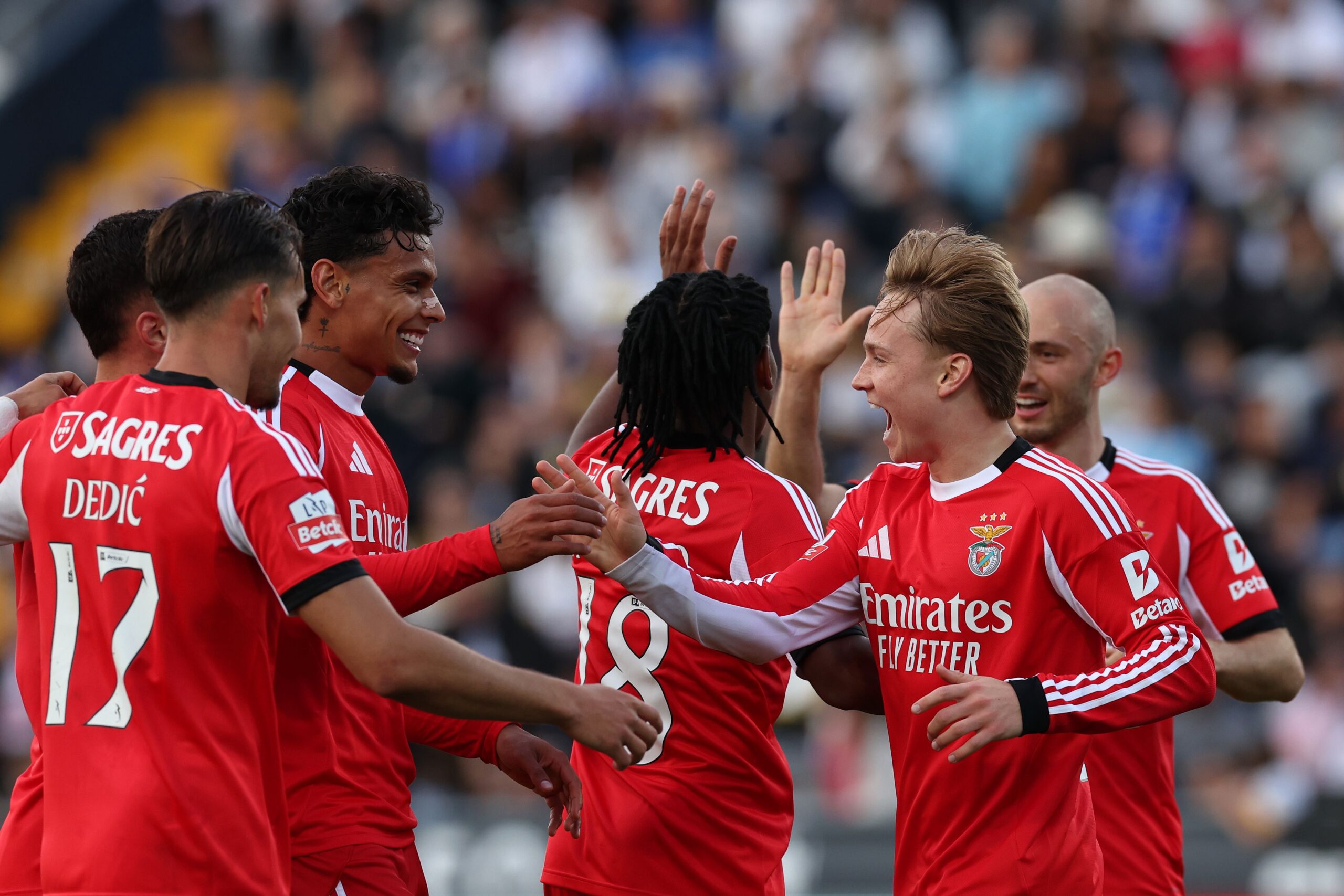
Benfica’s initial phase was defined by a high-intensity transition press designed to exploit Famalicão’s defensive asymmetries. This pressure culminated in a critical sequence involving Ivanovic, whose anticipatory movement forced a foul from Realpe. While the on-field official initially deferred judgment, the intervention of VAR official Rui Oliveira corrected the omission, highlighting the role of technological governance in maintaining competitive integrity. Andreas Schjelderup’s 12th-minute conversion of the subsequent penalty fundamentally recalibrated the match’s risk-reward profile, forcing Famalicão out of their conservative low-block.
Crisis Management: The Otamendi Dismissal
The match’s structural integrity was tested in the second half following Nicolás Otamendi’s dismissal for a high-force challenge on Mathias de Amorim. This transition to a numerical disadvantage necessitated an immediate pivot from offensive expansion to defensive preservation. The removal of the veteran captain created a leadership vacuum that required immediate tactical intervention to prevent a total defensive collapse against an increasingly aggressive Famalicão offensive.
Mourinho’s Midfield Recalibration
In response to the red card, Mourinho executed a strategic substitution, withdrawing the creative asset Prestianni for the defensive robustness of Enzo Barrenechea. This move transformed Benfica’s shape into a compact, reactive unit. Barrenechea’s role was to neutralize the central playmaking of Gustavo Sá, acting as a physical screen to mitigate the territorial dominance gained by the home side. This pragmatic shift prioritized structural stability over aesthetic performance, reflecting the existential necessity of the three points.
Operational Anomalies and Institutional Stakes
The match featured a rare logistical disruption when assistant referee Fábio Silva was sidelined by injury, necessitating a temporary stoppage for official Diogo Araújo to assume the role. Such intervals test psychological resilience; for Benfica, it was a moment to reset their defensive lines, while for Famalicão, it disrupted their offensive momentum. Ultimately, Benfica’s ability to navigate these interruptions—and Famalicão’s failure to convert late opportunities—underscores the slim margins separating European qualification from domestic stagnation. For Benfica, securing this win is a vital safeguard for the club’s international brand and future scouting liquidity.