
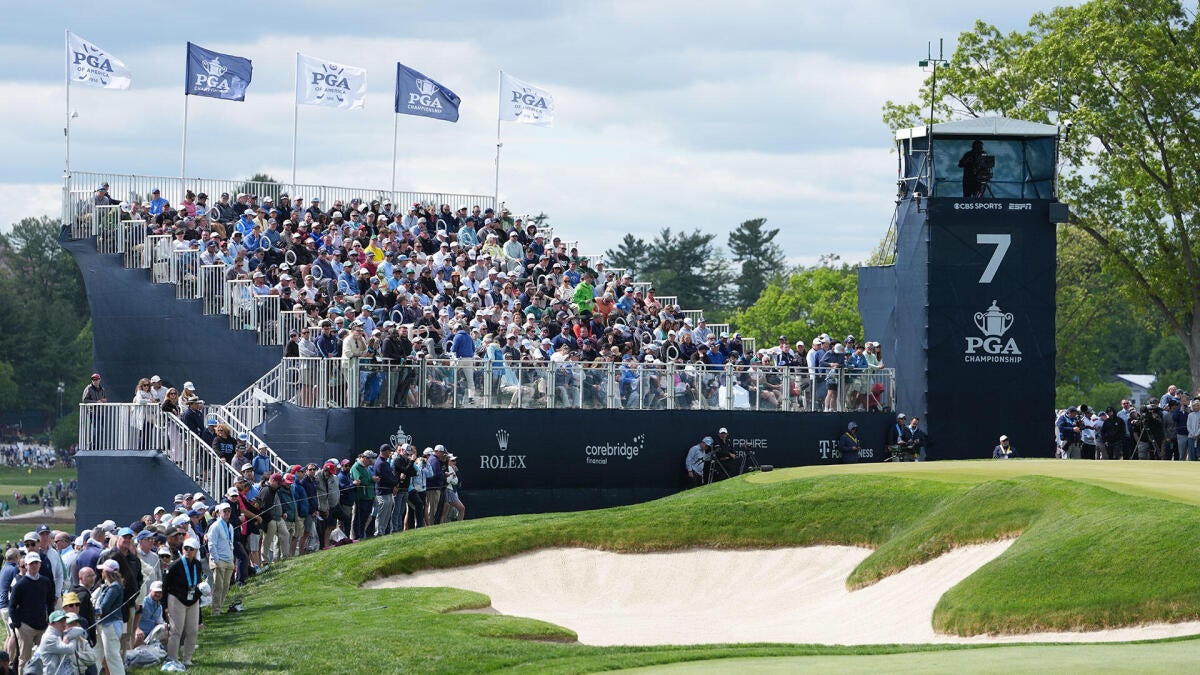
The 108th PGA Championship at Aronimink Golf Club has entered a high-stakes attritional phase. As the second round commences in Newtown Square, Pennsylvania, the 156-player field faces a primary winnowing mechanism designed to eliminate nearly half the competitors. This year’s tournament is characterized by the venue’s rare inclusion in the major rotation, creating a modeling vacuum where a lack of recent, high-leverage tournament data forces players to rely on real-time tactical adaptation rather than historical precedent.
Venue Dynamics and Modeling Uncertainty
Aronimink’s defensive architecture presents a unique challenge to modern competitive strategies. The absence of a frequent PGA Tour stop at this site reduces the efficacy of predictive performance modeling, placing a premium on mid-round recalibration. For the field, Friday represents the final opportunity to internalize the course’s idiosyncratic green speeds and bunkering before the weekend’s high-leverage sessions. This data deficit creates a strategic volatility that favors players with superior improvisational skills over those reliant purely on pre-tournament blueprints.
Operational equity is maintained through the precise orchestration of tee times, balancing the climatic shifts between the morning and afternoon waves. Stakeholders—ranging from broadcast partners to commercial sponsors—monitor these variables closely, as the retention of marquee names through the cut line is directly correlated with weekend engagement metrics and the tournament’s overall market liquidity.
Scheffler’s Statistical Dominance vs. Spieth’s Historical Pursuit
Defending champion Scottie Scheffler has transitioned from participant to the field’s primary benchmark. His leadership position reinforces an operational consistency that acts as a psychological deterrent to the chasing pack. Scheffler’s ability to minimize variance on Aronimink’s demanding par-4s forces rivals into a high-risk posture, often resulting in the scoring volatility seen across the leaderboard. His performance dictates whether the weekend evolves into a runaway exhibition or a contested multi-player scramble.
Parallel to Scheffler’s dominance is Jordan Spieth’s pursuit of the career grand slam. Positioned within the optimal strike zone, Spieth must balance aggressive gap-closing with the tactical restraint required to avoid the catastrophic errors that Aronimink penalizes. His narrative equity is a vital asset for the PGA of America; a successful pursuit would provide an institutional uplift, cementing this championship as a landmark event in professional golf history. His efficiency in recovery shots and high-pressure putting remains the definitive indicator of his readiness to secure the final leg of the slam.
Risk Mitigation: The McIlroy Inflection Point
Rory McIlroy represents the tournament’s most significant downside risk following a late-round collapse on Thursday. For a back-to-back Masters winner, missing the cut at Aronimink would constitute a disruption of the event’s intended narrative arc and a blow to broadcast viability. McIlroy’s struggle to find technical stability highlights the fragility of elite performance under major championship conditions. Friday serves as a high-stakes rescue operation, requiring immediate mechanical corrections to navigate the projected cut line.
The institutional exposure of a marquee player’s potential exit necessitates a pivot in coverage strategy. If McIlroy fails to stabilize, the focus must shift toward emerging contenders to sustain global viewer interest. This volatility underscores the relentless nature of the Friday cut—a hard reset that serves as the most consequential structural event of the tournament week.
Technological Infrastructure and the ‘Every Shot’ Mandate
The commitment to broadcast every individual shot represents a massive capital investment in digital infrastructure. This granular coverage meets the demand for player-specific content, allowing fans to track the progress of leaders and cut-line battles with unprecedented precision. For the PGA of America, this is a strategic move to capture deeper engagement metrics and provide granular value to sponsors, effectively mitigating the loss of star power by diversifying the viewer’s focus across the entire field.
As the preliminary phase concludes, the strategic lines are clearly drawn. The events at Newtown Square are currently defining the competitive terms for the final 36 holes, where the intersection of technical precision and mental fortitude will determine the next custodian of the Wanamaker Trophy.

Photo by Felix-Mittermeier on Pixabay.