
The Mathematics and Logistics of FIFA’s Expanded Knockout Allocation
The transition of the FIFA World Cup to a 48-team format in 2026 introduces unprecedented administrative and structural complexity to the tournament’s knockout phase. To accommodate the expanded field, the group stage will feature twelve groups of four. While the top two teams from each group qualify automatically, the remaining slots in the Round of 32 will be filled by the eight best-performing third-place teams. This asymmetric progression mechanism generates high competitive uncertainty, requiring a highly technical regulatory framework to govern bracket placement.
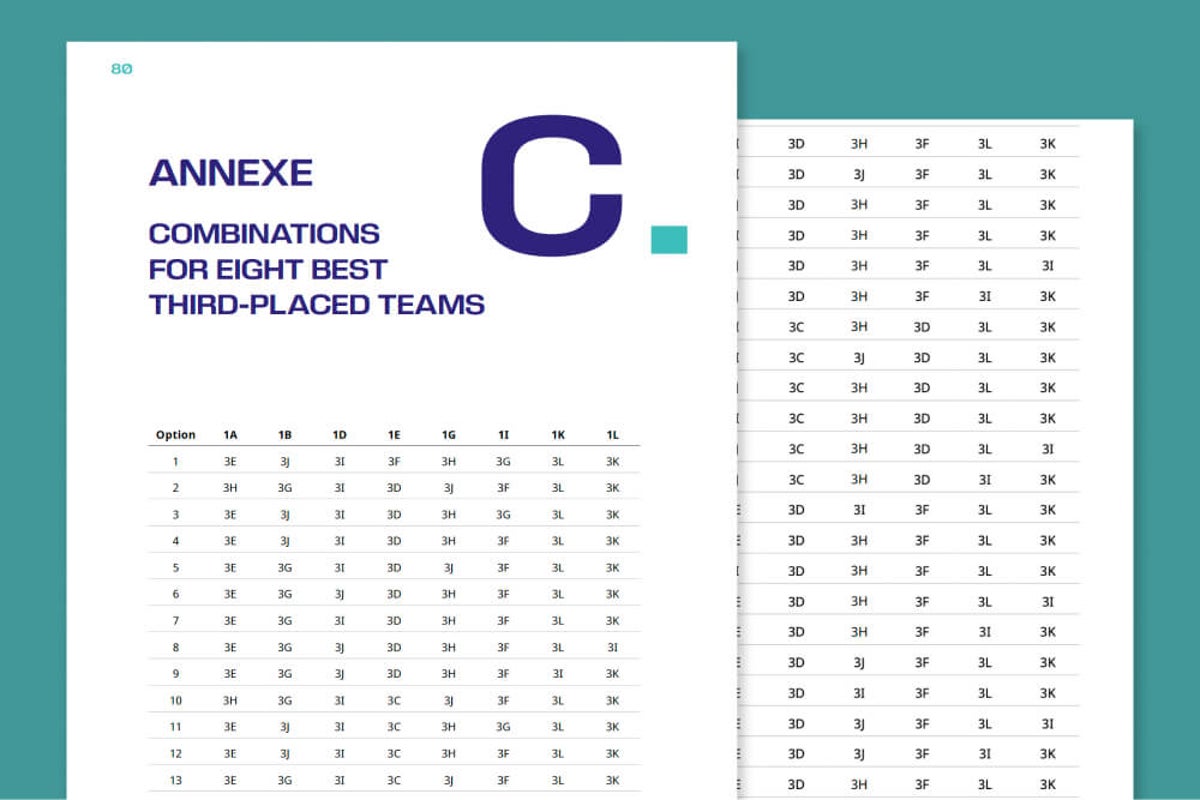
The logistical blueprint for this allocation is detailed in FIFA’s “Annexe C: Combinations for eight best third-placed teams.” This framework contains a mathematical lookup table detailing every possible combination of advancing third-place cohorts. By treating the eight qualifying teams as a collective set rather than assigning them to slots on a rolling, dynamic basis, FIFA prioritizes deterministic bracket rigidity. This system ensures that no teams from the same group meet prematurely, while managing the complex distribution of matches across host cities.
The Combinatorial Logic of Annexe C
The underlying math behind the progression system relies on basic combinatorics. Selecting eight advancing entities from twelve potential groups yields exactly 495 possible configurations:
$$\binom{12}{8} = \frac{12!}{8!4!} = 495$$
Each of these 495 scenarios corresponds to a specific row in the Annexe C lookup matrix, which maps the qualified third-place groups to designated round-of-32 opponents (primarily group winners). Instead of relying on a real-time, dynamic seed ranking that changes after every goal, the system waits for the group stage to conclude entirely. Once the definitive set of eight third-place teams is established, their bracket positions are instantly resolved via the pre-determined matrix. This methodology eliminates ambiguity but creates a highly complex, multi-variable analytical environment for competing nations.
Strategic and Game-Theoretic Implications
This structural design alters the strategic calculus for coaching staffs and national federations. Under previous 24-team formats (such as the UEFA European Championship), teams had fewer combinations to monitor. At the 2026 World Cup, teams will find it mathematically impossible to identify their next opponent with certainty until the final whistle of the last group-stage matchday.
This delay in opponent identification impacts technical preparation. Scouting staffs must prepare reports, tactical analyses, and medical protocols for up to three potential opponents simultaneously. Furthermore, late-stage group matches will be subject to intense game-theoretic calculations: teams may actively weigh the goal-differential benefits of pursuing a win versus settling for a draw, as even minor changes in the final third-place standings can cascade through the 495-row matrix, shifting potential paths from high-ranked opponents to more favorable bracket sectors.
Operational Bottlenecks and Broadcast Scheduling
From an operational standpoint, the 495-combination matrix presents challenges for tournament organizers, host cities, and broadcasters. While stadium allocations and dates for the Round of 32 are fixed years in advance, the actual teams playing in specific venues cannot be confirmed until the final set of third-place qualifiers is locked.
This operational latency affects several critical areas:
- Broadcasting: Television networks cannot finalize prime-time programming schedules or promote marquee matchups until late in the group stage.
- Security and Fan Logistics: High-risk matches or rivalries may be randomly assigned to specific venues with little lead time, testing local transit systems and security protocols.
- Team Travel: Advancing third-place teams must rapidly coordinate flights, hotel bookings, and training site transitions to match their newly assigned bracket coordinates.
Institutional Governance and Competitive Integrity
FIFA’s reliance on a rigid, pre-computed table reflects an institutional priority to eliminate administrative subjectivity and prevent matches from being manipulated. By hardcoding every possible outcome into Annexe C, FIFA prevents situations where teams can choose their knockout opponent through strategic underperformance. However, the sheer opacity of a 495-row lookup system risks alienating casual fans and media representatives, who may find it difficult to track qualification scenarios in real-time. This structural complexity remains a necessary compromise to balance tournament expansion, commercial growth, and sporting fairness.

Photo by xusenru on Pixabay.