The conclusion of the Leagues Cup group stage has established significant competitive benchmarks across North American soccer. Club América consolidated its qualifying status under manager Guillermo Almada, while traditional rivals faced divergent outcomes across domestic brackets.
The structural format of the tournament tested tactical adaptability over three fixture rounds. Roster depth, administrative continuity, and tactical implementation dictated quarterfinal placements and early eliminations.
Managerial Transitions and Performance Metrics
Guillermo Almada has registered an immediate operational impact since assuming leadership at Club América. Across his first five competitive fixtures encompassing Liga MX and Leagues Cup play, the Uruguayan tactician recorded four victories and one draw.
This performance sequence represents a direct statistical improvement over the opening record of former manager André Jardine, who began his tenure with three victories over Puebla, Chicago Fire, and St. Louis City, alongside two defeats.
Almada constructed his unbeaten five-match sequence through consecutive victories against Querétaro, Santos Laguna, San Diego FC, and Portland Timbers, conceding points only in a draw against Atlante.
Comparative Early-Stage Managerial Trajectories
Comparative data highlights distinct transitional efficiencies within elite Mexican football. Managing early fixture density while maintaining results reflects tactical clarity and rapid squad integration.
Almada emphasized the psychological dimension of this relationship prior to the final group fixture at Q2 Stadium, framing the club’s fanbase as an essential operational factor that demands high-intensity pitch execution.
This managerial alignment mitigates friction during technical overhauls, protecting institutional expectations while navigating cross-border tournament demands.
Leagues Cup Group Stage Dynamics
The final round of the opening phase determined seeding hierarchies for the quarterfinals. Club América entered its closing match against Austin FC with qualification secured, shifting focus toward regional seeding.
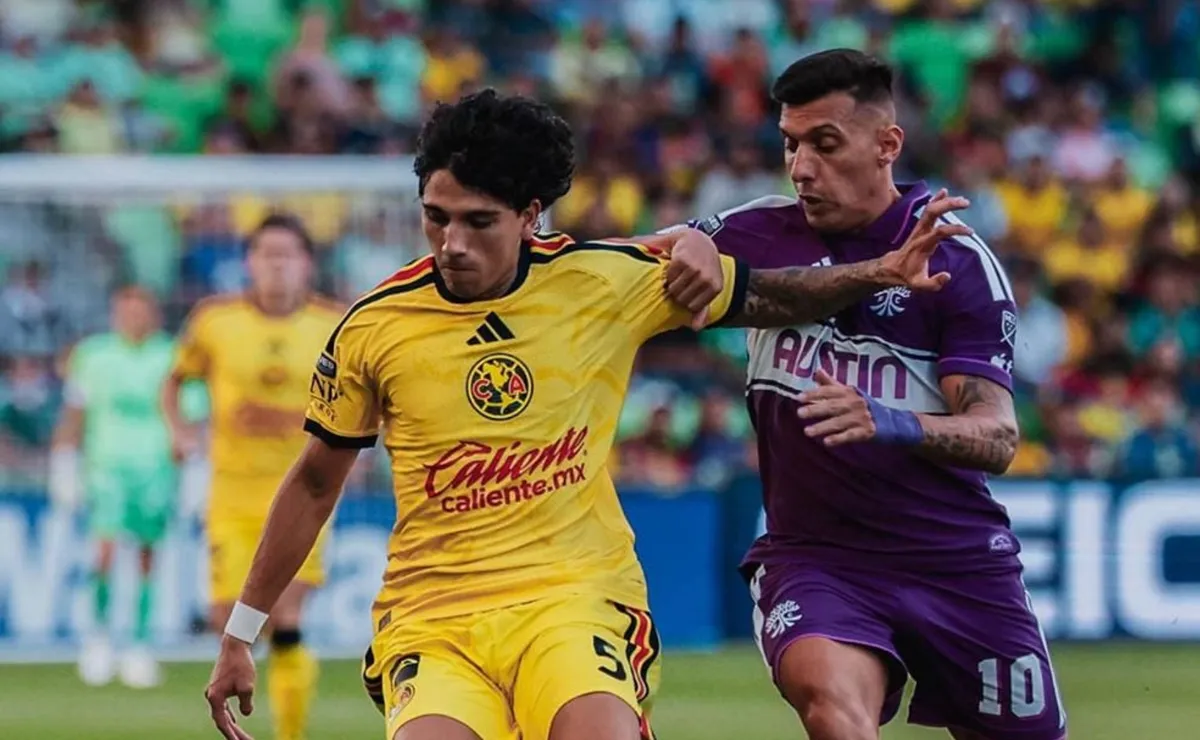
A 1-1 draw against Austin FC at Q2 Stadium concluded with a penalty shootout defeat, placing the Mexico City side second within the Liga MX grouping on seven points.
Club León claimed the top ranking with nine points, Toluca secured third, and Monterrey advanced in fourth.
Major Eliminations and Competitive Volatility
The group stage concluded with the elimination of Cruz Azul, which required a positive outcome but suffered a 2-1 defeat against Chicago Fire.
This loss enabled Monterrey to claim the final Mexican quarterfinal berth. Chicago Fire leveraged the result to secure the top MLS ranking with nine points, followed by Austin FC with eight points.
Systemic Implications for Regional Club Competition
Cross-border tournament structures alter squad rotation practices and test institutional resilience. Competing in external venues against MLS opposition requires rapid operational adjustments under compressed calendars.
For Club América, maintaining an undefeated baseline reinforces Almada’s tactical authority. Conversely, Cruz Azul’s group exit exposes structural vulnerabilities requiring evaluation ahead of domestic resumptions.