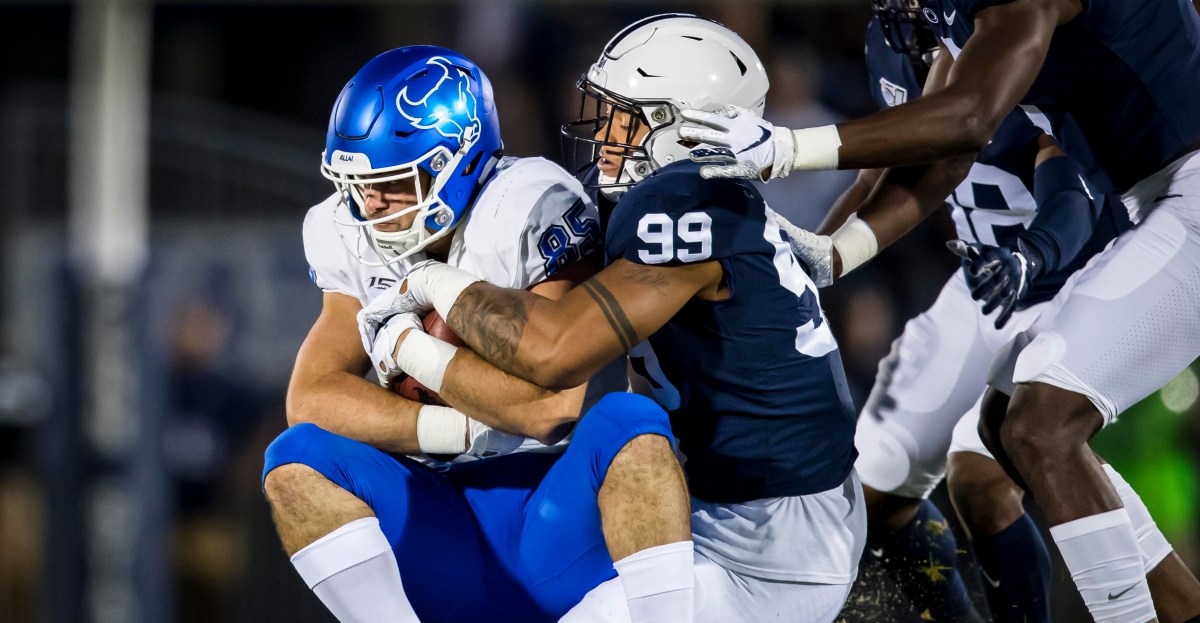
The week three collegiate football schedule features a classic power conference versus mid-major non-conference matchup as the No. 14 Penn State Nittany Lions host the Buffalo Bulls. Kickoff is set for 12:00 p.m. Eastern Time on Saturday, September 19, 2026, at West Shore Home Field at Beaver Stadium in University Park, Pennsylvania. This contest offers a critical evaluation of both programs’ early-season tactical adjustments and roster integration.
Penn State enters this Week 3 encounter unblemished at 2-0, having secured dominant victories over Marshall (45-0 shutout) and Temple (27-9). These early results underscore the seamless integration of head coach Matt Campbell’s strategic vision and roster continuity. Conversely, Buffalo holds a 1-1 record, narrowly defeating Albany 21-17 at home before a 33-20 road loss to Florida International exposed early structural vulnerabilities.
Such non-conference scheduling dynamics inherently position Group of Five programs like Buffalo against significant resource and talent disparities. Beaver Stadium, renowned as one of college football’s most intimidating venues, presents a formidable environmental and competitive challenge. For the Bulls, this contest serves not only as a rigorous stress test of their roster depth but also as a high-visibility opportunity for programmatic exposure.
Penn State’s Offensive Apex Under Campbell-Becht Synergy
Penn State’s early-season success is largely attributable to the swift, frictionless integration of head coach Matt Campbell’s offensive system, anchored by quarterback Rocco Becht. Becht’s decision to transfer and rejoin his former Iowa State coach in Happy Valley has been pivotal, significantly reducing the typical latency associated with new coaching transitions. This continuity in offensive philosophy and quarterback execution has yielded immediate dividends, stabilizing the Nittany Lions’ attack.
Through two games, Becht’s statistical profile reflects exceptional efficiency and risk aversion. He has completed passes for 539 yards and seven touchdowns without a single interception, achieving a remarkable 150.6 passer rating—ranking second nationally in the Football Bowl Subdivision. His precision was evident in the 27-9 victory over Temple, where he completed 21 of 27 attempts for 268 yards and three touchdowns. This zero-turnover propensity allows Penn State to dictate game tempo and protect field position, creating structural leverage against even aggressive defensive schemes.
Buffalo’s Offensive Imbalance and Passing Dependency
Conversely, Buffalo’s offense enters Week 3 grappling with significant operational imbalances. A hard-fought 21-17 victory over Albany was overshadowed by a 33-20 road loss to Florida International, which starkly highlighted a struggling run game. This marked decline in rushing productivity, relative to historical program benchmarks, has rendered the Bulls’ offense predictably pass-heavy, increasing vulnerability to opposing pass rushes and extending crucial downs.
Quarterback Elijah Holmes, while protecting the football with 253 passing yards and three touchdowns without an interception, faces an escalating burden. The unit’s reliance has converged around primary pass-catcher Chance Morrow, who leads the Bulls with 221 receiving yards and five touchdowns through two contests—accounting for a substantial portion of the team’s scoring. Wide receiver Victor Snow provides a critical secondary target, preventing defenses from solely bracketing Morrow, but the overall lack of a credible rushing threat allows defenses to deepen coverage shells and limit yards after the catch. Buffalo’s capacity to generate immediate perimeter production against a disciplined Penn State secondary will be paramount.
The Consecutive Transfer Quarterback Dynamic
A unique tactical narrative for Buffalo’s defense this week centers on facing consecutive former Iowa State quarterbacks. After encountering JJ Kohl of FIU in Week 2, the Bulls now prepare for Rocco Becht, Kohl’s former teammate, leading the No. 14 Penn State offense. This sequential exposure offers Buffalo’s defensive staff an unusual analytical advantage, allowing them to compare and contrast fundamental mechanics and progression reads developed within the same collegiate system.
However, the competitive context differs significantly. While Kohl was operating within an evolving FIU scheme, Becht benefits from immediate continuity under coach Matt Campbell, executing a more sophisticated and established Big Ten offense. The challenge for Buffalo escalates from a developing talent to a proven starter backed by elite infrastructure. The defensive insights gained from Kohl’s performance may offer subtle processing advantages, but the sheer speed and precision of Penn State’s supporting cast present a far more formidable defensive assignment, demanding flawless communication from the Bulls’ secondary.
Defensive Architecture and Comparative Run Prevention
The defensive disparity between these two programs is pronounced through the first two weeks. Penn State’s defense has been stifling, surrendering a mere nine total points across eight quarters, including a dominant shutout of Marshall. This elite scoring suppression provides immense strategic flexibility for the Nittany Lions’ offense, alleviating pressure and enabling a deliberate, high-percentage approach.
Buffalo’s defense, conversely, exhibited vulnerabilities during their 33-20 loss to FIU, struggling with situational conversions. Compounded by an offense unable to sustain drives via the run, Buffalo’s defensive unit has absorbed prolonged snap counts, leading to increased physical wear and exposure. Playing at Beaver Stadium amplifies this challenge, introducing environmental strain that will rigorously test the Bulls’ defensive conditioning and depth.
Buffalo’s primary defensive objective will be early-down containment. Allowing Penn State to consistently gain manageable yardage on first and second downs will systematically wear down the Bulls’ front seven. Disrupting this rhythm by forcing long-yardage third-down situations will be critical to creating isolated pass-rush opportunities and challenging Becht’s impeccable turnover record.
Market Valuation and Consensus Point Spreads
The significant institutional disparity between Penn State and Buffalo is unmistakably reflected in the commercial betting markets. Consensus lines position the No. 14 Nittany Lions as substantial 40.5-point favorites, with an over/under points total set at 50.5. These quantitative metrics underscore profound market confidence in Penn State’s overwhelming advantages in personnel, depth, and home-field leverage.
A spread exceeding forty points signals an expectation of comprehensive domination across all phases of the game. The 50.5 total implies Penn State is projected to account for the vast majority of the scoring, severely limiting Buffalo’s offensive production. Such a robust market assessment highlights that any competitive performance by the Bulls would represent a significant deviation from established performance baselines.
For Penn State, upholding these elevated market expectations demands unwavering focus for all four quarters, regardless of early score differentials. Conversely, Buffalo faces no structural market expectations, granting their coaching staff freedom for aggressive tactical variance. Non-standard fourth-down attempts or unconventional alignments often become crucial tools for heavy programmatic underdogs seeking to disrupt equilibrium.
Broadcast Ecosystem and Commercial Distribution
Saturday’s matchup is a key component of the Big Ten Conference’s extensive multi-platform broadcast strategy. The game will be nationally televised on the Big Ten Network (BTN), with linear cable coverage emanating directly from West Shore Home Field at Beaver Stadium. Concurrent digital distribution via streaming platforms like Fubo ensures broad audience access across various connected devices.
The 12:00 p.m. ET kickoff secures a prominent slot within the national morning and early afternoon college football viewing window. Non-conference contests against regional opponents are strategically vital for expanding BTN’s media footprint into new television markets. For Buffalo, this primary BTN broadcast offers invaluable national brand exposure to potential recruits and institutional stakeholders.
Beyond linear and digital broadcasts, fan engagement is amplified by dedicated online communities. The Penn State – Buffalo Open Thread, for example, serves as a consolidated digital hub, allowing fans to track live developments continuously. This interactive infrastructure exemplifies how modern sports audiences converge on real-time digital platforms during major televised events.
Systemic Implications for the 2026 Season
As non-conference play nears its conclusion, the strategic ramifications of Saturday’s contest extend beyond immediate results for both programs. For Penn State, an authoritative victory would decisively affirm the seamless integration of Matt Campbell’s tactical systems and solidify their top-15 national ranking, providing critical momentum heading into a demanding Big Ten conference schedule.
For the Buffalo Bulls, success will be measured less by the final score and more by the demonstration of foundational improvements, particularly in their struggling rushing attack. Establishing more consistent blocking leverage and diversifying offensive production beyond Chance Morrow are essential for achieving Mid-American Conference stability. A disciplined competitive effort at Beaver Stadium, even in defeat, would offer valuable validation following their challenging loss to Florida International.
Ultimately, Week 3 at Beaver Stadium encapsulates the multifaceted layers of modern collegiate football—from strategic quarterback transfers and coaching continuity to intricate broadcast ecosystems. As Rocco Becht and Elijah Holmes lead their respective offenses, each program navigates unique strategic imperatives within an ever-evolving landscape. The intersection of tactical execution, defensive suppression, and amplified media exposure will define the operational narrative of Saturday afternoon.