
The Strategic Divergence: Institutional Stability vs. Radical Restructuring
The Week 2 intersection of No. 6 Oregon and Oklahoma State serves as a definitive case study in modern roster construction. Oregon enters Stillwater possessing significant institutional momentum following a 34-27 victory over Boise State. While the margin was narrower than projected, the performance validated the Ducks’ capacity for poise in high-leverage scenarios—a prerequisite for a College Football Playoff (CFP) trajectory. Conversely, Oklahoma State is currently an experimental entity, having replaced its entire coaching staff and integrated 90 new players via the transfer portal after a catastrophic 2025 campaign.
Dante Moore and the Metrics of Offensive Efficiency
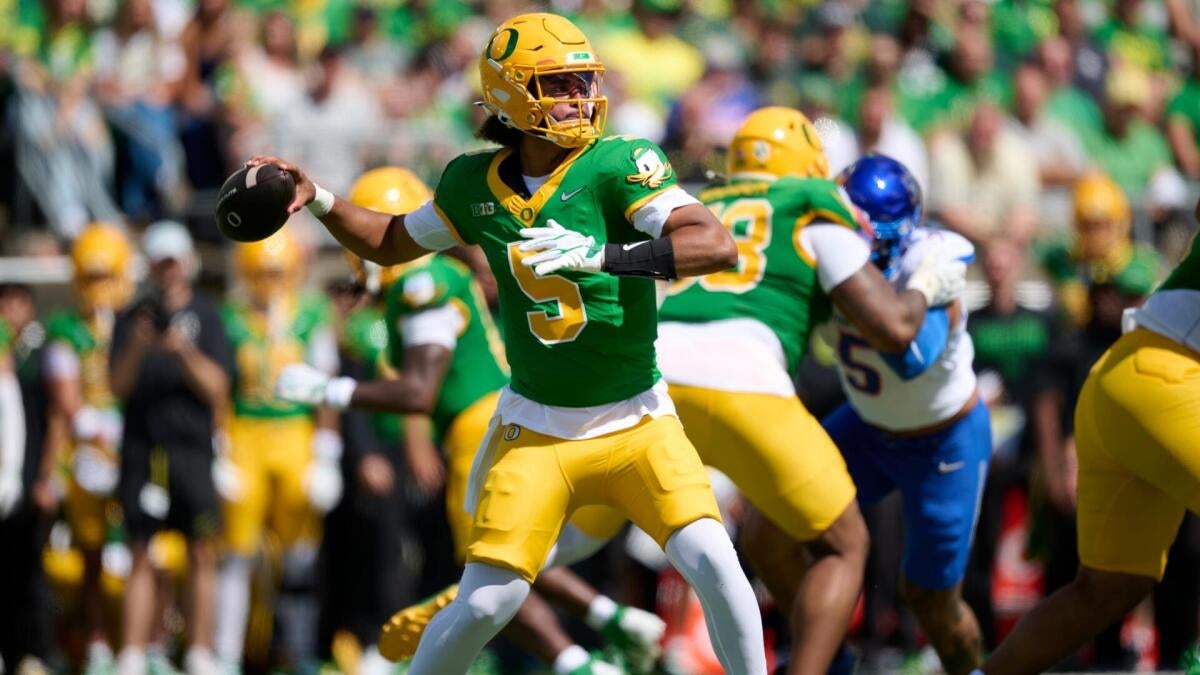
Dante Moore’s season-opening performance—378 yards and three touchdowns—has redefined Oregon’s offensive ceiling. Moore operates not merely as a facilitator but as a strategic force multiplier, utilizing elite processing speed to exploit defensive mismatches. His efficiency is the primary driver of Oregon’s market value, providing a stable floor that offsets the inherent volatility of road environments. In contrast, Oklahoma State’s reliance on North Texas transfer Drew Mestemaker highlights a significant talent gap. Mestemaker’s Week 1 performance (241 yards, two interceptions in a 24-10 loss to Tulsa) suggests an offense struggling with mechanical synchronization and high-pressure execution.
The 90-Player Overhaul: Analyzing Systemic Risk
Oklahoma State’s decision to bypass traditional developmental cycles in favor of a total transfer-led reset is an unprecedented operational gamble. This 90-player pivot creates significant ‘integration friction,’ where a lack of shared experience leads to catastrophic execution errors. The Cowboys’ inability to establish rhythm against Tulsa underscores the difficulty of forging a cohesive unit in a single off-season. Oregon’s continuity provides a distinct advantage in situational awareness, particularly on third downs and in red-zone efficiency, where communication often dictates the outcome.
Market Valuation and Defensive Leverage
The betting markets have established a 23.5-point spread, reflecting a profound lack of confidence in Oklahoma State’s defensive integrity. This valuation acknowledges Oregon’s athletic superiority and its ability to force Mestemaker into high-variance passing situations. With the total points adjusted to 54.5, analysts anticipate a controlled dominant performance by Oregon rather than a high-scoring shootout. Oregon’s defense, characterized by its disciplined secondary and aggressive front, is positioned to exploit the Cowboys’ lack of chemistry, potentially turning the game into a feedback loop of turnovers and short-field opportunities for Moore.
Conclusion: The Efficacy of the Modern Build
This matchup will serve as a referendum on two opposing philosophies in the 2026 era. Oregon represents the peak of elite talent retention and incremental growth, while Oklahoma State represents the ‘burn-and-build’ model of the transfer portal. A decisive Oregon victory would reinforce the value of program continuity, whereas a competitive showing by the Cowboys would provide a necessary proof of concept for radical systemic resets. In the landscape of the Power Four, the gap between the established elite and those in the midst of volatility has never been more pronounced.
Photo by paedwards on Pixabay.