Meteorological Impact Across the Kansas City Metropolitan Area
Severe winds moving across the Kansas City metro area on Wednesday afternoon compromised electrical infrastructure, downing power lines and trees. According to Evergy’s outage map, more than 1,200 customers lost electricity during the peak of the storm, affecting communities including Lake Winnebago, Pleasant Hill, Strasburg, and Holden. The National Weather Service documented widespread disruptions across multiple Missouri municipalities, highlighting the systemic vulnerability of regional distribution grids to high-velocity convective weather events.
Documented wind gusts reached between 60 and 70 mph in Baldwin City, while Holden recorded gusts up to 59 mph. Additional damage reports encompassing broken tree limbs and downed wires emerged from Prescott, Pleasanton, Clinton, and Kingsville. These localized meteorological spikes demonstrate the operational challenges faced by regional utility providers when maintaining continuous service under sudden environmental stress.
Infrastructure Vulnerability and Utility Response
The concentration of outages across dispersed semi-urban and rural communities highlights the logistical complexities inherent in grid maintenance and rapid restoration protocols. Utility providers operating within the Kansas City metro area must continually balance capital expenditure on subterranean hardening against the baseline economics of overhead distribution lines. Wednesday’s storm sequence underscored the immediate pressure placed on emergency dispatch and maintenance crews deployed to clear debris and re-energize localized circuits.
Continuous monitoring by regional meteorological services indicated that showers and storms would persist overnight into Thursday morning, sustaining a state of operational readiness for local response teams. The intersection of severe wind velocities and mature arboreal populations near power corridors remains a persistent risk factor for regional distribution networks. Consequently, municipal stakeholders face ongoing decisions regarding vegetation management budgets and infrastructural resilience investments to mitigate future grid failures.
Festival Disruption and Vendor Exposure
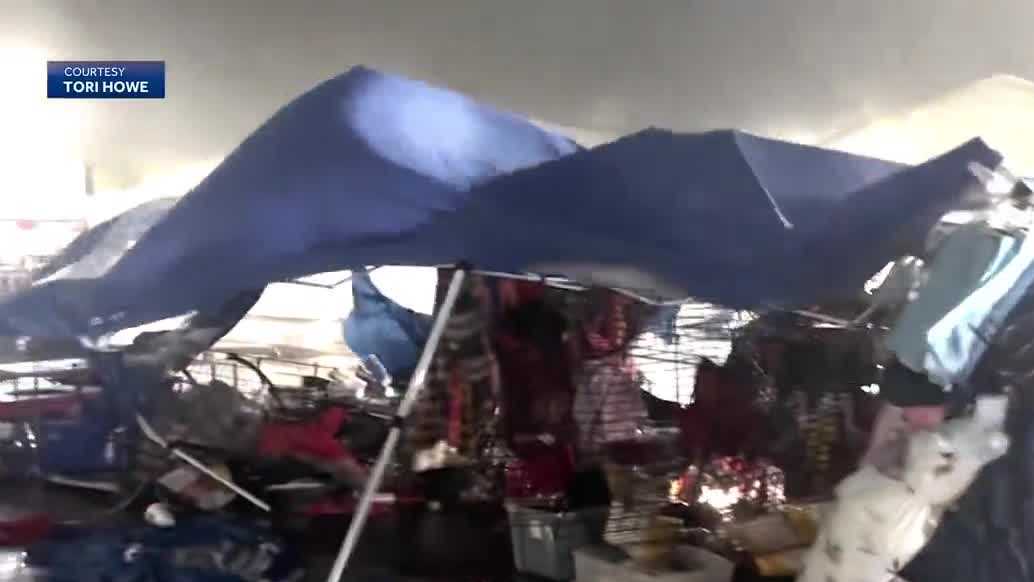
Severe weather also impacted public events in the region, most notably striking the SantaCaliGon Days festival in Independence on Sunday night. Winds reaching up to 60 mph caused structural damage to festival infrastructure, leaving shredded tent roofs, scattered merchandise, and food debris across the grounds. Despite the intensity of the localized storm, official reports confirmed no injuries resulting from the sudden destruction.
Vendor operations experienced immediate operational paralysis as the environmental conditions compromised temporary structures and commercial inventory. William Doughty, owner of the Walkers Branson Taco Experience, noted that the storm arrived with minimal institutional warning. Festival staff members deployed golf carts to alert participants, leaving vendors with an extremely compressed operational window of thirty seconds to two minutes to secure assets.
Economic and Logistical Consequences for Small Business Operators
The disruption of seasonal events like the SantaCaliGon Days festival exposes independent vendors and small business operators to significant revenue volatility. Doughty observed that prior foot traffic numbers had already been depressed by prolonged extreme heat before the storm struck the grounds. The combination of environmental headwinds and sudden weather truncation restricts the ability of mobile vendors to recover fixed participation costs.
Event organizers and municipal leadership now confront the downstream economic fallout experienced by participating businesses. Jackson County executive proposals, such as organizing a Square Saturday event, represent institutional attempts to offset canceled programming and restore economic viability for affected vendors. Such administrative interventions illustrate the economic interdependence between municipal cultural programming and the commercial cash flow of visiting enterprises.
Institutional Mitigation and Future Resilience Planning
The convergence of severe weather events and public festivals necessitates a reevaluation of emergency communication protocols and crowd safety management. The limited warning window reported by vendors underscores the operational gap between regional radar detection and immediate, ground-level dissemination to event participants. Enhancing early warning transmission channels remains an urgent priority for event coordinators operating temporary large-scale public gatherings in regions prone to sudden meteorological shifts.
As municipal authorities and county executives formulate recovery strategies, the structural focus shifts toward risk mitigation and adaptive event planning. The financial exposure borne by small businesses during extreme weather events emphasizes the need for comprehensive institutional safety nets and streamlined recovery frameworks. Ultimately, navigating these operational vulnerabilities requires synchronized coordination between municipal planners, emergency services, and commercial vendors to safeguard regional economic activity against increasingly unpredictable weather patterns.