Federal court filings have revealed that the Trump administration received a technical assessment from a U.S. National Park Service (NPS) engineer on June 11 warning that the floor of the Lincoln Memorial Reflecting Pool was peeling due to renovation defects. The engineer documented that the “top layer of liner has peeled” but emphasized that the layer was “very thin and will not impact the strength of the liner.” The contractor attributed the superficial failure to “overspray” generated during the application of polyurea to the perimeter joint, identifying the issue as an installation defect rather than external structural compromise.
Despite this internal technical record, public and prosecutorial responses framed the damage as intentional vandalism. Following the pool’s reopening, President Donald Trump publicly accused visitors of “destroying” the landmark. Shortly thereafter, the U.S. Attorney’s Office for the District of Columbia charged former Olympic canoeist David Hearn with destruction of property stemming from a June 19 visit, premising the case on deliberate destruction.
The legal foundation of the prosecution eroded when prosecutors subsequently acknowledged they were “not aware of or in possession of” the Department of the Interior’s technical warnings at the time charges were filed. This disclosure highlights a severe inter-agency information silo between federal infrastructure managers and federal prosecutors, shifting the evidentiary focus from individual criminal culpability toward pre-existing contractor workmanship failures and administrative oversight gaps.
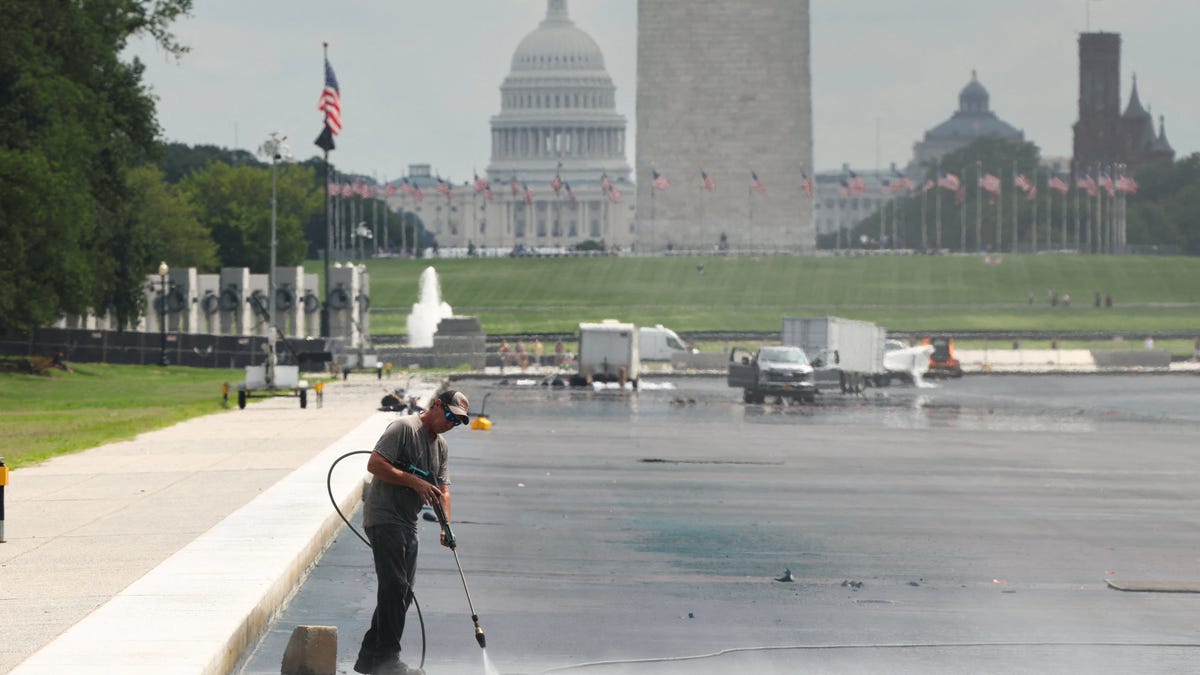
The operational fallout continued into August 2026, as remediation crews deployed power-washing equipment and construction machinery to strip and repair the compromised polyurea application. Characterized in filings as corrective work for a botched repair project, the extended maintenance cycle raises critical financial and contractual questions regarding performance bonding, warranty claims, and the expenditure of public funds to rectify contractor errors.
The sequence of events—technical warnings, executive accusations, premature legal indictment, and subsequent evidentiary corrections—underscores significant institutional liabilities. Beyond the immediate legal implications for the defendant, the case demonstrates the operational risks that emerge when executive messaging and prosecutorial actions decouple from internal technical assessments on public infrastructure assets.