
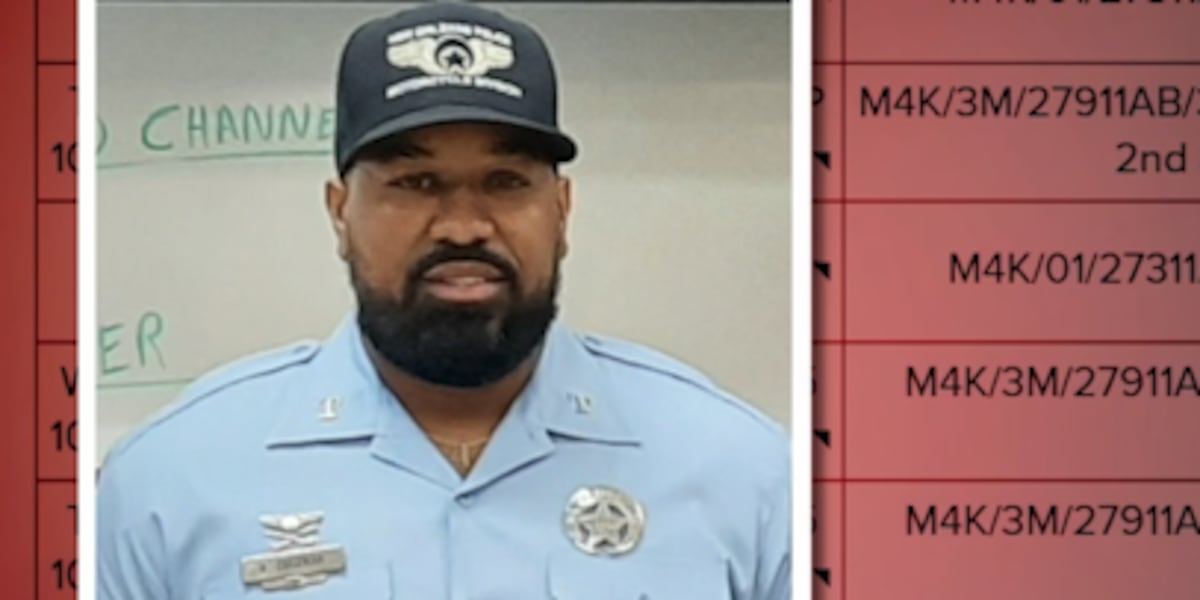
Criminal Indictment and Arrest Dynamics
Senior Officer Brandon Coleman of the New Orleans Police Department (NOPD) has been formally charged with 350 criminal counts following a comprehensive multi-agency investigation into payroll malfeasance. The charges, filed after his booking into the Orleans Parish jail, include 325 counts of filing false public records and 23 counts of public payroll fraud, alongside charges of malfeasance in office and theft. This legal action follows an emergency unpaid suspension issued by NOPD leadership as the scope of the alleged fraud became clear.
The sheer volume of charges reflects a meticulous approach by the Louisiana State Police (LSP) and the New Orleans Office of Inspector General (OIG). By treating each fraudulent timesheet as an individual criminal act of filing false records, prosecutors have built a case centered on a systematic pattern of deception rather than a single administrative error. This indictment represents one of the most significant crackdowns on internal police corruption in the department’s recent history.
Financial Analysis: The $172,000 Discrepancy
Forensic accounting revealed a massive divergence between Coleman’s base salary of $68,000 and his total annual compensation of $229,000. While initial LSP estimates suggested $111,000 in fraudulent earnings, the Louisiana Attorney General’s Office has argued in court that the total unearned compensation exceeds $172,000. The fact that the officer’s overtime pay nearly tripled his base salary served as the primary red flag for institutional auditors.
The financial scale of the case underscores a critical failure in municipal supervisory protocols. When compensation structures allow for such high-velocity overtime billing without real-time verification, public safety budgets face significant depletion. This case serves as a high-profile example of how unchecked administrative procedures can be exploited for substantial private gain at the expense of municipal taxpayers.
Investigative Methodology and Geospatial Evidence
The joint probe, initiated in April 2026, utilized a data-driven approach to verify Coleman’s operational claims. Detectives cross-referenced digital timesheets with physical location data, exposing chronic inconsistencies. Surveillance and analytical tracking documented multiple instances where Coleman remained at his private residence while simultaneously claiming active-duty status on official payroll logs. This spatial-temporal mismatch formed the evidentiary core of the 325 counts of false record-keeping.
By leveraging technology to track movement against reported hours, investigators were able to bypass traditional supervisory loops that had failed to catch the discrepancies. The use of geo-fencing and digital audit trails demonstrates an evolving standard in law enforcement internal affairs, where physical presence must now be corroborated by digital footprints to ensure fiscal accountability.
Media Surveillance as an Investigative Catalyst
A pivotal element of the investigation was the external pressure generated by FOX 8 WVUE’s ‘Unchecked Overtime’ series. Investigative journalists used undercover surveillance to capture footage of Coleman at home during his scheduled shifts. Notably, the investigation revealed that even after Coleman discovered a hidden camera near his property, he continued to log hours from home before eventually departing for his assigned shifts, indicating a persistent disregard for oversight.
The televised evidence provided a public proof-of-concept that validated the suspicions of state auditors. This synergy between independent journalism and state-level prosecution highlights the role of external transparency in maintaining municipal integrity. The media coverage effectively accelerated the timeline for the formal criminal indictment by the Louisiana State Police and the OIG.
Defense Strategy and Governance Implications
Defense attorney Bobby Hjortsberg has dismissed the charges as ‘absolutely baseless,’ signaling a strategy that will likely challenge the definition of compensable police work. The defense is expected to argue that senior officers often engage in remote administrative coordination or non-traditional duties that location data may fail to capture. However, the prosecution remains focused on the 325 individual instances of documented falsification that contradict these claims.
Superintendent Anne Kirkpatrick has maintained a stance of full institutional cooperation, emphasizing that integrity is non-negotiable. Beyond the courtroom, this case is driving calls for systemic reform, including the adoption of biometric timekeeping and automated location-based verification for all NOPD personnel. The outcome of the Coleman trial will likely serve as a benchmark for future public-sector payroll oversight and the legal standard for proving intent in systemic fraud cases.