
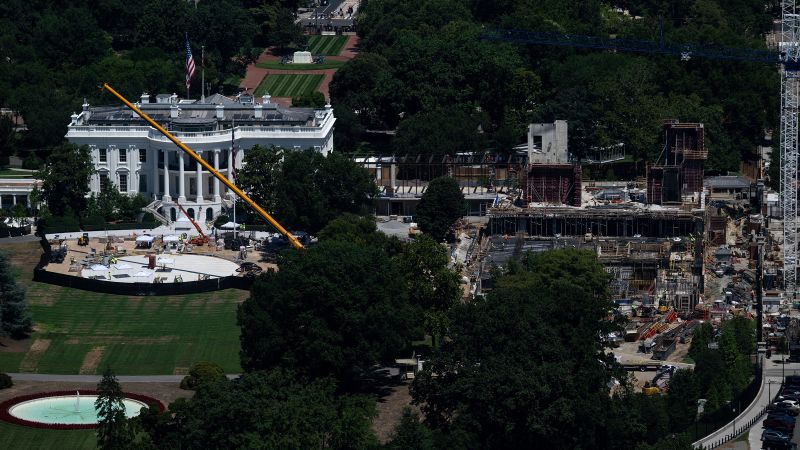
Appeals Court Blocks White House Ballroom Construction Over Congressional Authority Dispute
A federal appeals court has halted construction of a $400 million, 90,000-square-foot ballroom at the White House, determining that the Trump administration lacks the unilateral authority to proceed without explicit congressional approval. The ruling by the U.S. Court of Appeals for the District of Columbia Circuit emphasizes a core conflict between executive prerogative and legislative oversight in managing and modifying national landmarks.
In a 2-1 decision, the court sided with preservationists who argued that the Executive Branch cannot unilaterally alter the White House, the “People’s House,” to fit a president’s vision. This judicial intervention scrutinizes the extent of executive power over federal properties, asserting that significant changes require broader consensus than solely the executive office.
The majority opinion stated that the decision to build a “massive ballroom” is a legislative matter, not an executive entitlement. This framing classifies the project as a policy and fiscal decision falling under Congress’s purview, which controls appropriations and historically authorizes major federal building modifications.
The legal challenge, initiated by the National Trust for Historic Preservation, underscores the role of heritage organizations in safeguarding national assets. The successful appeal potentially sets a precedent for scrutinizing and overturning executive actions impacting historically significant federal structures based on statutory and constitutional grounds, particularly concerning the separation of powers.
The court’s two-week stay of its ruling offers the administration a chance to seek further review, potentially at the U.S. Supreme Court. This prospect highlights the significant implications for executive authority over federal property and the balance of power between branches.
The panel’s composition, with judges appointed by both Democratic and Republican presidents, reflects the complexity of the ruling. A dissenting opinion from a Trump appointee suggests judicial disagreement on the interpretation of executive authority in this context.
The $400 million allocated to the project raises questions about budget processes and oversight, especially given the court’s assertion that such a decision should be legislative.
The court’s extensive majority opinion, reportedly over 100 pages, indicates a deep dive into legal precedents and statutes governing the White House. The depth of legal reasoning will be crucial for any subsequent appeals regarding executive authority versus congressional control.
This ruling immediately impacts ongoing White House infrastructure projects, compelling a re-evaluation of how executive administrations initiate and fund large-scale renovations on federal property, likely requiring more robust congressional engagement.
The administration’s decision to proceed with demolition and construction without what the court deems sufficient congressional mandate exposes a reliance on executive discretion. This approach could invite further legal challenges and prompt a review of administrative procedures for federal property development.
The financial implications of the $400 million project are now under scrutiny, potentially affecting involved contractors and suppliers pending the outcome of any appeals.
The perceived performance benefits of the ballroom project for the executive branch are now weighed against the structural requirement for legislative consent, indicating a potential miscalculation in strategic execution.
The competitive implications center on institutional power struggles between the executive and legislative branches. The ruling reinforces Congress’s control over significant expenditures and alterations to national assets.
The administration faces potential further legal challenges to executive actions involving substantial resource allocation or physical transformations of federal property, potentially emboldening others to scrutinize perceived overreach.
Downstream market effects could include increased caution among federal project contractors and developers, who may require clearer congressional authorization before committing resources, creating broader industry uncertainty.
The institutional impact may lead to a recalibration of executive agency interactions with Congress on infrastructure, necessitating more formalized consultation and legislative buy-in early in project planning.
Media coverage is expected to focus on the executive-legislative power balance, the legal intricacies of executive authority, and the judiciary’s role in arbitrating such disputes over national symbols.
Stakeholder implications extend to the public, represented by Congress, suggesting that public interest, as voiced by elected officials, takes precedence over a president’s personal vision for national landmarks.
Future administrations may adopt a more constrained approach to executive-driven renovations, requiring more collaborative processes with Congress and potentially altering project scopes.
The court’s framing of the White House as the “People’s House” elevates its status to a national patrimony, underscoring that its modification is a matter of public trust requiring a broad mandate.
The legal basis likely involves statutes like the National Historic Preservation Act and constitutional separation of powers principles, with the detailed opinion crucial for understanding their application.
The dissenting opinion, if it presents alternative interpretations of executive authority or statutory application, will be a key focus in any Supreme Court review.
The decision’s impact on the administrative state could signal increased judicial scrutiny over significant executive financial commitments or physical transformations of federal assets.
Historical context of White House renovations often involved extensive congressional debate, reinforcing the current ruling’s reinforcement of legislative approval against executive unilateralism.
Economic leverage of the construction industry is indirectly affected; prolonged legal battles or adverse rulings could impact companies, while reversals could resume economic activity.
Strategic implications for the executive branch involve reassessing risk management for large projects, given the vulnerability of initiatives lacking robust legislative support.
Ultimately, the appeals court ruling imposes a significant legal and political hurdle, underscoring that transforming the White House requires broader consensus than a single executive’s decision.

Photo by ptrabattoni on Pixabay.