
Strategic Temporal Shifts and Market Displacement
The acceleration of the ‘Made By Google’ event to August 12 signifies a tactical pivot designed to disrupt the traditional smartphone release cadence. By abandoning the October window, Google seeks to preemptively capture market share ahead of late-Q3 competitor cycles. This early launch allows Google to dictate the technological narrative for the 2024-2025 fiscal year, positioning the Pixel 11 series as the primary benchmark for Android hardware before holiday purchasing patterns solidify.
Silicon Sovereignty: Tensor G6 and Vertical Integration
The Tensor G6 represents a maturation of Google’s proprietary silicon strategy, prioritizing specialized computational pipelines over raw synthetic benchmarks. Integrated with the Titan M3 security coprocessor, the G6 architecture focuses on hardware-level encryption and on-device machine learning efficiency. This vertical integration facilitates deeper optimization of the Android OS, enabling extended software support lifecycles and reducing reliance on third-party silicon providers. The G6 is not merely a processor but a bespoke engine for Google’s generative AI and privacy-first ecosystem.
Display Engineering: The 3,000-Nit Actua Standard
The Pixel 11 lineup utilizes Actua OLED technology, with the base 6.3-inch model achieving a peak brightness of 3,000 nits. This luminance threshold addresses the critical challenge of outdoor legibility while expanding the dynamic range for HDR content. The implementation of an adaptive 60Hz–120Hz refresh rate balances UI fluidity with thermal management and power conservation. By standardizing high-density panels across the lineup, Google ensures visual parity between compact and large-format devices.
Memory Hierarchy and Lifecycle Longevity
Moving toward a 12GB and 16GB RAM architecture indicates a shift toward ‘future-proofing’ hardware for intensive background processing and multi-modal AI agents. This memory overhead is critical for maintaining performance stability over Google’s promised multi-year update cycle. While internal storage remains fixed at up to 512GB, the emphasis on high-speed flash memory reinforces a reliance on local processing speed, complemented by Google Cloud for long-term archival storage.
The Pixel 11 Pro Fold: Structural and Ergonomic Evolution
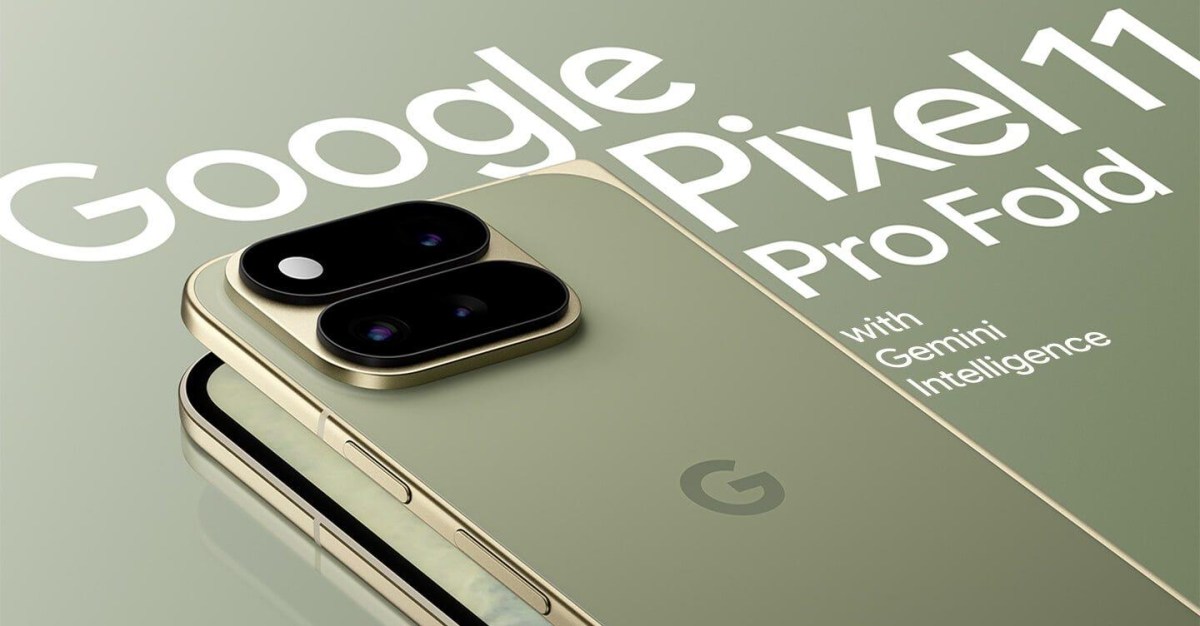
The Pixel 11 Pro Fold departs from the ‘passport’ aspect ratio of its predecessor, adopting a taller external display and an 8-inch internal panel. This redesign favors standard app scaling over customized square-ratio layouts, improving third-party software compatibility. The introduction of the redesigned camera array—distinguished by a glowy light element—and the olive green colorway serves to solidify the Fold’s identity as a premium productivity tool rather than a niche experiment.
Power Management and Infrastructure: Qi2 and PPS
Equipped with a 4,985mAh typical capacity battery, the Pixel 11 focuses on sustained endurance. The adoption of the Qi2 wireless charging standard—complete with magnetic alignment—modernizes the Pixel ecosystem, ensuring compatibility with a burgeoning accessory market. Wired charging via 30W USB-C PPS (Programmable Power Supply) emphasizes battery health through precise voltage regulation, mitigating the heat-induced degradation common in ultra-fast charging alternatives.
Market Segmentation: The Four-Model Tier Strategy
The expansion into a four-device lineup—Pixel 11, 11 Pro, 11 Pro XL, and 11 Pro Fold—reflects a sophisticated attempt to maximize Average Selling Price (ASP). By decoupling ‘Pro’ features from physical size (via the Pro and Pro XL), Google addresses the demand for high-tier photography in a compact form factor. This granular segmentation allows for competitive pricing in both the US and EU markets, challenging incumbents across every premium price bracket simultaneously.

Photo by AS_Photography on Pixabay.