
The operational stability of a major league pitching staff depends on maintaining a delicate equilibrium between veteran volume-eaters and high-ceiling minor league depth. When a single game disrupts this balance, front offices must execute rapid, high-stakes transactions to mitigate competitive exposure. The Atlanta Braves recently executed this exact playbook, initiating a multi-layered roster restructuring following a volatile 10-9 loss to the New York Mets.
The catalyst for this sudden organizational shift was a physical setback to left-hander Martín Pérez, who exited Sunday’s contest after being struck by a line drive off the bat of Juan Soto. Although diagnostic imaging returned negative for structural fractures, the resulting left forearm contusion necessitated an immediate 15-day injured list placement. This injury deprives the Braves of a consistent mid-rotation anchor who had compiled a 3.54 ERA over 18 appearances (14 starts) prior to the incident.
The Operational Impact of Martín Pérez’s Injury
Losing Pérez (6-6) forces an immediate reallocation of innings across both the starting rotation and the bullpen. Prior to his exit—where he surrendered five runs on six hits over 4.3 innings—Pérez had served as a stabilizing force capable of limiting bullpen exposure. His sudden absence leaves a vacancy in the rotation during a critical stretch of divisional matchups, threatening to trigger a negative feedback loop of bullpen fatigue.
By placing Pérez on the 15-day IL, the Braves’ front office bought administrative time to evaluate their internal options without permanently burning minor league options. However, the short-term strain on the active roster remains acute, forcing the coaching staff, under the guidance of Walt Weiss, to micro-manage pitcher workloads. This injury has fundamentally accelerated the developmental timelines for the organization’s top pitching prospects.
The Strategic Sunk-Cost of the Carlos Carrasco DFA
Simultaneous to Pérez’s injury designation, the Braves designated veteran right-hander Carlos Carrasco for assignment. Carrasco’s departure was precipitated by a challenging relief appearance in which he surrendered five runs on five hits in just two innings. This transaction underscores the organization’s zero-tolerance policy for performance deficits during a tight pennant chase.
Designating a veteran of Carrasco’s stature for assignment is a decisive move, signaling that the front office prioritizes immediate roster functionality over historical performance or financial commitments. Removing Carrasco from the 40-man roster creates a critical vacancy for younger, more versatile arms capable of providing multi-inning relief or spot starts. This move reflects the calculated efficiency required of modern front offices when optimizing the back end of a major league pitching staff.
The Promotion of Owen Murphy and Prospect Management
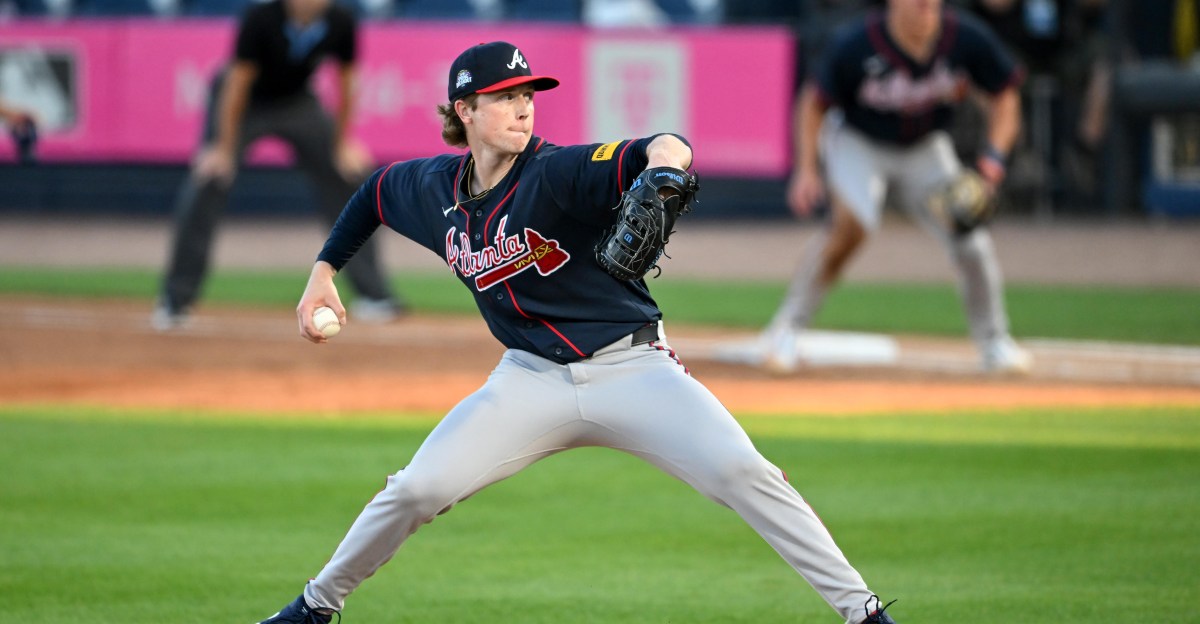
To fill the vacancies created by Pérez and Carrasco, the Braves promoted consensus top-10 organizational prospect Owen Murphy. Murphy, who has split his developmental season between Double-A Columbus and Triple-A Gwinnett, represents the next wave of high-ceiling pitching talent within the Atlanta pipeline. His promotion to the major league roster represents a calculated gamble on his current performance metrics and physical readiness.
At the Triple-A level, Murphy has demonstrated encouraging progress, posting a 3.88 ERA and a 4.27 FIP over 60.1 innings (11 starts). His underlying metrics—including an 81 ERA- and a 90 FIP-—indicate that he has performed significantly better than league average in a highly offensive minor league environment. Because Murphy is currently on regular rest, the timing of his promotion aligns perfectly with the rotation vacancy, allowing him to transition seamlessly into a starting role.
Promoting a young arm directly into high-stakes major league games carries inherent developmental risks alongside immense opportunity. Elite major league hitting can damage a prospect’s confidence if early outings go poorly. The Braves are banking on Murphy’s command and poise—which were on full display during his recent solid outings with the Gwinnett Stripers—to translate effectively to the sport’s highest level.
The Administrative Gymnastics of JR Ritchie’s Recall
The roster churn also featured the rapid recall of right-hander JR Ritchie from Triple-A Gwinnett, illustrating the complex transaction rules front offices must navigate. Ritchie had only recently been optioned to Gwinnett on Sunday after delivering a crucial three-inning scoreless performance to secure his first career save in Saturday’s 14-3 victory over the Mets. His immediate recall highlights how quickly injuries can alter a team’s short-term pitching plans and override previous developmental assignments.
Ritchie’s statistical profile this season includes a 1-2 record and a 4.53 ERA across nine appearances, including seven starts, for the major league club. This versatility makes him an invaluable asset for a depleted pitching staff, as he can function as a traditional starter, a long reliever, or a multi-inning high-leverage option out of the bullpen. His presence provides manager Walt Weiss with crucial tactical flexibility as the team attempts to navigate the loss of two veteran arms in a single day.
By utilizing Ritchie in various roles, the Braves can shield their primary high-leverage relievers from excessive wear and tear during games where the starting pitcher fails to go deep. This workload management is critical for preserving the overall health and effectiveness of the bullpen over the course of a 162-game season. Ritchie’s ability to absorb innings in multiple capacities will be a key factor in the team’s ability to maintain competitive stability in the coming weeks.
Position Player Adjustments and Bench Optimization
The roster restructuring was not limited entirely to the pitching staff, as the Braves also executed key transactions involving their position players. Outfielder Eli White was placed on paternity leave, a move that temporarily reduces the team’s outfield depth but complies with league-mandated family leave protocols. To fill this temporary vacancy, the front office recalled outfielder José Azócar from Triple-A Gwinnett, ensuring that the bench remains fully staffed with defensive versatility and speed.
Azócar’s promotion provides the Braves with an experienced depth option who can handle multiple outfield positions and contribute as a late-game pinch-runner or defensive replacement. While less impactful than the pitching staff overhaul, these minor bench adjustments are vital for maintaining late-game tactical options and ensuring that starting outfielders receive adequate rest. The seamless integration of depth pieces like Azócar demonstrates the organizational synergy between the major league club and its Triple-A affiliate in Gwinnett.
These parallel moves highlight the holistic nature of modern roster management, where a crisis in one department requires complementary adjustments across the entire 26-man active roster. The front office must constantly balance the immediate need for pitching depth with the ongoing requirement for bench versatility and defensive coverage. By executing these moves in tandem, the Braves have attempted to minimize their vulnerability across all phases of the game.
Strategic Implications for the National League East Race
The timing of this roster upheaval is particularly significant given the ongoing competitive dynamics within the National League East. Facing divisional rivals like the New York Mets requires a pitching staff that is both deep and resilient, as head-to-head matchups carry immense weight in the postseason race. The high-scoring nature of Sunday’s 10-9 loss exposed the vulnerabilities of an overworked or underperforming pitching staff, making these roster corrections an absolute necessity.
By aggressively addressing their pitching deficiencies through the DFA of Carrasco and the promotion of Murphy, the Braves have signaled to their division rivals that they will not tolerate prolonged periods of pitching instability. The success of this strategy will depend heavily on how quickly the newly promoted arms can adjust to the pressures of major league competition. If Murphy and Ritchie can provide stable, competitive innings, the Braves will have successfully navigated a potentially devastating roster crisis with minimal long-term damage.
Conversely, if the young pitching staff struggles to contain major league offenses, the front office may be forced to explore external trade markets to bolster their rotation before the deadline. This reality places immense pressure on the organization’s player development system to produce immediate results at the major league level. The coming weeks will serve as a critical test of the Braves’ organizational depth and their ability to sustain championship-level performance in the face of acute adversity.

Photo by Ribastank on Pixabay.