Judicial Imperative: The Denied Stay and Procedural Finality
The removal of Donald Trump’s name from the John F. Kennedy Center for the Performing Arts represents a definitive pivot in the legal contest over federal landmark branding. On Friday, Judge Christopher Cooper of the U.S. District Court for the District of Columbia denied the administration’s emergency motion for a stay, effectively mandating immediate compliance with a prior injunction. This ruling underscores the high evidentiary threshold required to halt a permanent injunction; the court found the defendants failed to establish a likelihood of success on the merits or irreparable harm during the appellate phase.
While the D.C. Circuit Court of Appeals retains jurisdiction over the underlying case, the absence of an administrative stay transformed the legal mandate into an operational reality. The administration’s inability to synchronize its appellate strategy with the District Court’s deadline forced a transition from litigation to physical dismantling. This development highlights the judiciary’s role in enforcing the original institutional identity of federal properties over transient political branding.
Logistical Execution and Architectural Stewardship
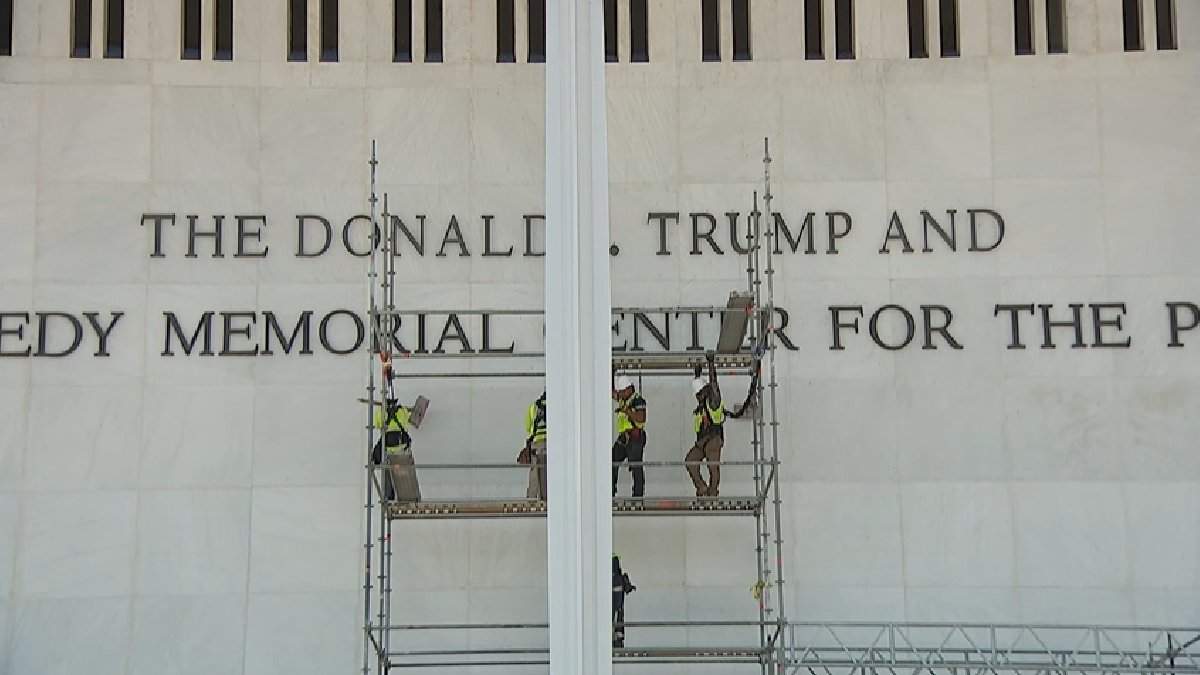
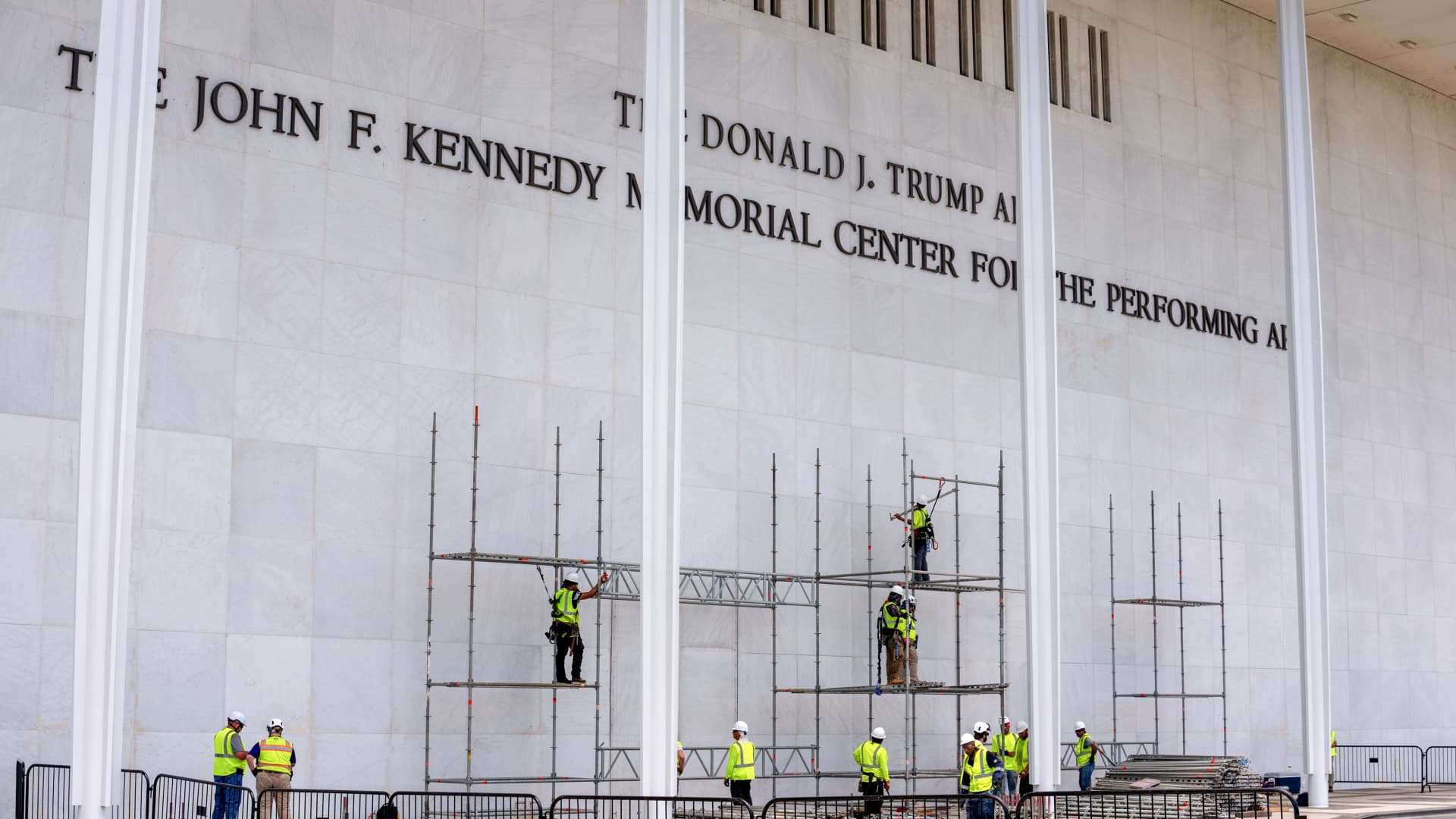
Following the ruling, crews initiated the complex task of detaching architectural lettering from the center’s facade. Operations are being conducted under rigorous federal maintenance guidelines to preserve the integrity of the landmark’s structure. Workers, navigating extreme environmental conditions, have deployed extensive scaffolding to facilitate the precision required for large-scale signage removal. The technical difficulty of this process—involving the detachment of heavy materials from the building’s exterior—serves as a visible indicator of the court-ordered administrative shift.
The timing of these maneuvers, synchronized with the expiration of the judicial stay, reflects the urgency imposed by the court. Live coverage of the event underscored the logistical coordination between federal contractors and institutional administrators, as the physical removal of the letters serves as a tangible conclusion to this phase of litigation.
Socio-Political Convergence and Institutional Impact
The site has become a nexus for diverse stakeholder groups, reflecting broader national tensions. Among the observers were federal employees recently impacted by the Department of Government Efficiency (DOGE) initiatives, whose presence linked the signage removal to current shifts in federal labor policy. They were joined by cultural stakeholders, including performers and longtime patrons, who view the restoration of the building’s original namesake as an affirmation of the center’s cultural mission.
Public engagement at the scene was high, with the crowd’s vocal support for the removal providing a rhythmic backdrop to the mechanical work. This assembly of displaced workers and cultural advocates transformed a logistical procedure into a significant public event, illustrating how the Kennedy Center serves as a theater for both performing arts and civic discourse.
Precedent and the Future of Naming Rights
This case establishes a notable precedent regarding naming rights on public-private federal entities. The judiciary’s focus on the facade’s historical mission suggests a prioritization of institutional legacy over contemporary political endorsements. Should the D.C. Circuit eventually rule in favor of the administration, the resulting legal landscape would be historically unique, potentially leading to further litigation over the restoration of branding. However, the current physical removal creates a factual status quo that may be difficult to reverse, marking a significant chapter in the history of D.C. landmark management.