
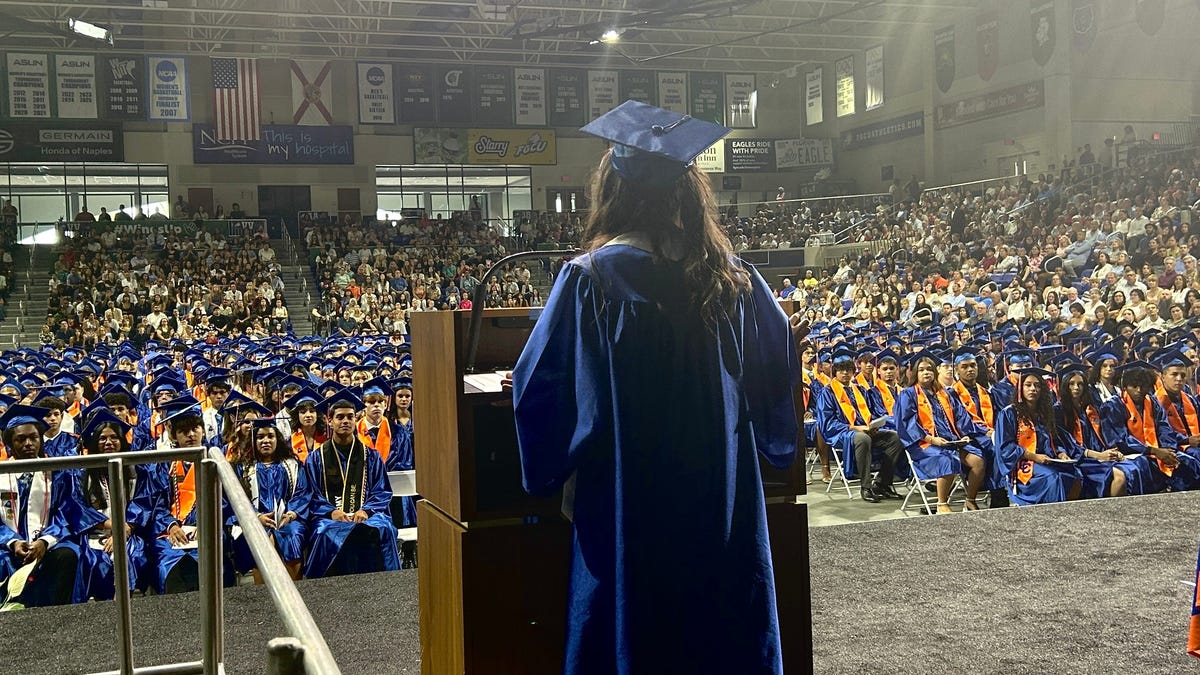
Student Expression Silenced Amidst Unscripted Remarks on Global and Domestic Issues
The graduation ceremony at Clayton High School was disrupted when valedictorian Leen Hijaz’s speech was abruptly terminated. The intervention occurred after Hijaz delivered unscripted remarks that touched upon global human rights issues and domestic immigration policies, specifically referencing the plight of those in Palestine, Sudan, Congo, and Afghanistan, and families affected by Immigration and Customs Enforcement (ICE) actions. This deviation from an anticipated, likely pre-approved, address prompted a school official to cut off her microphone.
The incident, captured on video and widely shared online, has amplified Hijaz’s message, paradoxically drawing greater attention to her unscripted commentary than might have occurred otherwise. This outcome highlights the persistent tension between institutional control over public speaking platforms and students’ fundamental rights to free expression.
Institutional Response and Unintended Amplification
The school’s decision to silence Hijaz’s spontaneous address has transformed a local event into a national talking point. This mirrors a common pattern where attempts to suppress controversial or unplanned speech on public stages often lead to increased visibility and broader dissemination of the censored message, particularly in the digital age. The very act of censorship, when broadcast, can serve as a powerful catalyst for the message it seeks to contain.
Following the incident, Hijaz reportedly had her diploma withheld. This action represents a significant point of leverage for the institution but risks escalating the dispute and attracting further scrutiny. It frames the situation as a direct confrontation between student rights and administrative authority, with potential ramifications for the school’s reputation and its future approach to student discourse.
Educational Context: Balancing Oversight and Student Voice
For educational institutions, this event underscores the intricate challenge of balancing academic freedom, administrative oversight, and the evolving landscape of student activism. It raises critical questions regarding the extent to which schools can and should regulate student speech, especially when it addresses sensitive sociopolitical issues that resonate deeply with students and the broader community.
Hijaz’s inclusion of ICE in her remarks introduced a layer of political commentary likely prompting institutional concerns about maintaining neutrality or avoiding controversy. This incident illustrates the delicate position schools occupy when student expression intersects with federal policy and enforcement, potentially exposing them to external pressures and criticism from diverse advocacy groups.
Digital Dissemination and Public Discourse Dynamics
The rapid spread of video footage across social media platforms exemplifies the power of digital networks in shaping public perception and mobilizing opinion. The viral amplification has elevated a local school event into a national conversation, engaging a wider audience in debates concerning censorship, free speech, and the role of educational institutions in fostering civic engagement.
The widespread sharing of the video suggests a public inclination towards narratives that challenge institutional authority and champion student voices. This dynamic poses a significant reputational risk for the school if its actions are perceived as overly restrictive or dismissive of student concerns, potentially affecting its ability to attract prospective students and faculty.
Strategic Considerations for Educational Administrators
Clayton High School’s administration faces a complex strategic dilemma: how to manage the fallout while establishing clear guidelines for future student communications. The current situation necessitates a precise calibration of policy to prevent similar incidents without unduly stifling legitimate student expression—a balance many educational bodies find challenging to achieve.
The decision to withhold Hijaz’s diploma, potentially intended as disciplinary action, could be viewed as an overreach, inviting legal challenges or further public condemnation. This underscores the need for administrative strategies that are not only procedurally sound but also strategically mindful of public perception and the long-term implications for institutional credibility.
The Impact of Unscripted Speech in Public Forums
The core of the incident lies in the unscripted nature of Hijaz’s remarks, suggesting a spontaneous expression of deeply held beliefs rather than a calculated political statement. Spontaneity is often perceived as more authentic, enhancing its impact and resonance, particularly when contrasted with carefully vetted institutional messaging.
The amplification of such unscripted messages through online channels presents a new paradigm for public discourse, where individual voices can rapidly achieve national traction. For institutions, this necessitates a re-evaluation of communication strategies and approaches to managing unexpected or potentially controversial statements made in public settings.
Sector-Wide Implications for Education Policy
This incident contributes to the broader discourse on free speech in educational settings, influencing policy discussions across K-12 and higher education. It reinforces the need for clear, consistent, and legally sound policies that define the scope of student expression and the limits of institutional control. Such policies must be adaptable to the evolving digital landscape and the increasing assertiveness of student voices on social and political matters.
Photo by MustafaKayacaglayan on Pixabay.