Strategic Optimization and Home-Ground Leverage
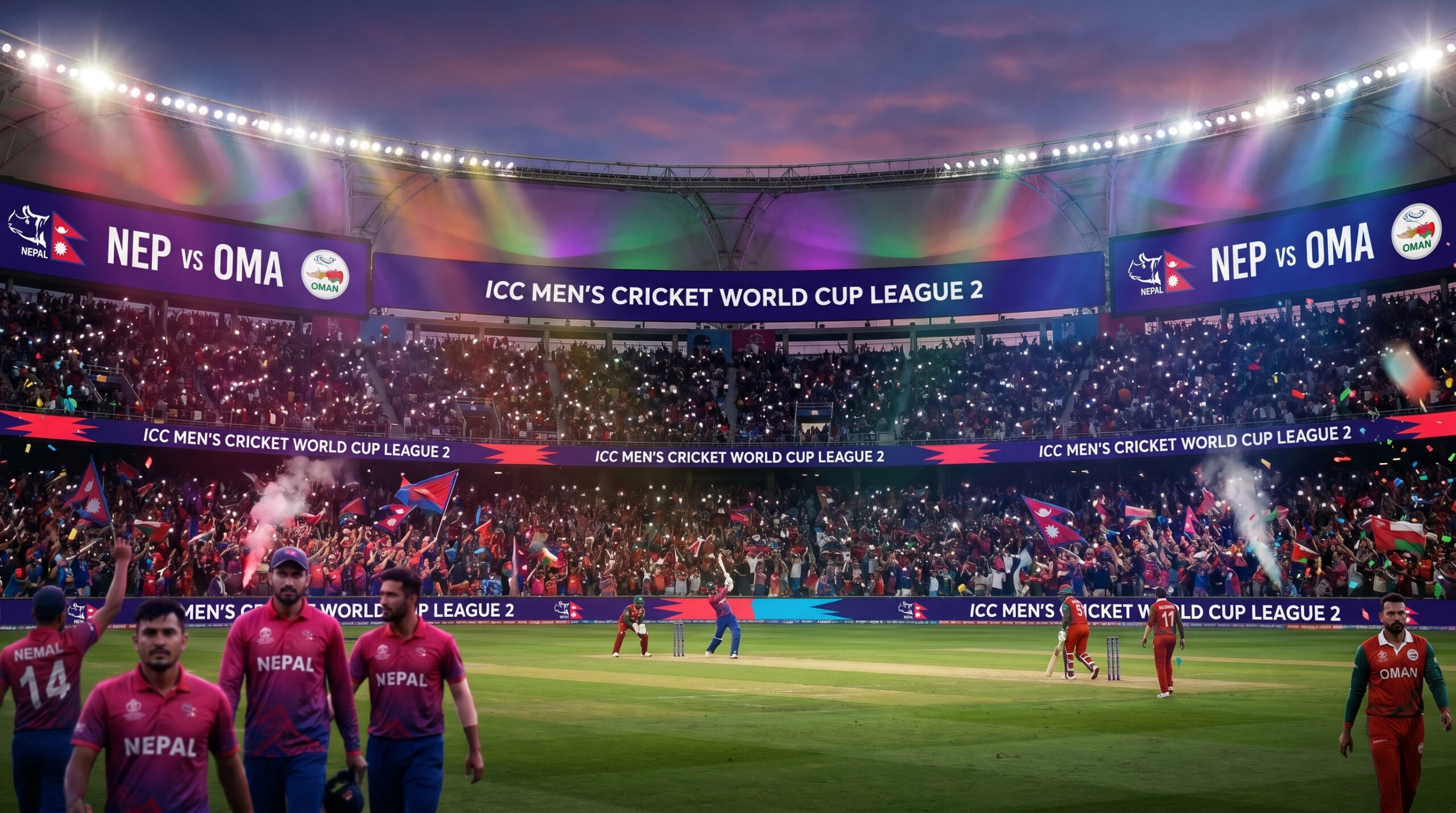
The encounter at the Tribhuvan University International Cricket Ground serves as a critical diagnostic of Nepal’s standing within the 2023-2027 ICC Men’s Cricket World Cup League 2 cycle. Nepal’s decision to bat first constitutes a calculated attempt to dictate the match tempo, leveraging home-ground familiarity to offset the volatility of morning atmospheric conditions. While the Kirtipur venue offers a psychological advantage, it also imposes a high-performance mandate on the national side to maximize points during home tri-series, where the margin for error in the qualification marathon is negligible.
Quantifying Top-Order Execution
Data from the initial 20 overs reveals a tension between the team’s stated ‘aggressive posture’ and tactical reality. Reaching 82/1, the partnership between Aasif Sheikh (46 off 59) and Arjun Kumal (35 off 60) prioritized wicket preservation over strike-rate acceleration. This foundational stability was a necessary countermeasure to Oman’s opening attack, which exploited early swing and 60% humidity. However, vice-captain Dipendra Singh Airee’s public critique of scoring distribution suggests an internal awareness of an ‘asymmetric dependency’—a structural bottleneck where the middle order is frequently exposed to high-leverage situations due to a lack of deep-innings conversion from the top flight.
Defensive Discipline and Institutional Constraints
Oman’s tactical response, spearheaded by Nadeem Khan and Siddharth Bukkapatnam, emphasized ‘containment logic.’ By restricting the 19th and 20th overs to singles and dot balls, Oman effectively disrupted Nepal’s rhythm, testing their patience in a middle-over squeeze. Compounding this competitive friction is the absence of a TV Umpire, leaving adjudication entirely to on-field officials Durga Subedi and Prageeth Rambukwella. In an Associate ecosystem where a single LBW decision can pivot a four-year qualification trajectory, this technological deficit introduces a layer of systemic volatility that teams must navigate as a secondary environmental variable.
Commercial Distribution and Long-Term Trajectory
The match’s reliance on digital-first streaming (e.g., FanCode) reflects the current commercial fragmentation of Associate-level cricket. This distribution model, while capturing core demographics, underscores the challenge of scaling high-engagement local markets into global commercial assets. As Match 103 of this cycle, the fixture is less about individual statistics and more about ‘points-swing dynamics’; a victory for Nepal serves as a corrective for previous losses, while Oman’s disciplined 50-over execution reinforces their status as a benchmark for consistency in the League 2 hierarchy.