
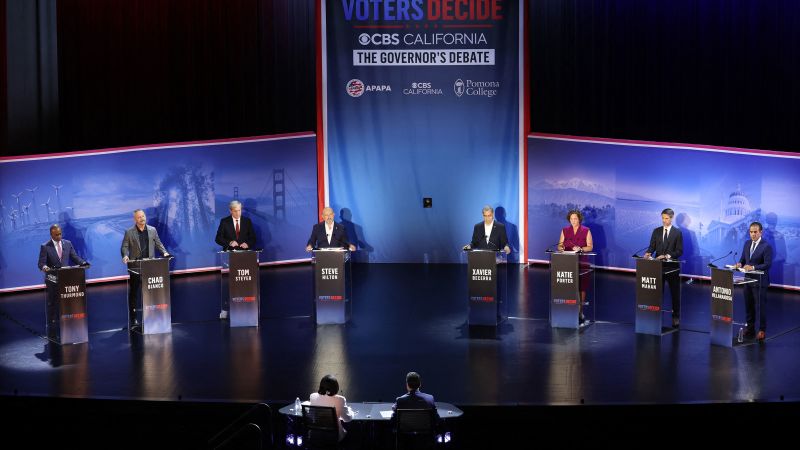
California Gubernatorial Debate Highlights Shifting Political Landscape
The recent California gubernatorial debate convened eight candidates, revealing a dynamic and competitive electoral environment. The event served as a crucial platform for contenders to articulate their policy visions, especially concerning the pressing issue of affordability, as they address an electorate seeking tangible solutions.
The debate’s timing, following former Rep. Eric Swalwell’s withdrawal, strategically repositioned the race. Swalwell’s exit created a vacuum, prompting remaining candidates to intensify efforts to consolidate support, absorb his voter base, and secure donor networks, thereby sharpening the competition for a distinct electoral pathway.
Frontrunner Emergence and Strategic Counter-Offensives
Xavier Becerra, formerly US Health and Human Services Secretary, has demonstrably gained momentum in the gubernatorial race, indicated by a notable rise in recent polling. This suggests a consolidation of support positioning him as a leading contender.
Becerra’s campaign has also experienced a significant increase in fundraising, enhancing operational capacity and resource allocation for expanded outreach, infrastructure development, and targeted messaging across California’s diverse media markets.
Furthermore, an increasing number of endorsements signal institutional backing and coalition strength, lending credibility and potentially mobilizing specific voter blocs to reinforce his perceived viability and broad appeal.
However, Becerra’s prominence has concurrently made him a primary target for opponents. This is a predictable consequence of frontrunner status, as rival campaigns strategically focus resources on challenging the perceived leader to disrupt momentum and create opportunities for their own advancement.
Billionaire investor and candidate Tom Steyer has notably escalated this competitive pressure through targeted attack ads against Becerra. This significant financial investment in negative campaigning represents a strategic effort to shape public perception, undermine Becerra’s narrative, and introduce voter skepticism regarding his qualifications or policy positions.
The strategic deployment of such advertisements forces the targeted campaign into a reactive posture, requiring resource allocation for defense and rapid response. This can divert attention and capital from proactive messaging, impacting the campaign’s ability to control its narrative and maintain consistent communication with its base.
Debate Dynamics and Candidate Differentiation in a Crowded Field
The 90-minute debate, held in Claremont, featured two Republicans and six Democrats, complicating individual candidate efforts to achieve a definitive breakout moment due to fragmented airtime and focus.
The presence of numerous contenders from both major parties meant candidates engaged in both ideological sparring and intense intra-party competition. This internal struggle for differentiation is particularly acute among the six Democratic candidates, each vying to articulate a unique value proposition to a shared progressive or centrist base.
Candidates including Riverside County Sheriff Chad Bianco, former Fox News host Steve Hilton, San Jose Mayor Matt Mahan, and former US Rep. Katie Porter sought to leverage the debate platform to distinguish their platforms, reflecting the strategic imperative to carve out a distinct lane in a race demanding a balance of broad appeal and specific policy proposals.
The debate format, hosted by CBS News affiliates, provided significant media exposure but also presented challenges in message penetration. In a multi-candidate setting, concise, impactful statements and effective counter-arguments within strict time constraints are paramount.
Reported instances of candidates sparring with moderators underscore the high stakes and intense pressure of televised events, potentially reflecting attempts to regain narrative control, challenge perceived biases, or express frustration, all influencing public perception of their temperament and leadership.
Operational and Strategic Implications of an Unsettled Race
The characterization of the field as “unsettled” carries significant operational and strategic implications, suggesting a lack of clear frontrunner consensus that necessitates continuous adaptation of campaign strategies, resource allocation, and messaging to respond to evolving voter preferences and competitive maneuvers.
For campaigns, an unsettled field heightens the need for robust data analytics to identify emerging voter segments and refine targeting. This translates to agile communications strategies capable of pivoting quickly in response to new poll data, opponent attacks, or shifts in public discourse, thereby maximizing competitive leverage.
The ongoing struggle for candidates to “carve out a lane” highlights the strategic imperative of differentiation in a crowded electoral landscape. This involves not only articulating distinct policy positions but also cultivating a unique brand identity that resonates with specific voter demographics and distinguishes them from a broad field of contenders.
The issue of affordability, central to the debate, serves as a potent strategic battleground reflecting widespread economic concerns across California. Candidates’ approaches to housing costs, consumer prices, and economic opportunity will be critical in shaping their appeal to a diverse electorate grappling with the state’s high cost of living.
The financial implications of a protracted and unsettled race are substantial, requiring sustained fundraising to maintain campaign viability. The ability to continually attract donor support, particularly from well-resourced individuals like Tom Steyer, becomes a decisive factor in sustaining competitive operations.
Furthermore, the debate’s role in shaping media narratives is critical, as news coverage and analysis influence public perception and candidate visibility. Campaigns’ ability to generate positive media attention, manage negative portrayals, and effectively communicate core messages through various outlets directly impacts their electoral prospects.
Institutional Context and Future Trajectories
The California gubernatorial race, set against the backdrop of the state’s immense economic and demographic significance, carries profound institutional implications. The outcome will determine the leadership of a global economic powerhouse, influencing policy directions on issues ranging from climate change and technology regulation to social welfare and infrastructure development.
The competitive dynamics observed, including the rise of a frontrunner and subsequent strategic attacks, are indicative of the intense political maneuvering typical in high-stakes elections. These early campaign stages are crucial for establishing momentum, building coalitions, and testing messaging that will define the broader electoral contest.
The engagement of a diverse field of candidates, representing various political ideologies and professional backgrounds, reflects the multifaceted nature of California’s political landscape. Each candidate contributes unique experiences and perspectives to the public discourse, even as they compete for limited political capital and voter attention.
The strategic deployment of capital, exemplified by Tom Steyer’s attack ads, underscores the financialized aspect of modern political campaigns. The capacity to fund extensive advertising, conduct polling, and build robust ground operations often correlates with a candidate’s ability to effectively compete and project their message across a large and diverse state.
Looking ahead, the race’s trajectory will be heavily influenced by how Becerra manages increased scrutiny and attacks, and how other candidates effectively differentiate themselves. The ability to adapt to evolving competitive pressures and communicate a compelling vision for California will be paramount for all contenders.
Ultimately, the debate serves as a microcosm of broader political forces, revealing the strategic decisions, financial investments, and competitive dynamics that shape electoral outcomes. The ongoing evolution of this race offers insights into modern political campaigning and the challenges of governing a complex, influential state.

Photo by mibro on Pixabay.