
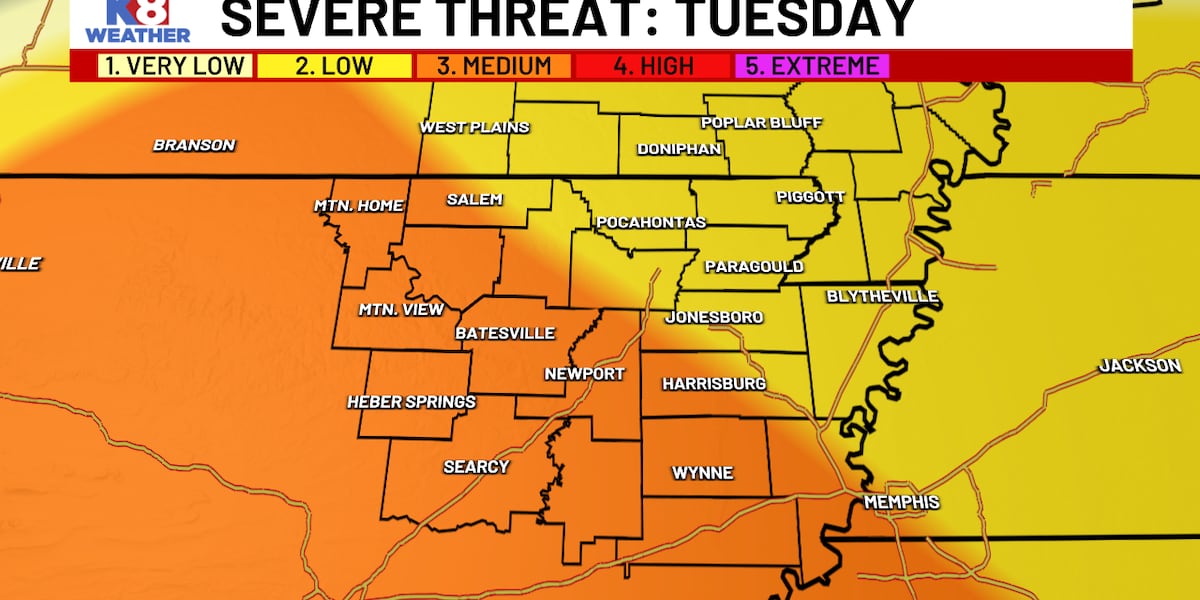
Strategic Implications of the Level 3 Meteorological Designation
The classification of the current Arkansas weather event as a Level 3 (Enhanced) threat represents a quantitative threshold for institutional emergency management. This medium-threat designation mandates a transition from passive observation to active operational mitigation for stakeholders in Region 8. Such categorization indicates high confidence in storm organization, which correlates directly with heightened insurance liability and potential disruption to the regional supply chain. For institutional actors, this status triggers specific protocols regarding resource staging and personnel safety, focusing on the Jonesboro corridor’s ability to withstand atmospheric instability.
Temporal Risk and Operational Constraints
The projected six-hour window—spanning from 1 p.m. to 7 p.m.—intersects with the region’s peak economic and social activity. This timeframe overlaps with the end of the school day and the afternoon commute, creating a high-density risk environment for mobile populations. Strategically, this window restricts pre-event mitigation capabilities, forcing logistics and transport networks to weigh the costs of operational suspension against the physical risks of large hail and damaging winds. The duration of this volatility suggests a sustained strain on emergency response systems should multiple incidents coincide.
Capital Exposure: Hail and Wind as Economic Volatility Factors
The identification of large hail and high-velocity winds as primary hazards establishes a specific financial loss profile. Hail represents a significant volatility factor for the insurance sector, typically manifesting in high-frequency claims for automotive and roofing assets. Concurrently, sustained wind gusts target the integrity of the regional power distribution grid and older commercial structures. Stakeholders must account for secondary costs related to business interruption and grid instability, which often extend beyond the immediate atmospheric clearance as utility providers move into reactive restoration postures.
Digital Resilience and IoT Emergency Protocols
The K8 Storm Team’s multi-platform strategy reflects a shift in emergency broadcasting toward digital resilience. By integrating traditional over-the-air signals with streaming services (Roku, FireTV, Apple TV), the infrastructure addresses audience fragmentation. A critical technical directive—the recommendation to reboot streaming hardware and smartphones—addresses vulnerabilities in the Internet of Things (IoT) environment. These reboots clear cached data and stabilize network connections, ensuring that push notifications are not delayed by software latency during the critical 1 p.m. to 7 p.m. window.
Institutional Authority and Communication Redundancy
The collaborative branding of the Arkansas Storm Team functions as a mechanism for institutional authority. The ‘Alert Day’ nomenclature serves as a strategic signal, elevating the forecast to a prioritized safety event to trigger pre-planned protocols in industrial and healthcare facilities. Furthermore, the reliance on redundant communication pathways—cable, satellite, and cellular—ensures a fail-safe against localized infrastructure failures. This systematic approach prioritizes the delivery of actionable intelligence over specific medium preferences, maintaining the continuity of the regional safety framework.
Photo by Roseley14 on Pixabay.