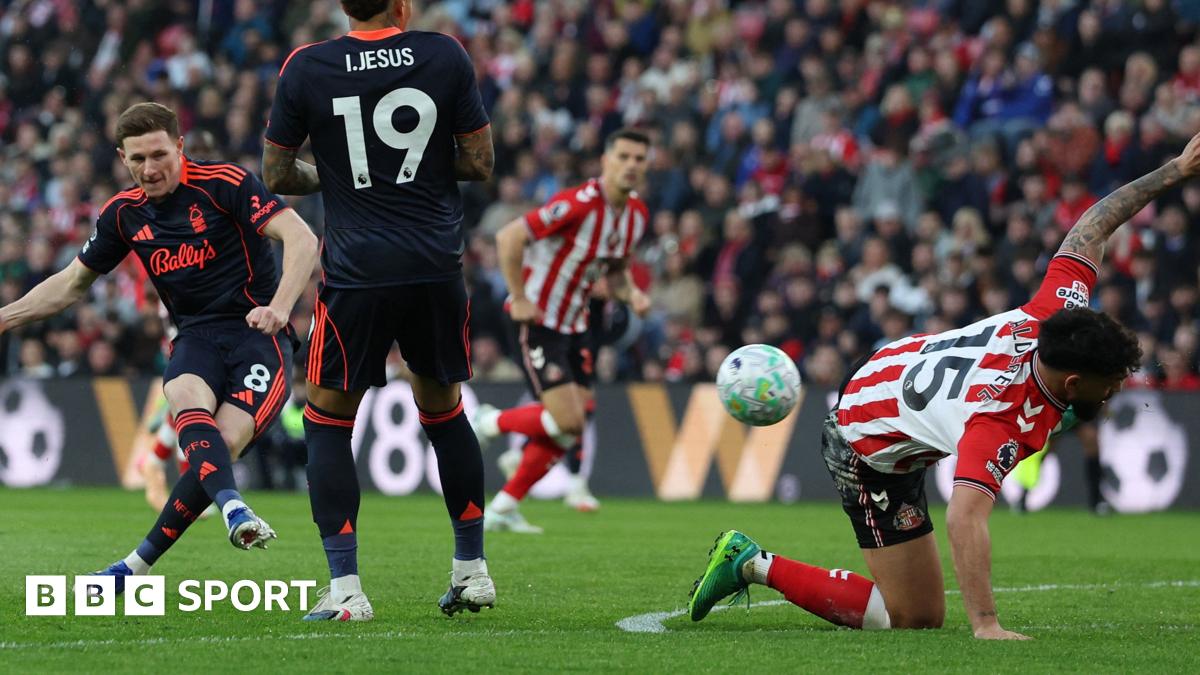
The Premier League encounter between Sunderland and Nottingham Forest at the Stadium of Light serves as a critical case study in tactical adaptation. This fixture, the first home league meeting for Sunderland against Forest since 2017, highlights the divergence in squad depth and defensive philosophy between two clubs currently grappling with consistency in the 2025-26 campaign.
Defensive Correctives: The Ballard-Hume Integration
Sunderland’s decision to drop Luke O’Nien and Reinildo for Dan Ballard and Trai Hume is a reactive structural adjustment following the 4-3 capitulation against Aston Villa. Statistically, the four goals conceded in that single fixture accounted for nearly 10% of Sunderland’s total goals against for the season, necessitating a shift toward Ballard’s superior aerial presence and Hume’s recovery speed. This overhaul aims to mitigate the volatility of a backline that has shown vulnerability during high-speed transitions.
Operating within a 4-2-3-1, the double-pivot of Granit Xhaka and Sadiki is tasked with neutralizing the ‘Zone 14’ creative threat. Their primary objective is to maintain vertical compactness, preventing Nottingham Forest’s attacking midfielders from exploiting the gaps that emerged during the Villa defeat.
The Murillo Dependency and Forest’s Operational Risk
Nottingham Forest’s defensive metrics undergo a significant degradation in the absence of Murillo. Historical data confirms a high correlation between his unavailability and Forest’s inability to secure points, with the club managing only one victory in the last nine matches he has missed. The integration of Jair Cunha into the starting XI represents a high-exposure risk, particularly in managing the build-up play usually orchestrated by Murillo.
Offensively, the promotion of Igor Jesus to a starting role alongside Chris Wood signals an intent to capitalize on Sunderland’s specific defensive flaw: a susceptibility to long-range efforts and secondary balls. With Morgan Gibbs-White averaging 2.9 shots per 90 minutes, Forest will likely prioritize high-volume shooting to test Sunderland’s restructured central pairing.
Statistical Anomalies and Scheduling Pressures
Institutional pressure is compounded by Sunderland’s historical ‘Friday night’ deficit. The club remains winless in the Premier League on this specific day across three previous attempts. Overcoming this psychological hurdle is essential for a side that ranks second-lowest in the league for total goal involvement (trailing only Crystal Palace), suggesting that a single defensive lapse often dictates the final result.
While Forest has historically struggled at the Stadium of Light—losing five of their last six league visits—their recent form of two wins in three matches suggests an upward trajectory. However, the tactical symmetry of both sides employing a 4-2-3-1 suggests that the outcome will hinge on individual duels, specifically the ability of Sunderland’s Brian Brobbey to exploit Cunha’s lack of match rhythm in the absence of Murillo’s leadership.