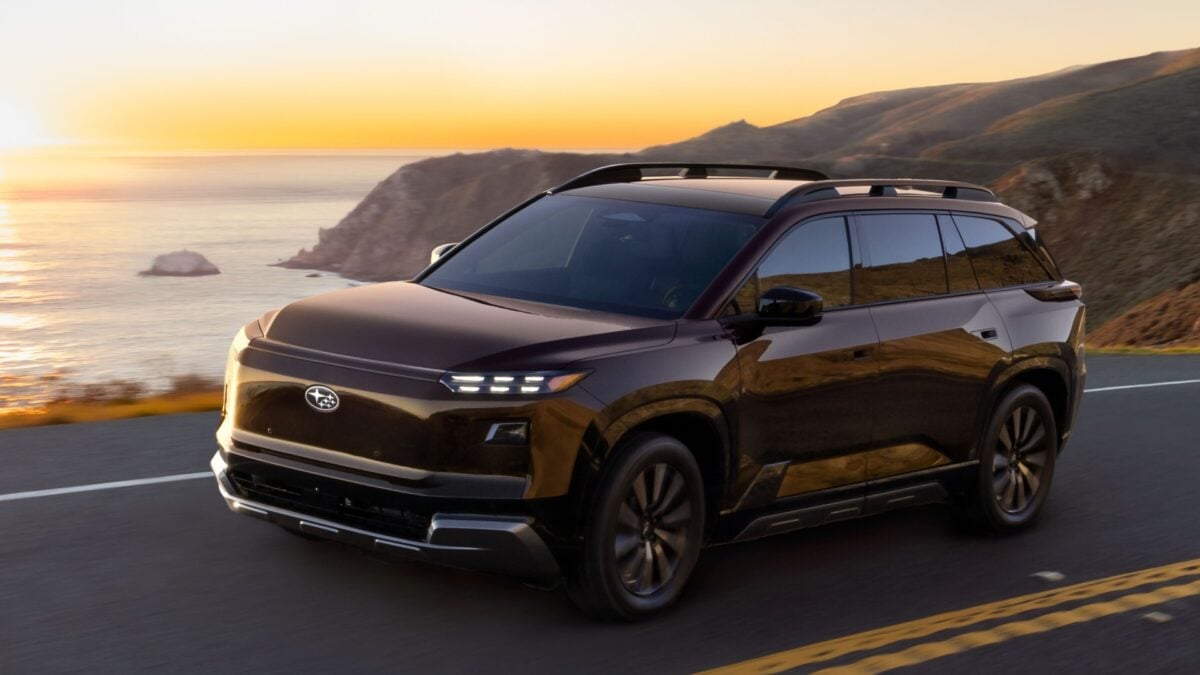
The unveiling of the 2027 Subaru Getaway at the New York International Auto Show signifies a critical evolution in Subaru’s capital allocation strategy and its collaborative framework with Toyota. By launching its fourth electric vehicle in four years, Subaru achieves ‘portfolio parity,’ providing an electric alternative to each of its legacy internal combustion engine (ICE) SUVs. This aggressive expansion utilizes Toyota’s manufacturing scale, allowing Subaru to concentrate its R&D on brand-specific drivetrain calibration and chassis tuning.
Competitive Differentiation via Performance Engineering
While the Getaway utilizes the same 95.8-kWh battery and architecture as the 2027 Toyota Highlander EV, the two models target distinct market tiers. Subaru’s standard dual-motor configuration delivers 420 horsepower—an 82-hp surplus over the Toyota variant. This performance delta serves as a strategic tool to justify a premium brand position within the crowded three-row segment. By bypassing Toyota’s 221-hp single-motor entry-level configuration, Subaru reinforces its institutional commitment to an all-wheel-drive-only lineup, preserving the mechanical expectations of its enthusiast base.
Technical Specifications and Off-Road Capability
The Getaway is engineered for rapid torque delivery, achieving 0-60 mph in under five seconds. Beyond straight-line speed, Subaru has integrated its proprietary X-MODE Dual-Mode system to manage software-defined traction control in rugged environments. Maintaining 8.3 inches of ground clearance is a pivotal structural decision that balances off-road credibility with the aerodynamic constraints of a high-riding EV. With a 3,500-pound towing capacity and a 300-mile range, the Getaway prioritizes versatile utility over marginal efficiency gains.
Infrastructure Integration and Battery Strategy
The adoption of the North American Charging Standard (NACS) port is a tactical move to mitigate consumer anxiety regarding charging accessibility. Supporting 150-kW peak DC fast charging, the Getaway can replenish from 10% to 80% in approximately 30 minutes. While some competitors pursue higher peak rates, Subaru’s 150-kW ceiling suggests a conservative thermal management strategy designed to maximize the long-term health of the 95.8-kWh battery pack. Furthermore, a planned 77-kWh variant arriving later in 2027 indicates a tiered pricing strategy intended to capture high-volume fleet and suburban markets.
Market Outlook and Institutional Impact
For Subaru, the Getaway is a defensive necessity against shifting zero-emission mandates. The partnership with Toyota provides an operational cushion, allowing Subaru to scale EV production without the prohibitive capital expenditure of independent factory development. By outperforming the Highlander EV on paper, Subaru creates a narrative of added value through engineering modifications. As the 2027 model year approaches, the Getaway’s success will be measured by its ability to transition brand purists to a software-defined torque-vectoring ecosystem while maintaining the rugged identity that defines the brand.