
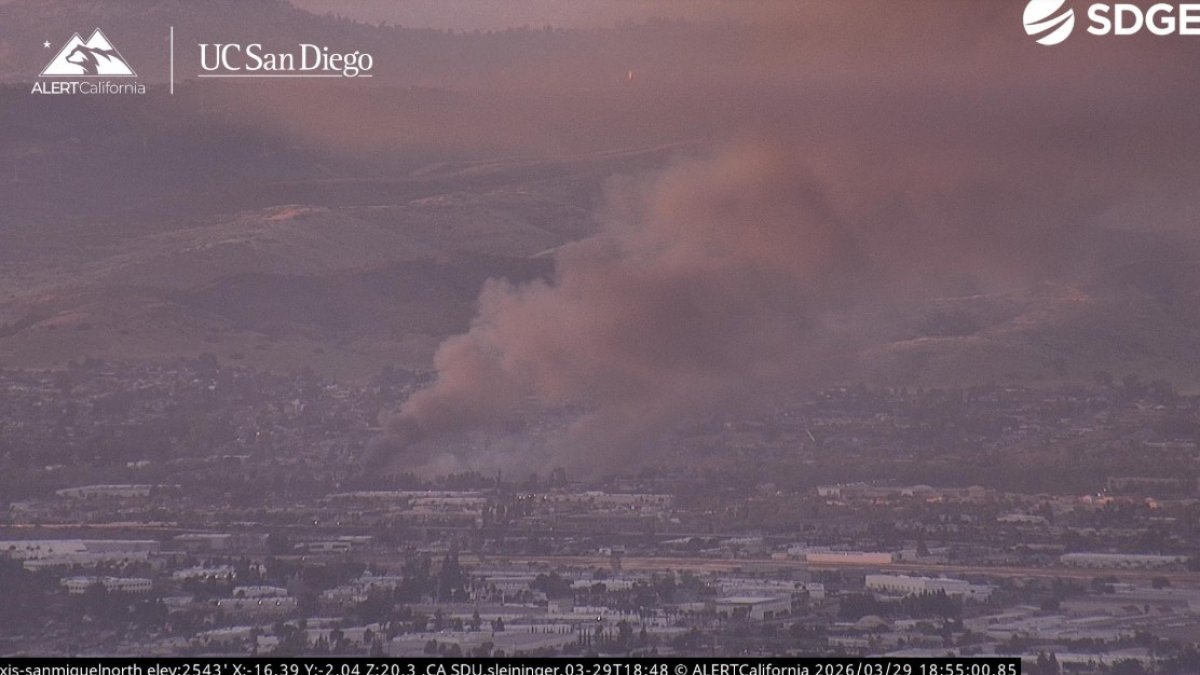
The activation of emergency protocols for the vegetation fire near River Rock Court in Santee, emerging shortly after 6:30 p.m., immediately revealed critical operational constraints at the jurisdictional interface between the Santee Fire Department (FD) and the San Diego Sheriff’s Department (SDSO).
The incident’s timing, coinciding with peak evening commercial activity, mandated rapid asset prioritization, juxtaposing immediate life safety mandates against maintaining economic continuity for high-value commercial assets.
Operational Escalation and Jurisdictional Interface
Initial response mobilization, routed through the SDSO, highlights the systemic reliance of smaller municipal fire entities on county-level law enforcement for perimeter security and large-scale public notification during emergent, large-footprint incidents.
The fire’s location adjacent to the San Diego River corridor and Town Center Parkway positioned the incident directly within a complex Wildland-Urban Interface (WUI) zone, where established vegetation management standards directly conflict with high-density commercial infrastructure, complicating suppression and containment geometry.
Commercial Exposure and Targeted Evacuation Strategy
The directive to evacuate specific commercial anchors, notably Walmart and Michaels, signifies a risk matrix that weighted immediate life safety for transient populations over the disruption of high-volume retail operations. This targeted vectoring away from residential zones suggests the fire’s immediate spread potential was assessed as higher threat to exterior commercial access points.
The financial impact of evacuating major commercial anchors extends beyond immediate revenue loss, imposing strains on regional supply chain logistics and localized employment continuity dependent on those operational hours.
Resource Allocation and Incident Command Synergy
The Santee FD’s commitment of initial attack resources immediately stressed local operational readiness, necessitating the activation of mutual aid agreements to backfill routine municipal coverage.
The SDSO’s centralization of public access and traffic control was a strategic maneuver to insulate specialized fire assets from public interference, allowing singular focus on suppression efforts. The concurrent management of the ‘Town Center Fire’ alongside the ‘Border 2 Fire’ county-wide underscores a multi-front operational challenge demanding sophisticated, cross-jurisdictional resource optimization.
Information Velocity and Media Integration
The immediate integration of 24/7 streaming news platforms (e.g., NBC 7) into emergency communication reflects the modern acceleration of information dissemination, bypassing traditional broadcast windows but simultaneously elevating the risk of rapid, unverified data proliferation.
The primary control measure—a public advisory to avoid the area—is designed to prevent secondary incidents arising from unauthorized access or interference with emergency apparatus staging and movement corridors.
Strategic Implications of Riparian Fuel Continuity
The fire’s origin within the San Diego River riparian corridor is structurally significant. These zones serve as high-continuity fuel pathways, capable of accelerating fire spread independent of immediate urban meteorological conditions. This geography mandates suppression tactics centered on immediate defensible space creation along the riverbank.
WUI Vulnerability and Insurance Modeling
Commercial zones situated immediately adjacent to natural fuel breaks inherently carry elevated insurance risk profiles. This proximity increases operational overhead for businesses and subjects them to higher underwriting scrutiny.
The external threat posed by unmanaged vegetation directly tests the resilience of the internal fire suppression systems within these large retail structures. The incident’s ‘developing’ status confirms that containment lines remain unverified, keeping the structural integrity of the commercial park contingent on resource saturation and immediate weather shifts.
Inter-Agency Protocol Stress Testing
The coordinated deployment between Santee FD (suppression) and SDSO (public safety/perimeter) provided a high-fidelity stress test for established Regional Emergency Operations Plans (EOPs). The efficiency of data exchange regarding evacuation boundaries and containment status is a direct metric of EOP robustness, crucial for minimizing economic downtime.
Discrepancies in messaging between perimeter control and operational updates can cause systemic friction, eroding public confidence in the unified command structure.
Economic Ripple Effects and Stakeholder Risk Assessment
The immediate evacuation of primary retail anchors generates a localized economic vacuum, redirecting consumer demand to unaffected competitor centers. Affected businesses must deploy continuity plans addressing inventory security, employee welfare coordination, and rapid post-containment damage assessment.
Capital Exposure and Underwriting Impact
The event will trigger immediate claims across commercial property and business interruption insurance lines, influencing future underwriting models for properties sharing similar WUI risk profiles across the county.
Prolonged closures shift financial exposure from immediate physical damage to sustained revenue contraction, impacting the lending institutions underwriting the affected commercial entities.
Regulatory Scrutiny and Land Use Review
Significant WUI incidents proximate to major commercial hubs invariably trigger subsequent reviews of municipal zoning ordinances and existing defensible space mandates.
Stakeholders, including municipal bondholders, will scrutinize the documented adherence to pre-existing vegetation management regulations along the river corridor. The concurrent management of the Border 2 Fire suggests a systemic vulnerability across the county’s interface zones, likely driving capital reallocation toward comprehensive fire mitigation infrastructure.
Digital Information Control
The reliance on streaming news positions the media outlet hosting the stream as the temporary situational authority, significantly shaping public perception of response efficacy. Any noted failure in automated data ingestion (‘SCRAPE_FAILED’) indicates fragility in automated situational awareness systems, creating informational voids that official channels must aggressively fill to maintain narrative control.
Institutional Continuity and Preparedness Benchmarking
The initial success in avoiding residential evacuations validates the tactical deployment decisions that prioritized containment vectoring away from housing tracts. However, the sustained presence of SDSO implies the command anticipates a prolonged operational footprint due to the extensive mop-up required for vegetation fires.
Impact of ‘Developing’ Status
The ‘developing story’ designation confirms the incident remains in a high operational tempo phase, mandating maximum readiness across all responding agencies. This status limits resource availability for other county needs until formal perimeter control is declared.
The open-ended public advisory creates sustained uncertainty affecting commuter flow and local commerce until specific reopening parameters are formally established.
Systemic WUI Management Lessons
The Santee event provides essential real-time data validating the effectiveness of current county preparedness for riparian corridor fires adjacent to high-value commercial assets. Operational success is defined by the seamless procedural transition between law enforcement (public interface) and fire services (hazard mitigation).
Future capital planning for fire suppression technology and vegetation contracts in San Diego County will benchmark against the resource expenditure required for this specific Town Center Fire. The interplay between Santee FD’s initial attack capability and SDSO’s logistical support defines the operational leverage available when incidents cross municipal lines or involve high commercial density, providing a critical constraint evaluation for regional emergency planners.

Photo by timmossholder on Pixabay.