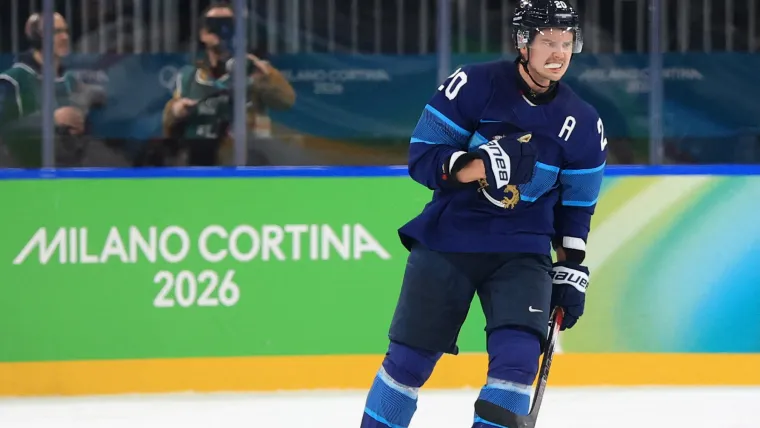
The 2026 Winter Olympics in Milano Cortina signify a structural shift for international ice hockey, reinstating NHL participation as the standard for excellence. For Team Finland, the tournament is a definitive test of their developmental philosophy. Tasked with defending a 2022 gold medal won without NHL talent, the Finnish Ice Hockey Association must now reconcile their disciplined, system-oriented play with a roster almost exclusively populated by North American professionals. This transition hinges on the health and output of high-ceiling assets like Kaapo Kakko.
The Kakko Variable: Recovery and ROI
Kaapo Kakko’s inclusion in the 2026 roster represents a calculated risk-reward scenario for both the national program and the Seattle Kraken. Following a season disrupted by upper and lower-body injuries, Kakko’s Olympic performance serves as a high-leverage conditioning window. For Kraken GM Jason Botterill, the tournament provides elite-level competition that can catalyze Kakko’s form ahead of the NHL postseason. Statistically, Kakko’s early tournament production suggests he has successfully mitigated the rust of a 20-game mid-season absence, positioning him as a primary offensive engine for the Finnish attack.
The ‘Gel’ Factor: Institutional Continuity
Finland’s primary competitive advantage—often termed the ‘gel’ factor—is rooted in systemic cohesion rather than individual star power. Unlike the high-turnover rosters of Canada or the U.S., the Finnish squad benefits from a shared pedagogical lineage. This institutional continuity, developed through the U18 and U20 national programs, allows for the implementation of complex tactical systems with minimal lead time. In a short-format tournament where practice windows are scarce, this ability to execute deep-seated zone-exit strategies and defensive rotations provides a critical operational edge against technically superior opponents.
Validating the 2022 Legacy
While the 2022 gold medal remains Finland’s peak achievement, its legacy is often scrutinized due to the lack of NHL participation. The 2026 Games serve as a reputational necessity to validate the Finnish system in a ‘best-on-best’ environment. Success in Milano Cortina would prove that the nation’s focus on defensive reliability and transition speed is scalable to the highest professional level. The defensive core, anchored by NHL veterans like Olli Maatta and Henri Jokiharju, reflects an evolution toward a more mobile, puck-moving identity necessary to counter North American speed.
Operational Risks and Club Exposure
The reintroduction of NHL players necessitates a delicate balance between national pride and franchise liability. For Seattle, the physical expenditure of Kakko’s Olympic run presents a fatigue management challenge. The condensed post-Olympic NHL schedule leaves little room for recovery, meaning the strategic gains of a ‘battle-tested’ forward must be weighed against the risk of secondary injuries. However, the media and market implications are significant; for a younger franchise like the Kraken, Kakko’s international visibility strengthens the club’s global brand and reinforces its commitment to elite player development.
Conclusion: A Systemic Stress Test
As Finland enters the elimination rounds, specifically a high-stakes semifinal against Canada, the focus shifts to tactical discipline versus offensive depth. The outcome will determine if the Finnish model can withstand the pressure of an NHL-saturated field. By integrating top-tier talents like Kakko into a rigid, historically proven framework, Finland remains a perennial contender, seeking to bridge the gap between their non-NHL past and their professionalized future.