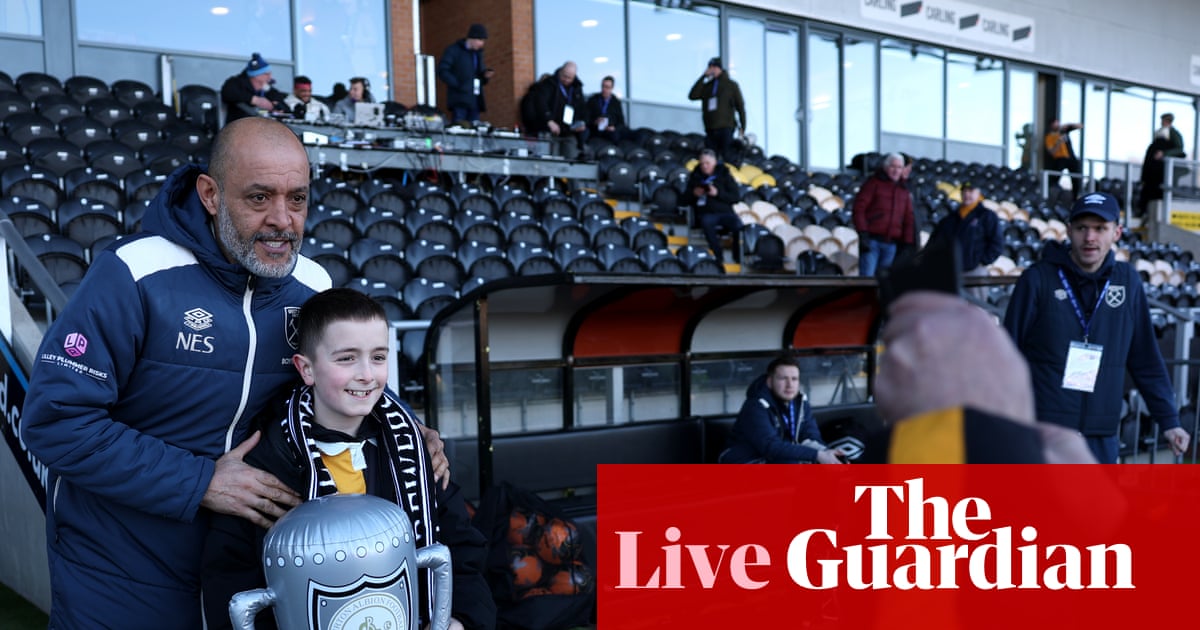
West Ham manager Nuno Espirito Santo’s decision to implement ten alterations for the FA Cup fourth round tie against Burton Albion, following a competitive 1-1 draw with Manchester United, serves as an unambiguous operational directive: Premier League survival supersedes early-stage cup progression.
Calculus of Resource Allocation: League Security vs. Cup Ambition
The conspicuous resting of primary assets, including Jarrod Bowen, reflects a rigorous institutional calculus. The marginal utility derived from advancing in the FA Cup is outweighed by the critical necessity of maintaining Premier League solvency. For a club navigating mid-table fragility, the FA Cup fixture is immediately reframed as a high-value performance audit rather than a primary objective demanding full deployment.
This rotation strategy is a calculated stress test on squad depth. It transforms the fixture into an evaluation crucible for fringe players. The debut of January acquisition Keiber Lamadrid, alongside six academy prospects (including Finlay Herrick, Josh Briggs, Lewis Orford, Josh Ajala, and Ezra Mayers), confirms this objective: integrating new signings and assessing youth readiness under competitive duress without risking core team fatigue or injury.
Performance Benchmarking for Fringe Assets and Contract Leverage
For players like Lamadrid, this match provides critical inflection points for valuation. Contractual obligations regarding loan spells (as mandated for Lamadrid’s debut) force Nuno to balance integration requirements against tactical coherence. Adequate performance against Premier League opposition, even a rotated unit, provides tangible leverage for future contract negotiations, transcending standard domestic league metrics.
The inclusion of Mohamadou Kante and Adama Traore making their first starts further indicates an active stress-test of reserve capacity, essential for managing hypothetical simultaneous domestic and European commitments.
Burton Albion’s Asymmetric Opportunity and Narrative Weaponization
Burton Albion manager Gary Bowyer explicitly framed the tie as a high-profile developmental and morale opportunity, referencing the club’s seminal 2006 draw with Manchester United. This reference is a calculated psychological maneuver.
Bowyer seeks to ‘sow a seed of doubt’ by weaponizing historical precedent and exploiting potential complacency in a heavily rotated opponent. The structural asymmetry is clear: West Ham mitigates risk via conservation; Burton maximizes opportunity through heightened motivation derived from narrative leverage. For League One sides, the financial and morale capital generated by successful cup exploits—or even competitive performances—provides operational flexibility rarely afforded by their league standings (currently 21st).
Divergent Operational Objectives and Performance Metrics
Operational goals are fundamentally divergent. Burton’s tactical blueprint involves maximizing physical confrontation and slowing tempo to negate technical disparity. Conversely, West Ham’s success metrics will focus less on the final scoreline and more on individual execution, tactical adherence from the unfamiliar unit, and successful workload management for key personnel. The lone survivor from the previous fixture, Konstantinos Mavropanos, acts as a necessary defensive anchor or an example of low-risk sustained load.
Burton’s concentrated offensive threat, driven by Tyrese Shade (5 FA Cup goals) and Fabio Tavares (3 goals in 3 games), dictates that West Ham’s rotated defense must neutralize this focal point early. Failure to do so rapidly shifts the narrative towards managerial miscalculation regarding competitive readiness.
Stakeholder Exposure and Institutional Integrity
For West Ham stakeholders, the primary risk is not elimination, but the failure of rotated players to demonstrate competence, thereby exposing deficiencies in the club’s recruitment pipeline or reserve quality. Conversely, if the youth contingent performs convincingly, it validates the academy investment, potentially reducing future reliance on high-cost external acquisitions.
The match also functions as a crucial element of Nuno’s succession planning—testing the organizational capacity for seamless transitions amidst fixture congestion. The differing pressures—Premier League security versus League One stability—define the strategic incentives driving both management teams toward the 12:15 GMT kickoff.