
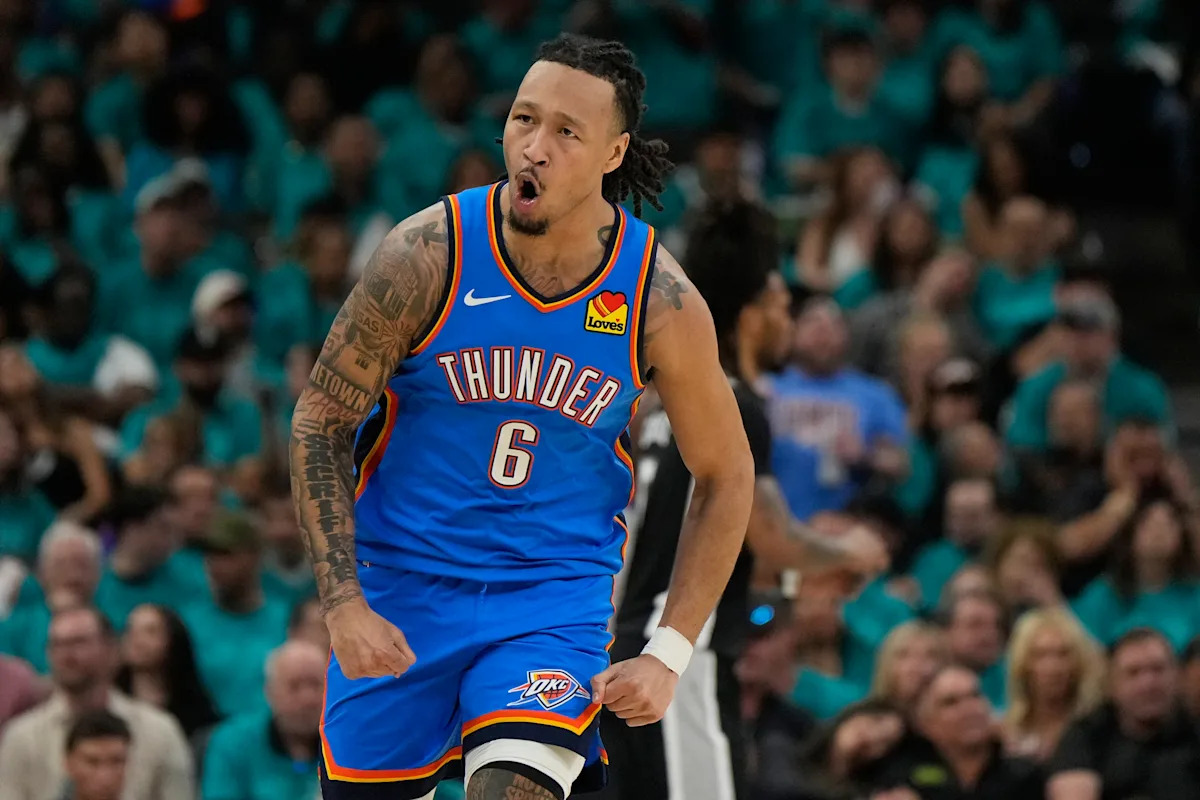
The 2026 Western Conference Finals have reached a state of tactical equilibrium, characterized by a fundamental divergence in roster construction. The 2-2 series deadlock between the San Antonio Spurs and the Oklahoma City Thunder represents a collision between top-heavy elite efficiency and distributed rotational depth. As the series pivots to Game 5, the primary analytical focus shifts from individual star-power to the operational resilience of secondary units.
Game 3 serves as the series’ statistical outlier and a case study in asymmetric depth. Despite a 15-0 opening salvo by San Antonio’s starters, Oklahoma City’s second unit—anchored by Alex Caruso, Jared McCain, and Cason Wallace—orchestrated a 123-108 reversal. The Thunder’s bench accounted for an unprecedented 76 points, nearly doubling the 47-point output of their starters. This internal scoring redistribution allowed OKC to mitigate an inefficient shooting night from Shai Gilgeous-Alexander, who transitioned into a playmaking role, logging 12 assists to supplement his 26 points.
Conversely, the Spurs’ offensive architecture remains precariously reliant on their starting five. While the San Antonio starters generated a robust 85 points in Game 3, the bench produced a negligible 23. This disparity highlights a critical bottleneck for Coach Mitch Johnson: the inability to maintain defensive intensity and spacing when Victor Wembanyama or Dylan Harper rests. Despite Keldon Johnson’s Sixth Man of the Year credentials, the Spurs’ reserve units have struggled to navigate Mark Daigneault’s aggressive defensive rotations.
Wembanyama has framed this series through the lens of spatial geometry, likening the on-court maneuvers to a high-stakes chess match. This mental model is reflected in the coaching duel; Daigneault has successfully utilized his bench to exploit the Spurs’ lack of defensive depth, forcing San Antonio into sub-optimal rotation patterns. For the Spurs to reclaim the initiative, they must optimize the minutes of Dylan Harper and improve the marginal utility of their bench scoring to prevent late-game fatigue among the starters.
Organizationally, the series validates the Thunder’s long-term strategy of accumulating versatile, high-floor assets. Even in the absence of Jalen Williams, Oklahoma City’s system-oriented approach ensures performance stability. For San Antonio, the 2-2 tie signals their arrival as a premier contender, yet exposes the remaining structural gaps in their rebuild. As the series returns to Oklahoma City for Game 5, the advantage lies with the roster capable of sustaining 48 minutes of high-leverage execution without a drop-off in production.
Photo by admomediaoffice on Pixabay.