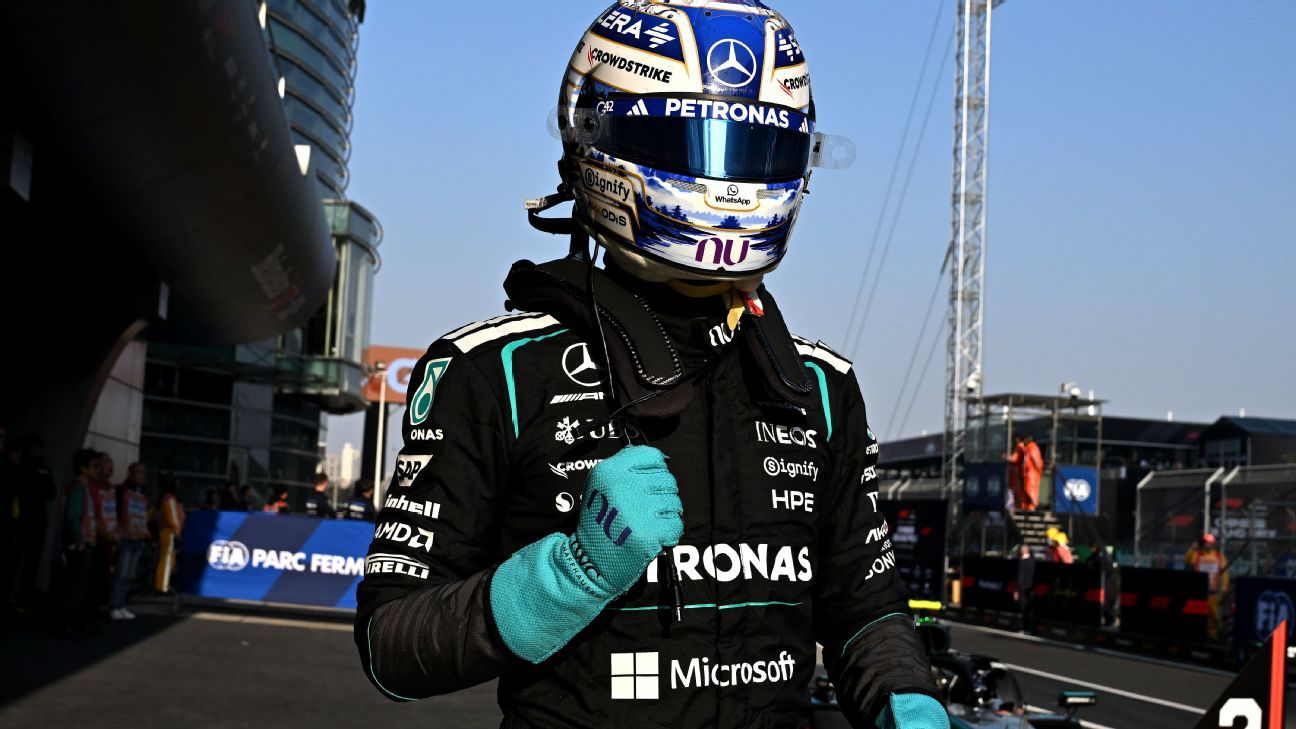
The 2026 Formula 1 season has reached a definitive technical inflection point at the Shanghai International Circuit. Qualifying for the Chinese Grand Prix Sprint has unveiled a significant performance divergence under the new regulatory framework, with George Russell’s pole-setting lap of 1:31.520 serving as a benchmark for the Silver Arrows’ successful integration of the 2026 power unit and aerodynamic mandates. This result validates Mercedes’ development trajectory, suggesting a mastery of energy deployment that currently eludes the rest of the grid.
The Architecture of Mercedes’ Technical Moat
The front-row lockout, bolstered by rookie Kimi Antonelli’s P2 (1:31.809), indicates that the W17 chassis possesses an exceptionally wide operating window. Antonelli’s ability to find pace within 0.289 seconds of his veteran teammate suggests an inherently stable platform, contrasting sharply with the volatile handling seen in rival machinery. Mercedes appears to have optimized the interplay between the increased electrical output and the revised active aero components, creating a systemic advantage in recovery and deployment efficiency. The 0.621-second gap to the nearest non-Mercedes car—Lando Norris’s McLaren—represents a massive margin in a sport typically defined by marginal gains.
McLaren and Ferrari: The Pursuit of Efficiency
McLaren continues its role as the primary challenger, with Lando Norris (1:32.141) and Oscar Piastri (1:32.224) securing third and fifth. However, the six-tenth deficit suggests a shortfall in peak aerodynamic efficiency or a more conservative energy mapping strategy for the high-speed Shanghai sectors. Meanwhile, Lewis Hamilton’s P4 for Ferrari (1:32.161) highlights a narrowing setup window for the Scuderia. While Hamilton maximized the SF-26 (implied) in low-grip conditions, Charles Leclerc’s P6—a full second off pole—points to a disparity in adapting to the 2026 braking and corner-entry dynamics, suggesting Ferrari is still grappling with fundamental balance issues.
Red Bull’s Regulatory Collapse
The session’s most staggering data point is the collapse of Red Bull Racing. Max Verstappen qualified eighth, a massive 1.734 seconds behind Russell. This deficit transcends minor setup errors; it signals a catastrophic failure to interpret the 2026 technical directives or a significant underperformance from the Red Bull Powertrains unit. Verstappen’s P8 start, adjacent to Haas’s Oliver Bearman, leaves the reigning champion vulnerable to mid-field volatility. With the cost cap restricting radical mid-season redesigns, Red Bull faces an existential threat to its competitive status if the RB22’s (implied) fundamental drag-to-power ratio cannot be rectified.
Mid-Field Volatility and the 2026 Learning Curve
The 2026 reshuffle has empowered mid-field innovators. Alpine’s Pierre Gasly secured P7 (1:32.888), out-qualifying both Red Bulls and demonstrating superior power unit integration. Haas also impressed with Oliver Bearman taking P9, highlighting a low-drag philosophy that excels in qualifying trim. Conversely, Audi’s works entry remains a work in progress, with Nico Hulkenberg (P11) and Gabriel Bortoleto (P14) sitting two seconds adrift, illustrating the steep learning curve of the new regulations. In the lower rungs, veterans Fernando Alonso (P19) and Carlos Sainz (P17) find themselves hamstrung by machinery—Aston Martin and Williams respectively—that appears to have failed the initial 2026 weight and cooling requirements.
Strategic Outlook for the 19-Lap Sprint
As the grid prepares for the 19-lap dash, the focus shifts to thermal management and tire degradation under the 2026 aero loads. Mercedes’ primary challenge will be internal management, while the rest of the field must use the Sprint as a high-speed data collection exercise. If the current 1.7-second spread persists, the FIA may face immediate pressure to review the technical directives to prevent a return to a one-team dominance era. For now, Shanghai has confirmed that the 2026 regulations have not closed the field, but rather created a new, tiered hierarchy led by Brackley.