The arrival of the first measurable snowfall (≥0.1 inches) in the United States serves as an operational threshold across municipal services, bulk logistics, and energy distribution. Data compiled from the National Oceanic and Atmospheric Administration (NOAA) Global Historical Climatology Network (GHCN) and synthesized by climatologists such as Brian Brettschneider reveals that first snowfall timing is strictly regulated by latitude, elevation, and proximity to maritime thermal buffers. For capital allocators and municipal operators, these climatological baselines establish the critical path for procurement cycles, fleet deployment schedules, and seasonal fuel inventory build-outs.
Methodological Frameworks: Medians vs. Probabilistic Climate Normals
Climatological risk modeling diverges along two primary metrics: median arrival dates and probabilistic thresholds. Brettschneider’s analysis evaluates 45 seasons of GHCN records (from the 1980–1981 winter onward), limiting observation to stations with at least 20 complete data years to determine the true median date. This non-parametric median suppresses the leverage of extreme anomalous years, establishing an operational baseline for multi-year planning. Conversely, NOAA’s 1981–2010 Climate Normals model the specific calendar date at which the cumulative probability of measurable snow crosses the 50% threshold, providing the actuarial baseline standard for underwriting insurance policies and weather derivative contracts.
Complementing these median projections, AccuWeather’s historical minimums capture the outer boundaries of early-season volatility. While the highest elevations of the northern Rocky Mountains routinely encounter snowfall as early as August or September, Denver’s earliest recorded snowfall on September 3, 1961, exemplifies high-impact tail risk. These extreme anomalies represent the outer perimeter of civil vulnerability, testing municipal systems before winter staffing, chemical stocks, and equipment retrofits are fully integrated.
Spatial Stratification and Regional Transition Windows
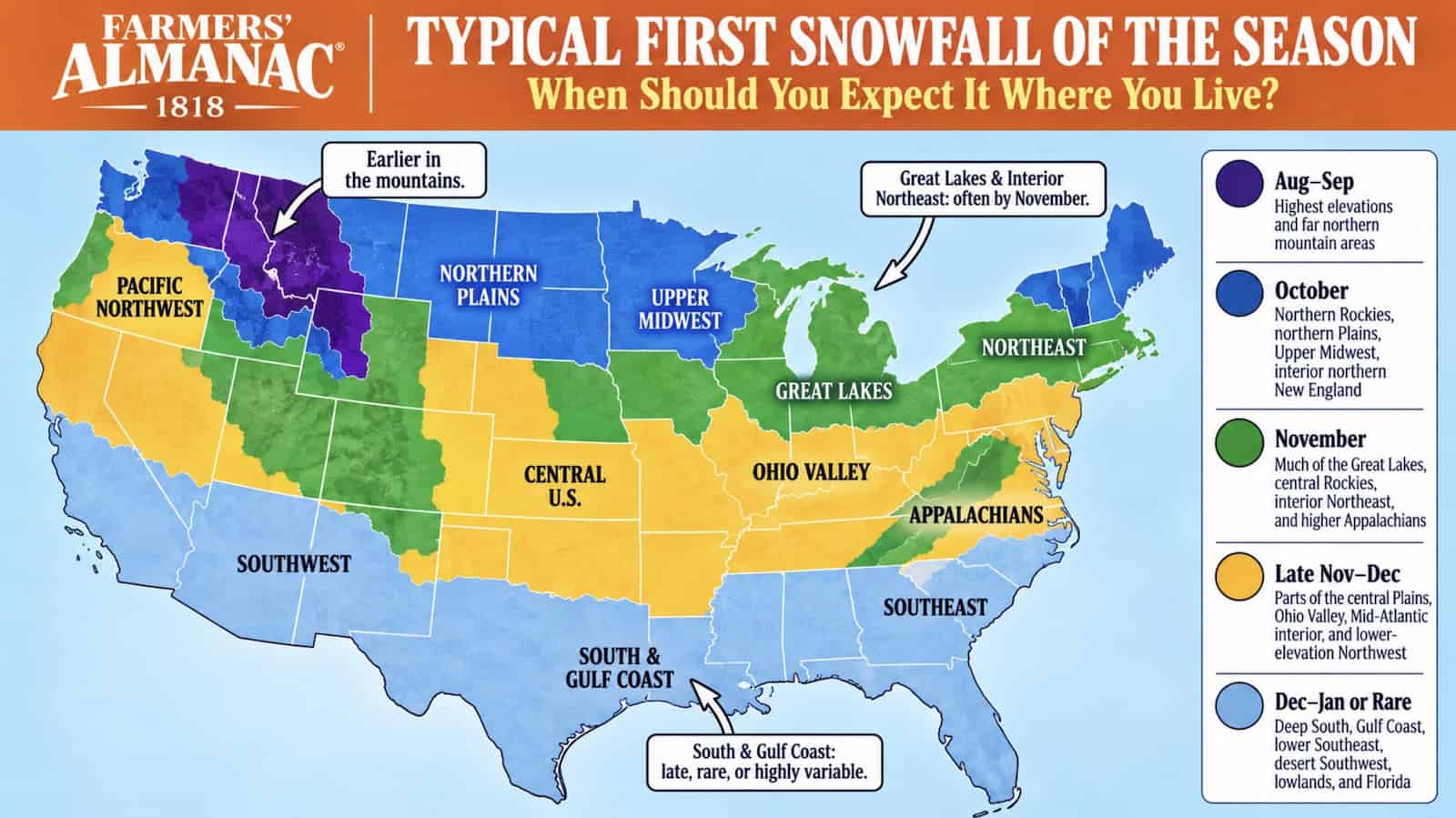
Continental United States snowfall distribution maps into nine temporal bands spanning from mid-September through late December. Northern Alaska and interior subarctic zones occupy the earliest band, facing sub-freezing precipitation profiles prior to September 15. This constraint compresses the logistical operating season for heavy civil construction, civil aviation resurfacing, and resource extraction logistics.
By late September and October, the transition encompasses the Northern Plains and Upper Midwest. This progression introduces critical deadlines for the agricultural belt, requiring completion of grain harvesting and transport before freezing precipitation reduces combine traction and triggers moisture penalties at regional elevator terminals. Stations such as International Falls, Minnesota (earliest snowfall: September 14, 1964), highlight the compressed margin separating late-summer logistical regimes from active winter operations.
Great Lakes and Northeast: High-Density Transit and Budget Pressures
Throughout November, measurable snow risks intensify across the Great Lakes and interior Northeast, corridors characterized by dense intermodal freight networks and high urban concentrations. Historical anomalies underline the narrow operational margin: Cleveland, Ohio, recorded measurable snowfall on October 2, 1974, and Buffalo, New York, on October 6, 1991. Early-season lake-effect events place outsized strain on municipal budgets by driving unplanned overtime and depleting bulk sodium chloride reserves before the official start of the fiscal winter maintenance period.
In the interior Northeast, the interplay of coastal low-pressure systems and inland topography creates severe microclimatic gradients. Boston, Massachusetts, registered an earliest snowfall date of October 10, 1979, while downstream maritime zones regularly remain snow-free until mid-to-late December. This variance necessitates dynamic labor contracts for regional utilities and commercial fleet operators, who must maintain reserve capacity against early coastal-inland baroclinic storms.
The Southern Tier: Structural Under-Investment and Grid Exposure
Across the Deep South, Gulf Coast, and Desert Southwest, snowfall remains an infrequent, high-consequence event. Historical markers such as Dallas, Texas (November 13, 1976), and Charleston, South Carolina (December 11, 1958), prove that cold-air outbreaks can breach low-latitude zones early in the season. Across parts of central Texas and northern Florida, median intervals span multiple seasons without measurable snow.
Consequently, southern municipalities face a rational economic trade-off: maintaining dedicated fleets of plow-equipped vehicles and continuous chemical inventories yields a negative expected return on capital. However, this absence of specialized machinery leaves municipal transit, interstate corridors (I-10, I-20), and local energy distribution systems vulnerable to cascading failures when atypical freezing events cross the freezing threshold.
Macroeconomic and Logistics Impacts
The first measurable snowfall functions as an economic trigger across spot energy and commercial logistics markets:
- Natural Gas Withdrawals: Early residential and commercial space-heating demand across major consumption nodes (e.g., Chicago, earliest snow: October 23, 1929; Detroit, earliest snow: October 12, 2006) accelerates underground storage withdrawal cycles, injecting volatility into Henry Hub cash markets and forward spreads.
- Retail Capital Turnover: Consumer behavior correlates tightly with the first visible snow event, which rapidly rotates seasonal retail inventory from outdoor goods to cold-weather apparel and emergency de-icing supplies.
- Commercial Aviation: International transit hubs require fully staffed glycol de-icing operations, anti-icing fluid supply chains, and runway sweepers weeks in advance of the median snowfall date to prevent schedule collapse during early synoptic cold drops.
- Intermodal Freight Transit: Class I rail operators and long-haul motor carriers introduce speed restrictions, reduced train lengths, and mandatory traction equipment protocols across mountain corridors in response to early-season Rocky Mountain pass blockages.
By synchronizing operational schedules with the statistical thresholds of GHCN data rather than arbitrary calendar dates, institutional operators convert meteorological volatility into structured risk management protocols.