
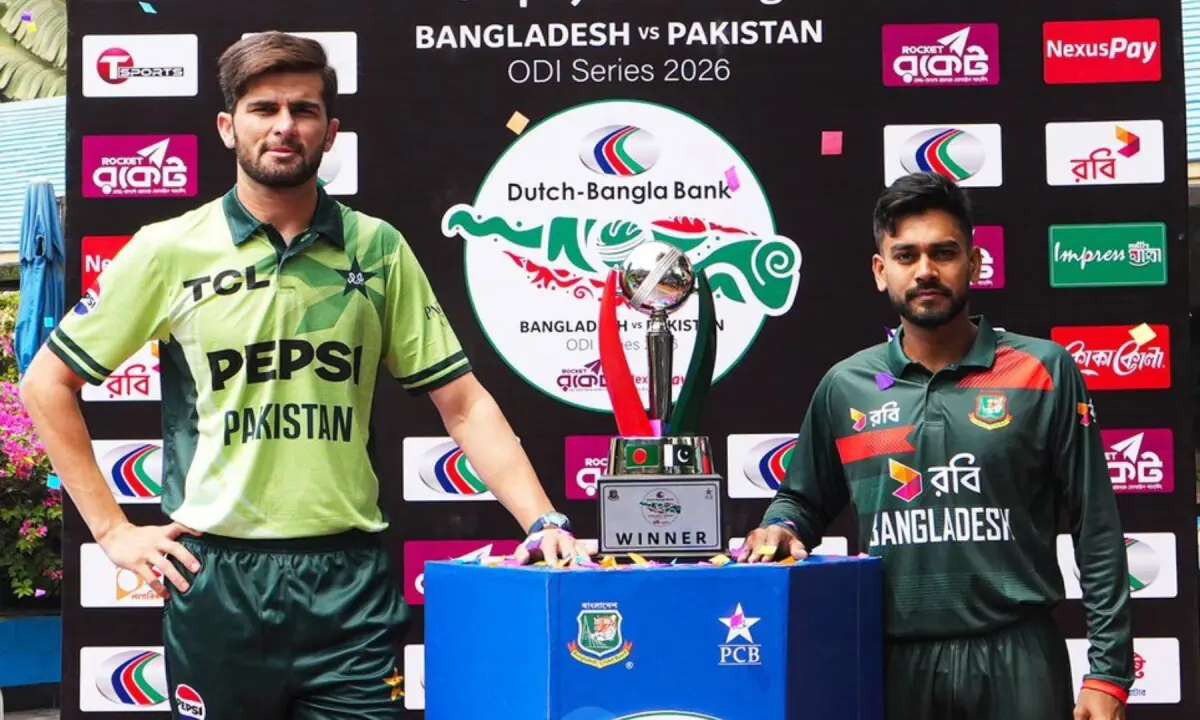
Immediately following a suboptimal performance in the T20 World Cup, the Pakistan cricket administration has initiated a pronounced strategic recalibration, demonstrably executed through the squad selection for the ODI series against Bangladesh.
This three-match contest, staged at the Sher-e-Bangla National Stadium, functions as a controlled environment—a selection laboratory—designed explicitly to stress-test personnel benchmarks essential for the 2027 50-over tournament cycle.
Analytical Density: The Mandate for Youth Integration
Captain Shaheen Shah Afridi has explicitly framed this series as an allocation of high-leverage opportunity, prioritizing the embedding of emergent domestic talent into competitive international scenarios. The confirmation of three primary debutants—Sahibzada Farhan and Maaz Sadaqat slated for opening duties, with Shamyl Hussain positioned at first drop—underscores a commitment to validating proven List A performers against established international bowling units.
Performance Leverage and Statistical Justification
Sahibzada Farhan’s elevation is particularly instructive, rewarding his domestic output (notably as a top run-scorer in the recent T20 World Cup domestic circuit) and challenging him to transpose that efficacy into the ODI accumulation format. His List A record—2926 runs at a 41.80 average over the preceding decade—provides a quantifiable baseline suggesting structural readiness for an ODI role, even accounting for format transition.
The inclusions of Sadaqat and Hussain reflect a deeper, data-informed assessment of national first-class pipelines, rewarding sustained upward trajectory over recent domestic seasons rather than relying on previous reputation.
Structural Pivot in Squad Management
The 15-member squad composition signals a definitive move away from short-term results accountability towards cultivating robust squad depth—a necessary administrative course correction following the T20 WC outcome. This contrasts sharply with typical high-pressure tournament selections favoring established combinations, indicating a tolerance for tactical volatility in the short term for long-term strategic coherence.
Afridi’s continuity as captain provides the institutional stability required to implement these foundational personnel shifts without administrative friction, allowing focus to remain on personnel integration metrics.
Downstream Implications for Domestic Competitiveness
The integration of these new faces directly contests the established ODI incumbents, creating an immediate performance uplift requirement across the domestic circuit. This selection validates the List A structure as the primary meritocratic pathway to national ODI selection, increasing the weighting applied to sustained run-scoring consistency.
Conversely, established players bypassed in this initial integration phase face a pronounced competitive disadvantage, requiring significant over-performance in subsequent domestic windows to re-enter selection consideration, thus sharpening domestic benchmarks.
Competitive Exposure and Technical Validation
The Bangladesh ODIs offer a controlled, low-stakes environment for validating the technical adaptability of debutants against a technically proficient international attack under familiar South Asian conditions. The challenge for the openers (Farhan and Sadaqat) centers on modulating T20 aggression into sustainable ODI innings construction—a core requirement for 2027 success.
Shamyl Hussain’s role at number three tests his tactical flexibility in anchoring or accelerating the middle overs, a high-demand zone that isolated domestic fixtures often fail to accurately model.
Stakeholder Narrative and Board Signaling
The Pakistan Cricket Board (PCB) communicates to stakeholders, particularly the demanding fan base, that the T20 failure necessitated structural reform beyond superficial personnel swaps. This youth-centric strategy manages short-term expectations while strictly aligning squad composition with the long-term 2027 mandate.
The efficacy of this integration phase will serve as a key performance indicator (KPI) for the current selection committee and captaincy structure over the ensuing 18 months of ODI programming.
Capital Allocation and Development Prioritization
Resource allocation within the national team framework will necessarily skew toward supporting the development pathways of these selected prospects, impacting specialized coaching investment and performance analytics deployment. The financial commitment and central contract potential for these players are now directly contingent upon their ability to solidify these initial ODI berths.
This strategic capital deployment reflects an institutional belief that the current talent pool requires immediate, high-intensity international exposure, rather than isolated refinement, to achieve optimal readiness by the 2027 deadline.
Market Positioning and Resilience Building
By aggressively onboarding new talent, Pakistan is consciously repositioning its ODI market profile, transitioning away from reliance on aging core players toward a more dynamic, experienced-at-scale composition. This strategy aims to embed greater resilience against future performance volatility by diffusing international exposure across a wider player base.
Performance data derived from these initial ODIs will be benchmarked against top-tier ODI nations, providing critical empirical evidence for subsequent strategic adjustments.
Contextual Familiarity as a Selection Lever
The conditions at the Sher-e-Bangla National Stadium offer a crucial environmental advantage, providing a familiar South Asian substrate that may mitigate the initial acclimatization friction for the debutants. Selectors utilize this contextual familiarity to maximize early performance potential, allowing players to concentrate on tactical execution.
However, the psychological pressure to immediately deliver results at home, post-tournament failure, presents a complex management variable for the coaching staff to address proactively.
Evolution of Selection Philosophy
The current selection pattern suggests a significant evolution in PCB philosophy toward a more meritocratic, data-driven model where recent, high-volume domestic output (exemplified by Farhan) is heavily weighted across format boundaries. This marks a departure from historical precedents where established reputation often buffered players against form degradation.
The mandate is now clearly the establishment of a transparent, performance-based hierarchy where the 2027 roster is constructed fundamentally on current capacity, decoupled from past association.
Anticipated Competitive Response from Bangladesh
Bangladesh, competing on home soil, will perceive this series as an opportunity to exploit inherent coordination gaps within Pakistan’s newly assembled batting unit. Their tactical imperative will likely focus on early dismissals to test the temperament of the debutant openers and first drop, directly aiming to dismantle the structure the Pakistani team intends to build long-term.
The tactical efficacy of Pakistan’s integration strategy will receive its first immediate validation through the quality of the Bangladeshi bowling attack’s execution in these opening fixtures.
Long-Term Structural Viability Assessment
The true measure of these initial ODIs transcends the series outcome; they represent the first tangible metric derived from the post-mortem analysis of the T20 failure. The structural integrity of the 2027 preparations hinges on the rapid absorption of international intensity by these prospects and their translation of domestic metrics into consistent international contribution.
A failure to integrate these players effectively within the next 18 months will signal a failure in the talent identification pipeline, mandating a further, potentially disruptive, administrative overhaul.

Photo by PublicDomainPictures on Pixabay.