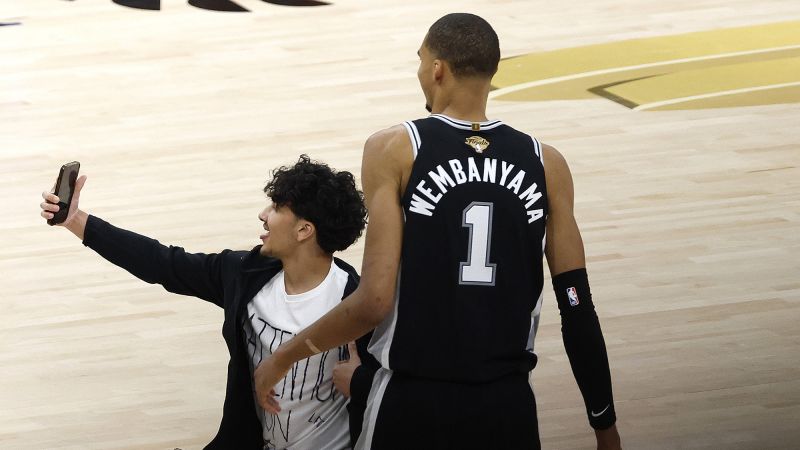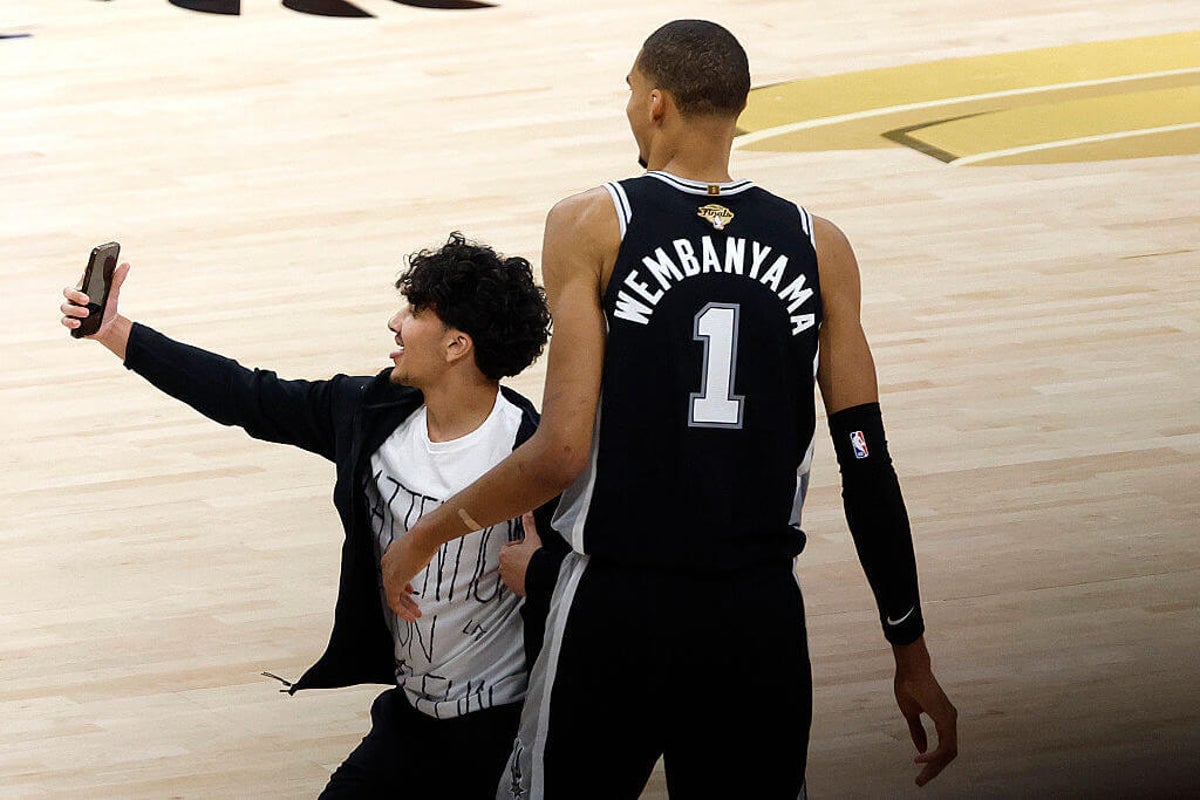
The security breach during Game 1 of the NBA Finals involving Victor Wembanyama represents a critical failure in operational perimeter control during a high-leverage sporting event. The institutional response—a permanent ban for two individuals—underscores a strategic shift toward protecting the league’s primary human capital against the rising trend of content-driven disruptions.
Anatomy of an Operational Failure
The intrusion, occurring with approximately six minutes remaining in the fourth quarter, exploited a vulnerability during a substitution phase. As Wembanyama re-entered the court, security focus likely underwent a temporary dilution, allowing the individual to penetrate the baseline barrier. While physical harm was avoided, the incident achieved the intruder’s primary objective: the creation of viral digital content through a forced interaction with a global star.
This outcome highlights a widening gap between traditional physical deterrence and the modern incentive structures of social media. The apprehension of the individual by security guards occurred only after the ‘clout’ was secured, suggesting that existing response protocols are reactive rather than preventive in the face of non-hostile but highly disruptive intrusions.
Strategic Deterrence and Collective Accountability
The decision to issue lifetime bans to both the intruder and an accomplice is a calculated administrative maneuver. By penalizing the individual filming the act, the NBA is attacking the logistical support system necessary for viral stunts. This strategy effectively increases the ‘cost of participation’ for third-party facilitators, aiming to dissolve the collaborative nature of modern arena disruptions.
From a legal standpoint, the lifetime ban utilizes private property rights to enforce exclusions that exceed the limitations of the criminal justice system. This long-term risk mitigation strategy safeguards the league’s multi-billion dollar live-event business by permanently removing high-risk actors from the ecosystem, thereby protecting the commercial integrity of the broadcast product.
Competitive Integrity and Psychological Variables
The breach occurred during a high-stakes offensive possession for the San Antonio Spurs, introducing an unscripted psychological variable into a championship environment. For Wembanyama, a rookie performing on the league’s largest stage, the interruption forced a sudden recalibration of focus. While Wembanyama exhibited professional resilience by scoring six points shortly after the incident, the forced pause in game momentum remains a significant concern for competitive equity.
The league must now address the liability frameworks governing player safety. As the NBA increasingly markets individual icons like Wembanyama, the financial exposure associated with unauthorized physical proximity becomes astronomical. This event will likely catalyze a re-evaluation of courtside seating logistics and the implementation of more robust ‘buffer zones’ during dead-ball situations.
The Future of Spectator-Athlete Boundaries
The NBA’s decisive action signals the end of the ‘harmless prankster’ era. In a landscape where every spectator is a potential broadcaster, the league is compelled to treat all unauthorized entries as high-level security threats. The permanent exclusion of these individuals is a necessary step in preserving the sanctity of the court, ensuring the focus remains on the athletic performance rather than audience-driven narrative insertions.