
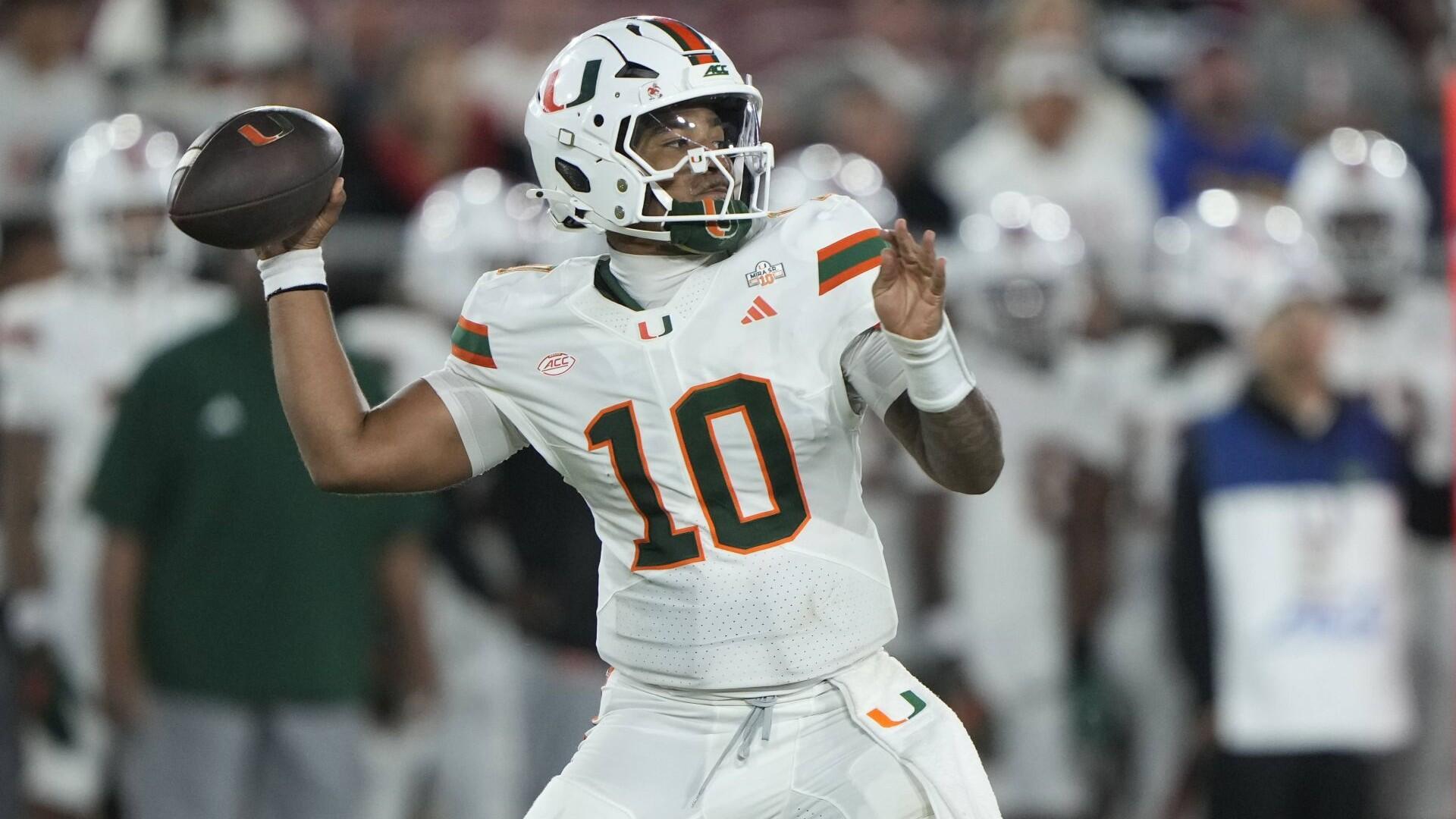
The seventh-ranked Miami Hurricanes transition to their 2026 home opener at Hard Rock Stadium following a clinical 45-6 victory over Stanford. This matchup against Florida A&M serves as a critical calibration phase for a program refining its championship architecture. While the scoreboard remains a primary metric, the internal focus centers on sustaining the high-efficiency personnel integration displayed in Palo Alto, particularly the synchronization between transfer quarterback Darian Mensah and his vertical threats.
Offensive Mechanics and Efficiency Metrics
Darian Mensah’s debut recalibrated expectations for the Hurricanes’ offensive ceiling. Completing 90% of his passes (27-of-30) for 401 yards against a Power Four opponent suggests a sophisticated command of the playbook that minimizes traditional early-season volatility. The emergence of Malachi Toney, who recorded a school-record 234 receiving yards, provides a tactical focal point that forces defenses into high-stress coverage shells, creating peripheral opportunities for Cooper Barkate and Daylyn Upshaw.
This offensive output is balanced by CharMar Brown’s red-zone efficiency, ensuring the Hurricanes possess the physical leverage necessary to complement their explosive passing game. The objective for the coaching staff is to maintain this 1.5 points-per-minute pace while rotating second-unit personnel to evaluate roster depth without a significant drop in execution quality.
Logistical Disparity and Scheduling Constraints
Florida A&M enters this contest under extreme physiological and operational pressure. Following a physical 31-13 loss to South Carolina State in the Orange Blossom Classic, the Rattlers are forced into a four-day turnaround. This condensed recovery window, coupled with the talent disparity inherent in a matchup against a top-ten FBS program, creates a structural disadvantage that is reflected in the historic 59.5-point betting spread.
For the Rattlers, this ‘guarantee game’ is an essential economic component of the athletic department’s long-term sustainability, despite the competitive challenges. The primary success metric for Florida A&M will be the health and resilience of their core roster as they navigate a prime-time broadcast window on the ACC Network against NFL-caliber size and speed.
Market Analytics and Institutional Trajectory
The betting market’s valuation, featuring a 66.5-point over/under, positions Miami as the sole driver of the game’s tempo. In the current College Football Playoff landscape, the ‘eye test’ in such lopsided matchups is vital; the selection committee scrutinizes efficiency and defensive discipline even when the outcome is certain. A clean performance reinforces Miami’s status as a contender capable of closing the marginal gap that resulted in their 2025 national championship loss to Indiana.
Strategically, this game allows the Hurricanes to consolidate gains in a low-travel week before returning to the rigors of the ACC schedule. For Florida A&M, it is a high-stakes exposure opportunity where individual standout performances can influence professional scouting reports, even as the team manages the broader realities of the FCS-to-FBS gap in the NIL era.

Photo by fiquetdidier1 on Pixabay.