
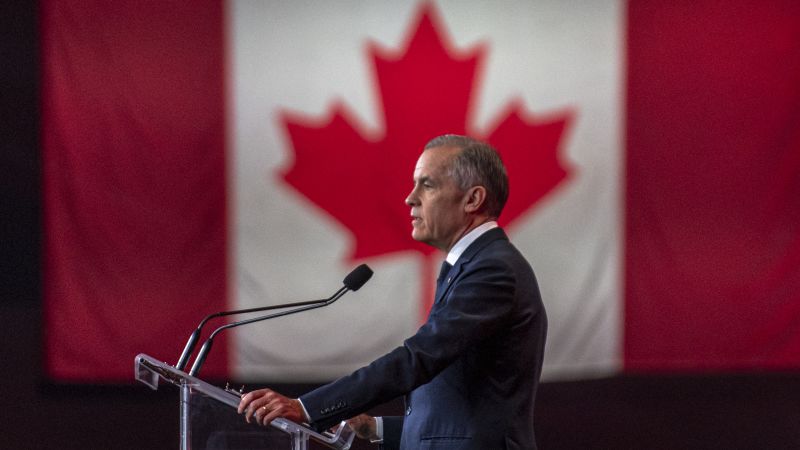
Carney Secures Majority, Gains Mandate for Economic De-risking from US
Canadian Prime Minister Mark Carney has consolidated power, securing a majority government through a combination of special election victories and strategic defections from opposition parties. This new majority strengthens his administration’s mandate to pursue economic diversification and reduce Canada’s dependency on the United States, positioning the government to counter protectionist policies and perceived threats of economic coercion attributed to the U.S. administration of President Donald Trump.
The Liberal Party achieved a decisive parliamentary advantage by winning two key special elections in the districts of University Rosedale and Scarborough Southwest. These victories pushed the Liberal seat count to 173 in the House of Commons, surpassing the 172-seat threshold required for a majority government. This allows Carney to pass legislation without relying on ad-hoc support from opposition parties, streamlining the implementation of his strategic agenda.
The Strategic Vulnerabilities of a Narrow Majority
While the new majority provides significant legislative control, the margin of a single seat introduces inherent operational vulnerabilities. The government’s stability hinges entirely on maintaining absolute party discipline. A single defection or loss in a future by-election could immediately revert the government to a minority position, necessitating a return to coalition building or reliance on ad-hoc agreements with opposition members to pass legislation. This structural constraint influences strategic decision-making by empowering individual backbenchers and specific regional factions within the Liberal caucus, potentially increasing the internal political cost for controversial policy initiatives, even as it simplifies legislative passage against external opposition.
Geopolitical Mandate: Economic Diversification and De-risking
Carney’s newly secured majority provides a clear mandate to accelerate Canada’s strategic objective of economic de-risking. This policy objective, fueled by public and political anger over U.S. tariffs and perceived annexation threats, necessitates a fundamental reevaluation of Canada’s trade architecture and supply chain integration. The strategic shift moves beyond simple trade negotiations to encompass long-term structural changes in investment, infrastructure, and market access.
The U.S. has historically served as Canada’s primary trading partner, leading to deeply integrated supply chains, particularly in the automotive and energy sectors. Reducing dependency requires significant capital investment in alternative infrastructure, such as new port facilities, rail networks, and pipelines designed to facilitate trade with markets in Asia, Europe, and Latin America. This diversification strategy inherently involves high upfront costs and long-term risk management, as it seeks to reorient established economic flows away from a geographically proximate and historically dominant partner.
Carney’s administration frames this agenda not merely as a policy choice, but as a necessary measure of national defense and resilience against external economic coercion. The public discourse surrounding “annexation threats” provides a powerful rallying point for national unity, strengthening support for a government perceived as defending Canadian sovereignty and economic autonomy on the global stage.
Political Momentum: Defections and Opposition Instability
The shift in parliamentary power was significantly accelerated by a series of high-profile defections from opposition parties. The source indicates five defections in the preceding five months, including four from the primary opposition Conservative party. These defections suggest a deeper structural shift in political alignment, reflecting a strategic calculation by individual politicians regarding the changing political landscape and public sentiment.
These floor crossings demonstrate a loss of confidence in the opposition’s ability to effectively counter the government’s agenda, particularly regarding high-stakes U.S.-Canada relations. One defector explicitly referenced Carney’s speech at the World Economic Forum in Davos, Switzerland, as influencing their decision. This highlights the strategic importance of international rhetoric in shaping domestic political outcomes. Carney’s condemnation of economic coercion at a global forum provided a compelling ideological contrast to U.S. policies, offering a narrative for opposition members seeking to align with a perceived national interest against external threats.
Stakeholder Implications and Market Repercussions
The consolidation of power triggers significant implications for various stakeholders, including financial markets and key industries. The increased political stability provided by the majority government reduces legislative uncertainty, which can positively influence investor confidence in long-term infrastructure and diversification projects. However, the specific policy direction introduces new risks for sectors deeply integrated with the U.S. economy.
For the energy sector, the mandate to reduce dependency may accelerate efforts to build alternative infrastructure, such as pipelines to Canada’s coasts, which have historically faced significant regulatory and political hurdles. The majority government’s ability to push through such projects could redefine Canada’s energy export strategy and its global market positioning. Conversely, financial institutions with significant exposure to cross-border U.S.-Canada trade face potential adjustments in risk assessment and loan portfolios as trade flows are reorient toward new international markets.
Conclusion: A Strategic Shift in Leadership and Governance
With a majority government in place following the leadership transition from former leader Justin Trudeau, Carney’s administration gains the operational capacity to implement significant legislative changes without the compromises inherent in a minority government. The focus shifts from securing legislative approval to managing the implementation phase of complex, multi-sectoral economic policies. The long-term success of Carney’s strategy hinges on the government’s ability to navigate the complexities of international trade negotiations and manage the internal political pressures associated with reorienting Canada’s economy. The outcome of this strategic shift will define Canada’s economic and geopolitical positioning for the next decade, moving away from a traditional reliance on its southern neighbor toward more diversified global engagement.

Photo by 652234 on Pixabay.