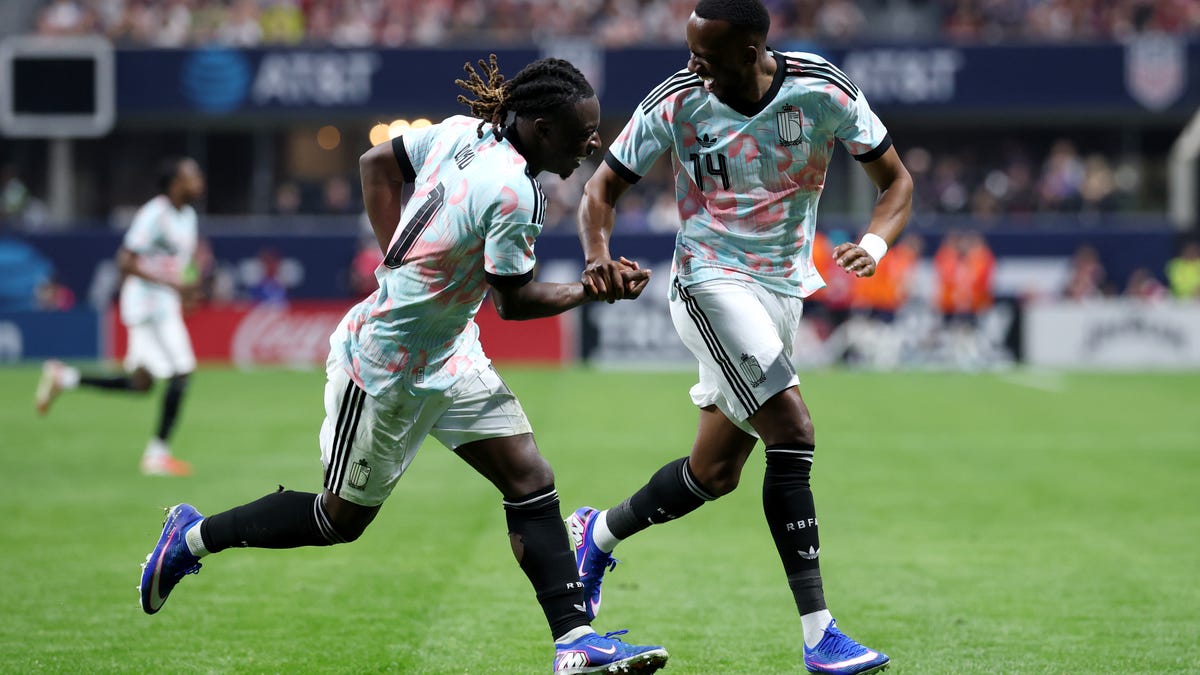
The international friendly at King Baudouin Stadium serves as the definitive strategic laboratory for Belgium and Tunisia before the 2026 FIFA World Cup. This fixture provides managers Rudi Garcia and Sabri Lamouchi a final high-intensity environment to stress-test tactical configurations and squad depth under match-simulation conditions.
Following a 2-0 victory over Croatia, Belgium seeks to refine the transition-heavy mechanics required for their Group G opener against Egypt in Seattle. For Tunisia, the match is a crucial corrective measure following a narrow 1-0 defeat to Austria in Vienna.
Tactical Architecture: Systemic Contrasts
Rudi Garcia’s 4-3-3 system emphasizes verticality and positional rotation. By utilizing Kevin De Bruyne’s progressive passing and Jeremy Doku’s 1v1 isolation on the flanks, Belgium aims to dismantle low-block architectures. The tactical burden falls on the midfield pivot to maintain structural integrity during defensive transitions, preventing central exploitation while full-backs overlap.
Conversely, Sabri Lamouchi has implemented a pragmatic 4-4-1-1 for Tunisia. This configuration prioritizes horizontal compactness and mid-block stability, designed to nullify vertical passing lanes. By deploying a second striker as a link-player, Tunisia facilitates rapid counter-offensive transitions, a necessity for their Group F campaign against high-possession sides like the Netherlands and Sweden.
Performance Leverage and Offensive Clinicality
Romelu Lukaku remains the cornerstone of Belgium’s offensive output. Having reached 90 international goals, his role as a focal point allows for diverse attacking patterns—ranging from direct long-ball hold-up play to intricate short-passing sequences in the final third. His physical presence creates the requisite space for late-arriving midfielders to exploit the ‘zone 14’ area.
Tunisia’s objective in Brussels is to resolve the lack of offensive efficiency noted in their recent European outings. While the 4-4-1-1 provides a resilient defensive shell, the Eagles of Carthage must improve their clinicality in the final third. This friendly tests their ability to absorb elite-level pressure while identifying exploitatory spaces behind Belgium’s advanced defensive line.
Strategic Context: From March Windows to North American Logistics
Belgium’s recent results—a 5-2 win over the United States and a 1-1 draw with Mexico—highlight a high ceiling in transition but occasional lapses against disciplined setups. Garcia’s final adjustments focus on maintaining tempo without compromising defensive balance, a critical factor for the varied climates of the North American venues.
Logistical readiness is paramount. With the opener at Lumen Field in Seattle approaching, Belgium must manage workload intensities to peak during the group stage. Tunisia faces a similar challenge, preparing for the heat and humidity of Monterrey, Mexico, where they will open against Sweden. The Brussels friendly serves as the final physical and psychological conditioning point before trans-Atlantic travel.
Institutional Stakes and Global Exposure
For the Royal Belgian Football Association, this tournament represents the validation of a squad in tactical transition. The commercial and institutional pressure to perform is mirrored by Tunisia’s drive to advance beyond the group stage for the first time in seven appearances. The match’s broadcast on Prime Video underscores the heightened global interest and commercial value of these final preparation windows.
Final Assessment of Tournament Readiness
As both nations finalize their operational blueprints, the Brussels encounter will reveal the maturity of their respective systems. Belgium enters as the statistical favorite, seeking a clean bill of health and tactical confirmation. Tunisia enters as the underdog, looking to prove that their structural discipline can frustrate elite opposition. The data points gathered here will define the internal narratives and external expectations for both squads heading into the summer of 2026.