Cosmic Echoes from the Dawn of Time
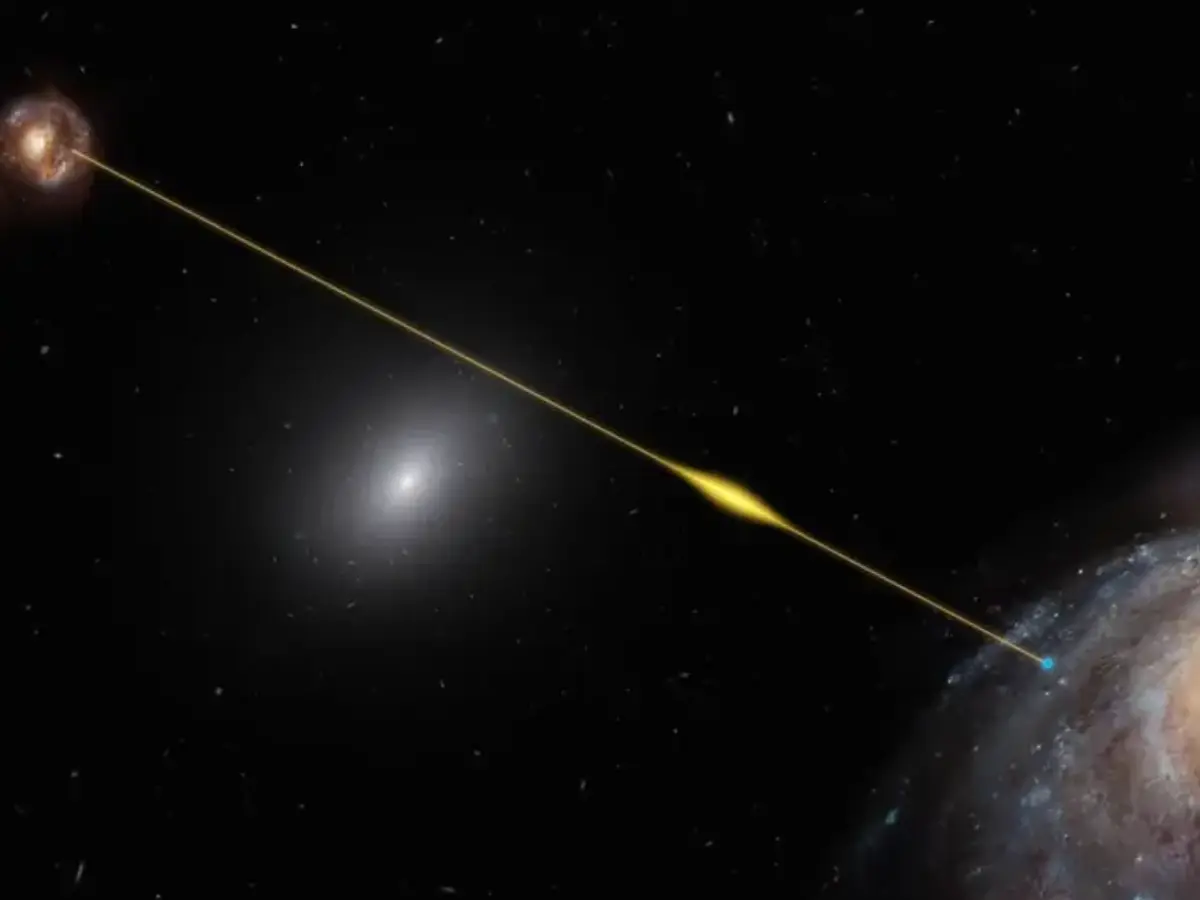
Imagine listening to a whisper that began its journey before our own galaxy, the Milky Way, even took shape. This is the extraordinary reality for astronomers today, who are meticulously analyzing faint signals emanating from the deepest reaches of space. These signals have traversed an astonishing distance, over 13 billion years, to finally reach our instruments.
This unprecedented feat of cosmic eavesdropping is thanks to the detection of a fleeting, yet profoundly significant, event: a gamma-ray burst lasting a mere ten seconds. Captured in March 2025 by a new, highly sensitive space mission, this intense flash of high-energy light has ignited a wave of scientific inquiry. The question has shifted from simply identifying such an event to understanding how it could have undertaken such an immense journey across billions of years, arriving at our cosmic doorstep precisely now.
A 10-Second Chronicle of the Young Universe
The data reveals that this specific burst of energy began its voyage when the universe was in its infancy, a mere fraction of its current age. NASA’s meticulous recording of this signal, which originated from deep space and persisted for only ten seconds, highlights several aspects of the early universe that have long been overlooked or poorly understood. Central to this is the concept of how time itself behaves under extreme cosmic conditions.
The implications of receiving such ancient light are far-reaching. It allows scientists to peer back to a time when stars and galaxies were first forming, a period largely shrouded in mystery. The very existence of these signals challenges and refines our cosmological models, offering concrete data where previously there was theoretical speculation.
Why This Matters: Unraveling Cosmic History
The significance of these ancient signals extends far beyond mere astronomical curiosity. They serve as direct messengers from a universe vastly different from our own, providing empirical evidence for the conditions and processes that shaped everything we observe today. Understanding the early universe is fundamental to comprehending our own origins and our place within the cosmos.
These gamma-ray bursts, though brief, are among the most energetic phenomena in the universe. Their detection allows scientists to probe the extreme physics of the cosmos, such as the life and death of massive stars, the formation of black holes, and the very fabric of spacetime. The fact that a signal originating 13 billion years ago can be detected now speaks volumes about the stability of cosmic structures and the predictability of light’s journey through the expanding universe.
Furthermore, the precise timing and nature of these bursts can offer clues about the distribution of matter and energy in the nascent universe. This helps cosmologists refine estimates of the universe’s age, its expansion rate, and its ultimate fate. It is through such observations that we can test and validate our most fundamental theories about gravity, nuclear physics, and the evolution of cosmic structures.
Connecting to Broader Scientific Trends
This discovery aligns with a broader trend in astrophysics: the development of increasingly sophisticated instruments capable of detecting fainter and more distant phenomena. Advances in detector technology, coupled with dedicated space missions, are pushing the boundaries of what we can observe, allowing us to explore epochs of cosmic history previously inaccessible.
The study of these signals also intersects with theoretical physics, particularly in areas such as general relativity and quantum mechanics. The extreme energies involved in gamma-ray bursts and the vast distances they travel offer opportunities to test theories of gravity in regimes not achievable on Earth. The warping of time and space, mentioned in the context of these signals, is a direct consequence of Einstein’s theories, and these observations provide real-world validation.
Moreover, the search for extraterrestrial intelligence (SETI) is indirectly advanced by such discoveries. While these signals are natural phenomena, understanding the energetic processes in the universe helps refine our search parameters and understand the potential signatures of advanced civilizations, should they exist. The ability to detect faint, ancient signals underscores the potential for future instruments to pick up even more subtle cosmic communications.
Looking Ahead: The Future of Cosmic Exploration
The ongoing analysis of this 13-billion-year-old gamma-ray burst is just the beginning. Scientists anticipate that future missions, equipped with even greater sensitivity and resolution, will detect more such events. Each new detection will add another piece to the intricate puzzle of the early universe.
Future research will focus on refining the localization of these bursts to identify their host galaxies and understand the specific astrophysical environments that produced them. This will involve correlating gamma-ray data with observations across the electromagnetic spectrum, from radio waves to X-rays.
The study of these ancient signals promises to revolutionize our understanding of cosmic dawn. As technology advances, the universe’s oldest secrets are slowly but surely being unveiled, offering humanity a deeper appreciation of its cosmic heritage and the profound mysteries that still lie beyond our reach.