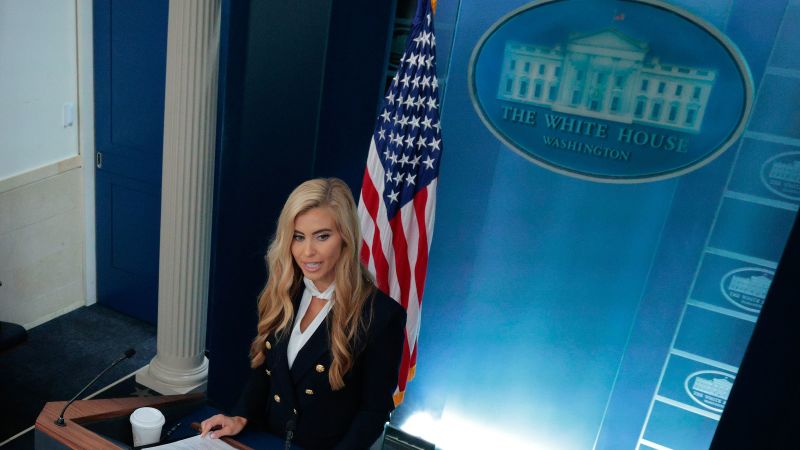
The resignation of Katie Zacharia as White House Press Secretary after five days marks one of the briefest tenures in the history of the modern executive communications apparatus. Confirmed by White House officials following public interventions by President Donald Trump, Zacharia’s rapid departure highlights structural vulnerabilities in institutional vetting and real-time narrative management at a critical political juncture.
The Briefing Breakdown: Tactical Failure at the Podium
The immediate operational catalyst for Zacharia’s exit occurred during Tuesday’s press briefing. Marked by halting delivery and an abrupt conclusion after taking questions from only three reporters, the appearance failed to establish authoritative message control. In the White House briefing room, communicative hesitation signals an operational disconnect between the podium and the policy apparatus. Rather than blunting press inquiry, the truncated session escalated scrutiny over her operational capacity and executive mandate.
Credentialing Deficits and Institutional Exposure
Compounding the briefing room failure was the controversy surrounding Zacharia’s professional qualifications. Her public acknowledgment of failing the bar exam while continuing to present herself as an attorney exposed the administration to severe credibility risks. In senior executive appointments, unverified credentials invite rigorous media verification; when discrepancies surface, the communications staff shifts from managing national policy priorities to defending its own integrity. The episode underscores the operational hazards of prioritizing alignment over standard personnel vetting protocols.
Midterm Alignment and the Strategy of Public Distancing
Zacharia’s departure arrived exactly 18 days prior to the midterm elections, an environment where message discipline directly impacts congressional races. En route to a political rally in Georgia, President Trump publicly suggested that Zacharia “reconsider” her position while framing her struggles as the product of unfair media treatment. This rhetorical posture achieved dual tactical objectives: it facilitated a necessary personnel transition without an overt dismissal, while simultaneously reinforcing the administration’s anti-media narrative to mobilize the base.
Nevertheless, internal communications turnover at this stage incurs substantial opportunity costs. Instead of amplifying economic and legislative messaging, the administration expended political capital mitigating internal instability. Zacharia’s exit leaves the communications shop forced to rapidly recalibrate its structure and restore briefing room stability before voters head to the polls.