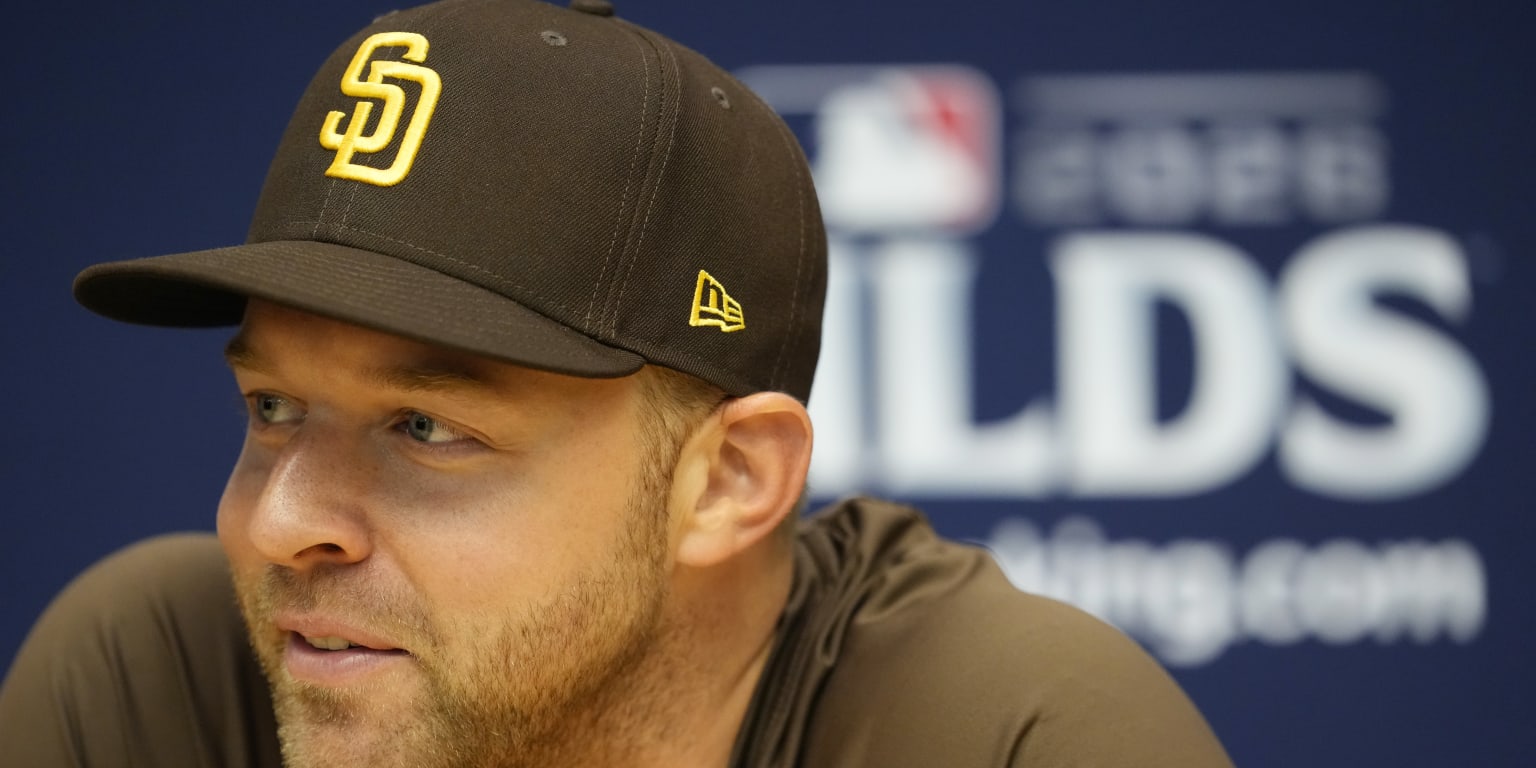
High-Leverage Stabilization: King’s Role in the NLDS Deficit
Following a 3-2 series-opening loss to the Milwaukee Brewers in the National League Division Series, the San Diego Padres entered Game 2 facing an immediate leverage test. Entrusted with equalizing the series, right-hander Michael King emerged as the focal point of the club’s pitching architecture. Manager Craig Stammen validated this reliance, noting, “We’re lucky to have him going into Game 2; and [we] feel really good about it.” King’s assignment carried dual operational mandates: neutralize Milwaukee’s early series momentum and insulate the San Diego bullpen from high-volume, multi-inning exposure.
Regular-Season Volume and Workload Absorption
King’s postseason positioning builds on an established baseline of durability and volume absorption. During the regular season, the right-hander served as the staff’s statistical anchor, pacing the Padres with 185 innings pitched, 159 strikeouts, and 12 victories alongside a 3.21 ERA and 1.18 WHIP. Stammen highlighted this durability: “He’s definitely been our leader on the pitching staff for the entire season; made every start; pitched really well; [he’s] coming off a great outing.” In an era where starter volume is often truncated, King’s sustained availability established the organizational floor necessary to navigate championship attrition.
Historic Postseason Run Prevention and High-Stakes Output
King’s playoff execution has elevated his profile among historic franchise benchmarks. His career postseason record of 3-0 across five starts ties him with Yu Darvish and Sterling Hitchcock for the Padres’ all-time playoff victory record. Across his current October run, King has compiled a 1-0 record and a 0.75 ERA over two starts spanning 12.0 innings.
This run is highlighted by rare run-prevention ceilings. After carrying a no-hit bid into the seventh inning against the Chicago Cubs in the Wild Card Series, King delivered four perfect innings to open NLDS Game 2 against Milwaukee. He became the first pitcher in 2026 to generate two postseason no-hit bids lasting at least four innings, joining an elite cohort featuring Blake Snell (2020), Justin Verlander (2013), and Mordecai Brown (1906).
Asset Management: The Five-Inning Hook and Game 4 Contingencies
Despite King’s four perfect frames against the Brewers, his removal after five innings highlighted the tactical trade-offs inherent to short-series pitching management. Managerial conservatism balanced immediate run prevention against pitch efficiency and future deployment scenarios. Stammen’s refusal to lock in an NLDS Game 4 starter confirmed an aggressive operational posture: an “all-hands” bullpen approach in Game 3, with King preserved as a contingency option on short rest or for a decisive Game 4, provided he was not required in emergency Game 3 relief.
Organizational Asymmetry and Macro Evaluation
King’s emergence as an October front-line starter also presents significant talent evaluation implications, specifically in contrast to the New York Yankees, his former organization. As the Yankees dropped the first two games of their American League Division Series, King’s performance underscored the asymmetric value realized by San Diego. By successfully expanding his role from multi-inning reliever to bona fide rotation leader, the Padres secured high-surplus value at the top of their rotation—redefining their immediate World Series ceiling and long-term roster construction.