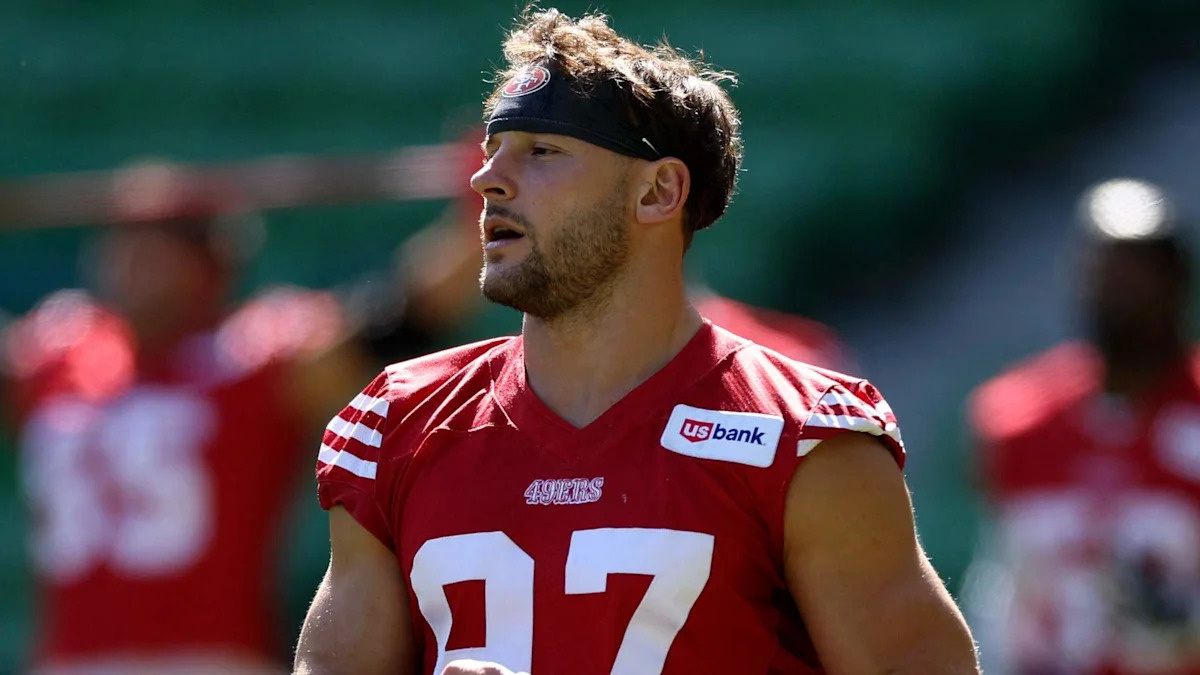
Defensive Architecture and the Gravity of Nick Bosa
The San Francisco 49ers have entered a period of operational volatility following the multi-week loss of edge rusher Nick Bosa to a calf strain. This injury, sustained during a high-leverage Thursday practice, necessitates an immediate recalibration of the defensive front prior to their Week 3 divisional matchup against the Arizona Cardinals. Bosa’s absence is more than a loss of individual talent; it removes the ‘gravitational force’ of the 49ers’ defense. Offensive coordinators typically allocate double-teams and chip-blocks to neutralize Bosa, creating favorable 1-on-1 matchups for the interior line. Without this central threat, the 49ers lose their primary mechanism for disrupting pocket integrity through a standard four-man rush.
Administrative Logistics: The IR Designation Gambit
Front office strategy now hinges on the decision to place Bosa on Injured Reserve (IR). While an IR designation mandates a four-game absence—sidelining him until a Week 7 clash with the Atlanta Falcons—it offers a vital roster spot to address depth deficiencies exacerbated by early-season attrition. However, this administrative maneuver commits the franchise to a prolonged period without their cornerstone asset during a pivotal stretch of the schedule. The organization must weigh the benefits of roster elasticity against the psychological and tactical cost of officially shelving their highest-paid defender.
Statistical Regression and Physical Indicators
A granular look at Bosa’s 2025 performance suggests that his recent physical setback may have been preceded by a latent decline in efficiency. Despite starts in Australia and against Miami, Bosa has recorded zero sacks this campaign, continuing a trend of only two sacks in his last five appearances. For an elite rusher, success is predicated on the ‘explosive first step’—a mechanical movement heavily reliant on the calf and knee. This statistical dip indicates that Bosa may have been compensating for soft-tissue imbalances long before the official diagnosis, highlighting the risks of cumulative mechanical stress on high-usage athletes.
Tactical Shifts: Moving Toward Blitz Aggression
To mitigate the loss of Bosa’s individual pressure, the 49ers’ defensive coordinator must pivot from a reliance on front-four execution to a more volatile blitzing philosophy. While increasing pressure, this shift exposes the secondary to high-variance explosive plays. The burden now shifts to situational specialists who must transition into every-down starters. This increased workload carries its own risk profile, as players unaccustomed to high snap counts face greater susceptibility to secondary injuries. The team’s survival through Week 7 depends on whether their linebacker and safety corps can maintain coverage integrity during the extended ‘time-to-throw’ periods opposing quarterbacks will now enjoy.
Institutional Risk and Load Management
Bosa’s injury underscores a broader pattern of early-season attrition that suggests systemic institutional risk. When elite assets like Bosa face ‘serious’ non-contact injuries despite conservative preseason handling, it forces a scrutiny of the team’s conditioning protocols. With Bosa’s history of major reconstructive surgery, the 49ers must resist the urge to accelerate his return. The long-term sustainability of their championship window relies on a sophisticated load-management approach that prioritizes late-season health over immediate divisional positioning, even as the margin for error in the NFC West narrows.