
Strategic Capital Preservation and Asset Management
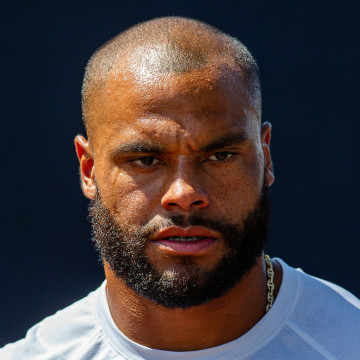
The Dallas Cowboys’ decision to bench Dak Prescott for the preseason opener reflects a sophisticated approach to franchise asset management. By prioritizing physical longevity over exhibition reps, the organization is utilizing a high-efficiency preparation model. For a veteran of Prescott’s tenure, the marginal utility of preseason snaps is dwarfed by the catastrophic risk of injury to the team’s primary competitive engine.
Head coach Mike McCarthy and offensive coordinator Brian Schottenheimer have signaled an institutional shift toward controlled-environment conditioning. This strategy assumes that Prescott’s established chemistry with core targets can be adequately maintained through high-intensity joint practices, which offer a higher degree of safety and data control than live game scenarios.
The Backup Quarterback Market: A High-Stakes Audit
With the starting role insulated from risk, the operational focus shifts to the internal competition between Cooper Rush and Trey Lance. This is more than a depth chart formality; it is a critical evaluation of the team’s insurance policy. The preseason opener serves as a primary data acquisition event, allowing the front office to quantify Lance’s developmental trajectory against Rush’s proven system stability.
For the coaching staff, this game provides a metric for decision-making under genuine pressure—a variable that practice simulations cannot fully replicate. The outcome of this developmental duel will dictate roster construction and potentially influence the Cowboys’ leverage in the secondary trade market as the 53-man deadline approaches.
Medical Protocols and Depth Chart Volatility
The management of minor injuries among the receiving corps and tight ends, such as the resting of Jake Ferguson, highlights the fragility of roster depth. These medical interventions are standard risk-mitigation components designed to prevent acute setbacks from evolving into long-term liabilities. By limiting the exposure of key contributors, the coaching staff forces an accelerated evaluation of tertiary options.
This vacuum of veteran presence creates a unique window for developmental prospects to secure a roster spot. Performance in these exhibition windows serves as the definitive crucible for bottom-of-the-roster players, influencing practice squad designations and special teams roles.
The RB2 Duel: Operational Leverage in the Backfield
With the departure of previous starters, the competition for the secondary running back role—headlined by Rico Dowdle and Royce Freeman—is a microcosm of the team’s search for offensive resilience. The RB2 must provide more than a change of pace; they must offer elite pass protection and short-yardage efficiency to maintain offensive tempo.
The preseason provides the only environment to test these players in high-leverage blocking assignments. Success in this area provides the Cowboys with the tactical flexibility needed to navigate the physical rigors of a 17-game schedule, ensuring the offense remains multi-dimensional regardless of individual personnel rotations.
Conclusion: Optimizing the Competitive Window
The Cowboys are navigating the preseason with a clear emphasis on medical discipline and depth-tier auditing. By insulating Dak Prescott and other high-value assets, the organization maximizes its probability of entering the regular season at peak operational capacity. The data harvested from these exhibition games will be synthesized into a final roster architecture built for long-term durability in the NFC East.
Photo by nancyenidd on Pixabay.