
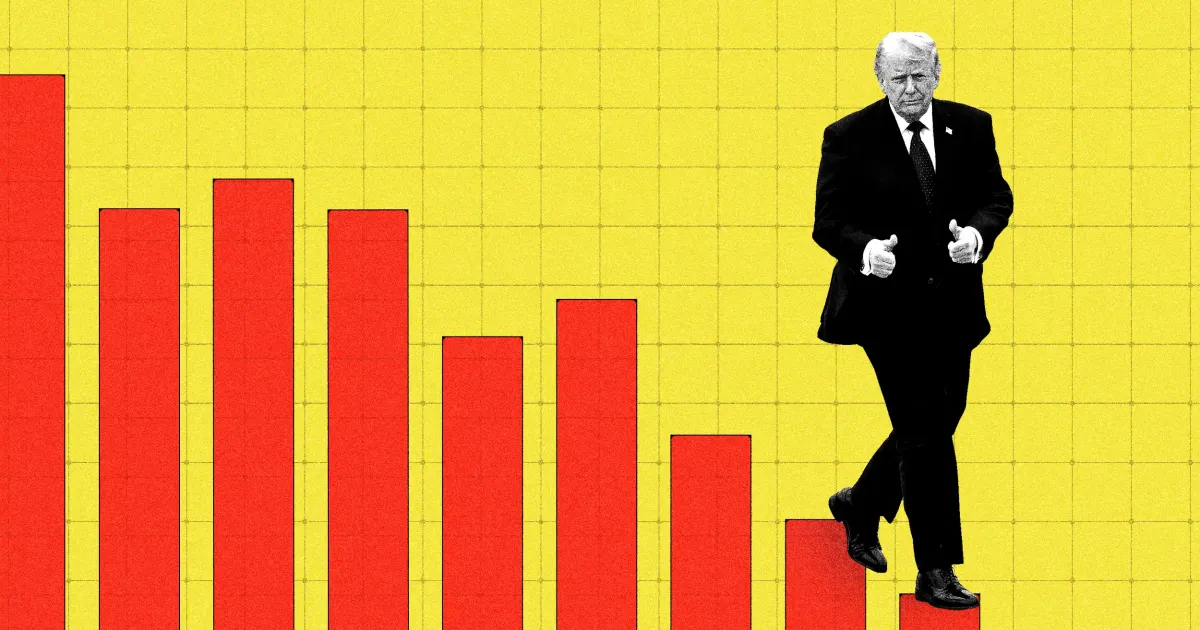
Presidential Approval Faces Sustained Decline
President Donald Trump’s approval ratings are experiencing a prolonged slump, reaching levels significantly lower than previously observed in his second term. National polling averages currently place his approval at 38% against 58% disapproval. His average approval has failed to consistently exceed 40% since late April, indicating a persistent negative trend.
This sustained downturn challenges conventional political wisdom regarding the inherent resilience of a politician’s base support. Historically, Trump has demonstrated an ability to recover from periods of unfavorable polling by mobilizing the unwavering loyalty of his core MAGA constituents.
Erosion of Key Demographic Support
The current trajectory suggests a potential fracturing of this perceived support floor. Critical demographic segments are exhibiting a marked shift in sentiment. A notable trend indicates a growing disaffection among white voters without college degrees, who are now increasingly disapproving of Trump’s performance.
Concurrently, younger and non-white voters, who had previously shown a rightward lean in the 2024 election cycle, appear to be reverting to Democratic support. This demographic recalibration, combined with a downward drift in independent voter allegiance, signals a broad-based erosion of his political capital.
Foreign Policy and Economic Headwinds
Public opinion on key foreign policy issues, particularly the protracted conflict in Iran, presents a significant challenge to the administration’s standing. A substantial 68% of Americans favor a swift resolution to the Iran war, indicating a strong public desire for de-escalation and peace.
However, this broad consensus for peace becomes more nuanced when specific deal parameters are introduced. A proposed peace agreement that does not mandate Iran’s relinquishment of enriched uranium garners only 34% support, with 37% opposing it. This highlights a divergence between general sentiment and specific policy details.
This division is further illustrated by the 11% who initially opposed any deal, joined by 26% of those who favored a quick resolution but reject the current proposal. The limited public perception of a likely deal, with only 9% deeming it very likely or almost certain, underscores the challenges in navigating and communicating foreign policy objectives effectively.
Economic Discontent Fuels Dissatisfaction
Inflation remains a critical concern for a significant portion of the electorate, directly impacting perceptions of economic stewardship. While specific inflation figures are not provided, its prominence as a top issue alongside the Iran war and Ebola suggests pervasive public anxiety regarding economic stability.
The confluence of these pressing issues—foreign conflict, public health concerns, and economic uncertainty—creates a challenging environment for any incumbent administration. The administration’s capacity to effectively address these multifaceted concerns will be pivotal in shaping future public sentiment and electoral outcomes.
Shifting Political Landscape and Future Implications
Current polling data suggests a potential recalibration of the political landscape, moving beyond established patterns of partisan entrenchment. Observed shifts in demographic support indicate that traditional voter blocs may be more fluid than previously assumed.
The erosion of support across key demographics, particularly among white working-class voters and the return of younger and minority voters to the Democratic fold, presents a strategic challenge for the Trump campaign. It necessitates a re-evaluation of outreach strategies and policy messaging to address the underlying drivers of this demographic realignment.
The administration’s response to these converging pressures—economic anxieties, foreign policy complexities, and evolving voter preferences—will be critical. Demonstrating tangible progress on inflation, effectively de-escalating the Iran conflict, and regaining trust among alienated voter segments will determine the extent of recovery from the current polling trough.
Institutional and Media Context
The reliance on national polling averages, such as The New York Times’ aggregation, underscores the media’s role in framing and disseminating public sentiment. These averages, while indicative of broad trends, often simplify complex voter attitudes into digestible metrics.
The Economist/YouGov poll further contextualizes public opinion by delving into the nuances of foreign policy preferences, revealing how general desires for peace can fracture when confronted with specific policy trade-offs. This highlights the challenge for political leaders in translating broad public mandates into actionable, and publicly palatable, policy decisions.
The discussion of a potential $250 bill featuring Donald Trump’s image, while presented as a polling item, also touches upon the symbolic and cultural dimensions of political discourse. Such proposals, even if hypothetical, can reflect or influence public perception of a leader’s legacy and standing.
Strategic Imperatives for the Administration
The current approval deficit necessitates a strategic pivot to address the underlying causes of public dissatisfaction. A singular focus on energizing the base may prove insufficient if broader segments of the electorate remain disaffected.
The administration must articulate a clear and compelling narrative on economic recovery, demonstrating a capacity to control inflation and foster stability. Simultaneously, a transparent and effective strategy for resolving the Iran conflict, one that garners wider public acceptance, is crucial.
Furthermore, understanding and responding to demographic shifts is paramount. Re-engaging younger and non-white voters, while solidifying support among previously reliable demographics, requires nuanced policy proposals and targeted communication acknowledging their evolving concerns.
Competitive Dynamics and Electoral Outlook
The significant decline in poll numbers has substantial implications for the broader competitive landscape. A weakened incumbent approval rating can embolden opposition parties and create opportunities for challengers.
The observed erosion of Trump’s support across different regions of the United States indicates a systemic challenge rather than isolated pockets of discontent. This widespread decline suggests the administration’s current strategy may not be resonating nationally.
The opposition’s ability to capitalize on these trends will depend on their capacity to present a unified and credible alternative addressing the core concerns of voters who have shifted their allegiance. The current environment indicates heightened electoral volatility, where traditional loyalties are being tested.
Long-Term Implications for Political Alignment
The potential collapse of a perceived support floor for Trump could signal a broader realignment in American political dynamics. If core voter groups, such as white voters without college degrees, begin to defect, it suggests a weakening of long-standing partisan affiliations.
The return of younger and non-white voters to the Democratic column, if sustained, could reshape electoral coalitions for years to come. This demographic fluidity underscores the need for continuous adaptation in political strategy and messaging.
The current period of low approval ratings, therefore, represents more than a cyclical downturn; it may indicate a structural shift in voter sentiment and political allegiances with lasting consequences for the American political system.
Photo by geralt on Pixabay.