
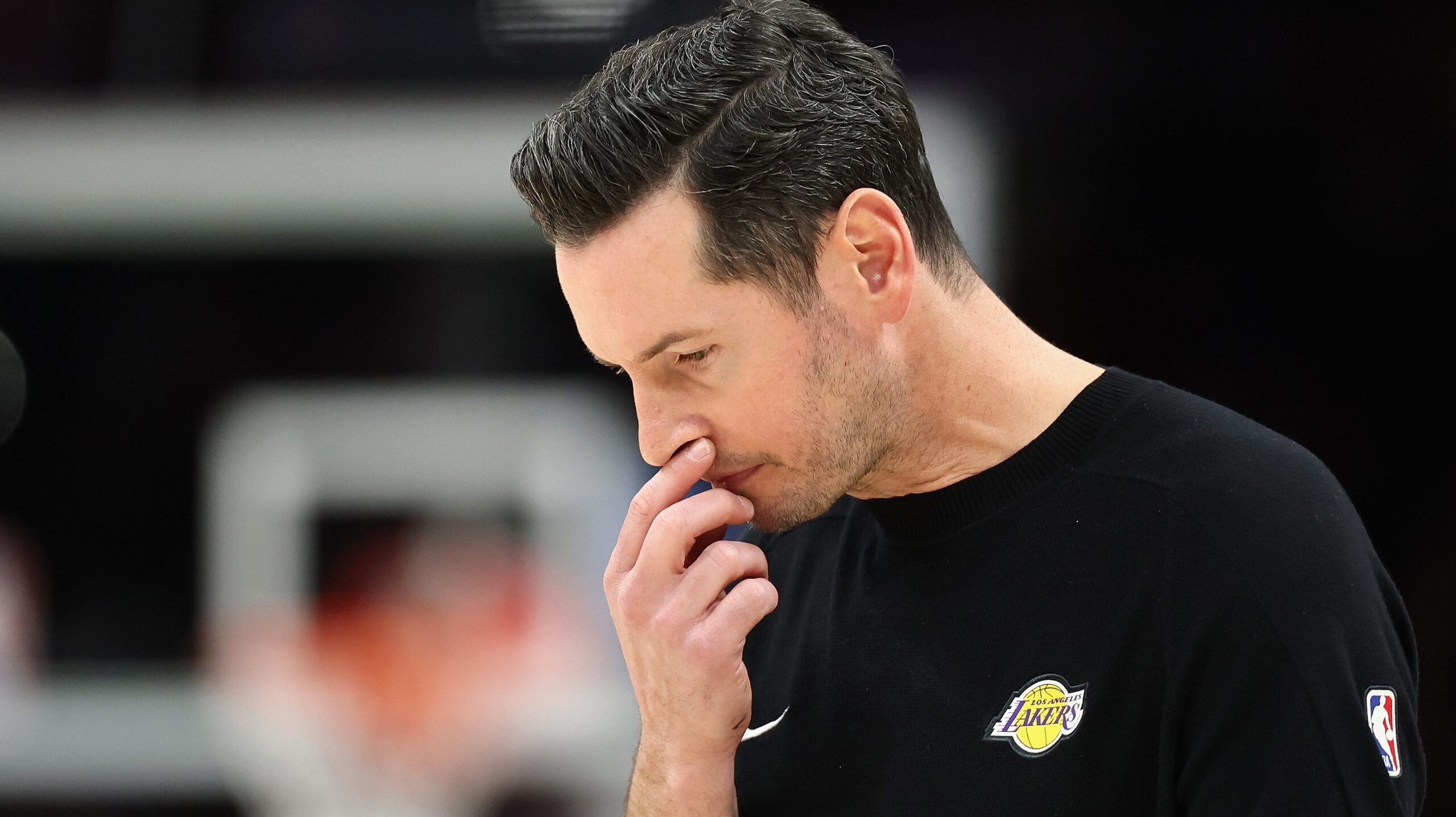
The Los Angeles Lakers’ 108-90 loss to the Oklahoma City Thunder in the second-round opener exposed a critical structural vulnerability: the bench unit’s inability to withstand elite ball pressure. While the defeat featured multiple failures, the performance of Jake LaRavia highlighted a specific personnel mismatch that the Thunder’s aggressive defensive system is engineered to exploit. For head coach JJ Redick, stabilizing the series requires a cold-eyed reassessment of LaRavia’s utility in high-leverage transition environments.
The Transition Catalyst: Identifying the Matchup Deficit
In Game 1, LaRavia’s 14-minute stint served as a primary catalyst for Oklahoma City’s transition engine. Despite his 6’7” frame, he struggled to navigate the high-intensity closeouts and trapping schemes that define the Thunder’s defensive identity. This lack of ball security resulted in two critical turnovers that bypassed the Lakers’ half-court defense, turning manageable possessions into immediate fast-break points. For a Lakers team already struggling with offensive rhythm, these self-inflicted wounds effectively neutralized the size advantage Redick sought to leverage.
The Thunder’s defensive architecture thrives on precisely these inconsistencies. When a secondary playmaker fails to secure the ball against aggressive ball-tracking, it triggers a cascade of defensive rotations that the Lakers proved unable to counter. Consequently, LaRavia’s inclusion has transitioned from a tactical gamble to a documented operational liability against this specific opponent.
Quantitative Decline: The -52 Performance Differential
Statistical analysis reinforces that LaRavia’s Game 1 struggles are part of a persistent regression. Over four regular-season meetings, he averaged 24.6 minutes but shot a marginal 25.8% from the field. This level of inefficiency allows the Thunder to sag off the perimeter, effectively double-teaming primary scoring threats and clogging the paint. The most damning metric remains the plus-minus differential; the Lakers were outscored by 52 points during LaRavia’s 98 minutes on the floor across the season series.
A 52-point deficit over such a substantial sample size indicates a systemic failure in how LaRavia’s skill set interacts with the Thunder’s scheme. His lone field goal in Game 1—a three-pointer in the waning seconds—did little to mask a performance defined by hesitant decision-making and a lack of competitive gravity. To salvage the series, the coaching staff must prioritize ball security over perceived versatility.
Structural Rebalancing: Redick’s Rotational Mandate
As a first-year head coach, JJ Redick faces a defining tactical crossroads. The recommendation to marginalize LaRavia is not a dismissal of his talent, but a recognition of the need for a more disciplined offensive structure. The absence of elite playmaking—a vacancy often compared to the impact of a Luka Doncic—places a disproportionate burden on secondary wings. Without top-tier creators to draw defensive gravity, players like LaRavia are forced into high-variance decision-making roles that exceed their current capacity.
To avoid an insurmountable series deficit, Redick must refine the rotation to favor high-floor contributors who can maintain offensive flow under duress. Continuing to play into the Thunder’s hands by providing them with high-turnover targets will only reinforce the cycle of transition scoring that doomed Game 1. Defensive integrity is a byproduct of offensive discipline; by removing high-risk variables from the floor, the Lakers can force Oklahoma City into a half-court game where the Lakers’ veteran experience remains their greatest asset.

Photo by PatrickBlaise on Pixabay.