
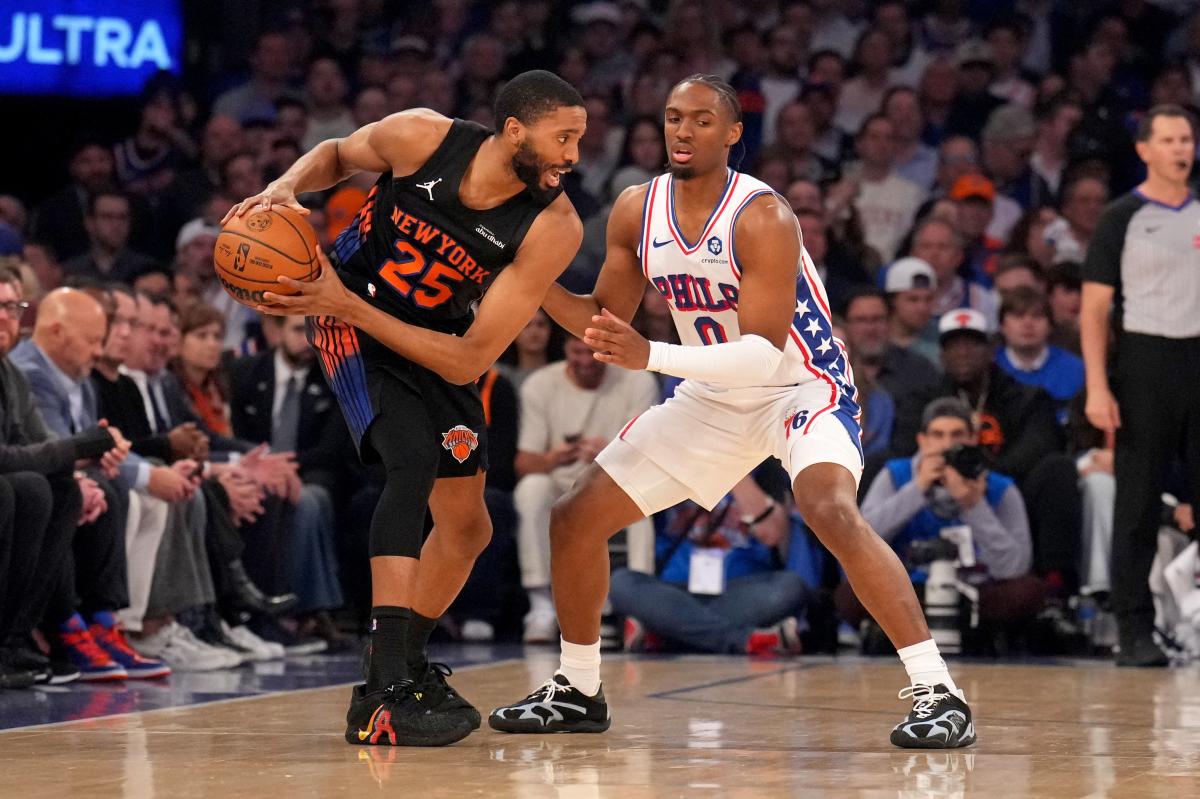
The Eastern Conference Semifinals have transitioned from the statistical outlier of Game 1—a 137-98 Knicks victory—into a complex tactical battle defined by roster attrition. While the 39-point margin established an initial benchmark for New York’s depth, Game 2 at Madison Square Garden has introduced significant operational volatility, primarily centered on the absence of Joel Embiid and the resulting redistribution of offensive usage.
The Structural Void: Philadelphia without Embiid
Joel Embiid’s absence constitutes more than a personnel loss; it represents the removal of Philadelphia’s primary defensive anchor and offensive fulcrum. This structural void has forced the 76ers to abandon their traditional post-up gravity in favor of a high-variance, perimeter-oriented attack. For the Knicks, this shift theoretically streamlines defensive assignments but introduces the risk of defensive complacency against a more mobile, unpredictable lineup.
Tyrese Maxey: Escalated Usage and Transition Efficiency
With Embiid sidelined, Tyrese Maxey has assumed the role of the 76ers’ primary offensive engine. Following a marginalized performance in the series opener, Maxey’s second-quarter surge—accounting for 14 points in a single period—exemplifies a tactical pivot toward transition-heavy play. By totaling 18 points by the half, Maxey’s high-volume penetration has become the sole viable countermeasure to New York’s physical perimeter defense. However, this reliance creates a sustainability risk, as the 76ers’ 52-46 lead hinges on Maxey maintaining elite efficiency under extreme defensive pressure.
Operational Constraints in the Knicks’ Frontcourt
Conversely, the Knicks are navigating acute rotational bottlenecks. Ariel Hukporti’s accumulation of four fouls in just four minutes of play highlights a significant breakdown in interior discipline. This foul trouble has compromised the Knicks’ defensive architecture, necessitating suboptimal configurations featuring Landry Shamet. While stabilizers like Mikal Bridges and Josh Hart managed to neutralize a mid-game deficit to tie the score at 54, the lack of reliable center minutes remains a critical vulnerability that threatens to derail New York’s home-court advantage.
Institutional Benchmarks: The Ewing Legacy
The intensity of the current postseason mirrors the historical standard set by Patrick Ewing. His reflections on his journey from Jamaica—noting the socioeconomic stakes that could have led to vastly different outcomes—serve as the franchise’s cultural anchor. Ewing’s narrative provides more than historical context; it establishes the institutional toughness required to navigate the attrition of a deep playoff run. The current roster’s resilience against rotational disruptions is a direct reflection of the grit Ewing normalized during his tenure.
Strategic Outlook and Market Implications
The outcome of this contest will dictate the series’ psychological trajectory. For Philadelphia, a victory without Embiid would represent a significant maximize of depreciated assets, while for New York, overcoming frontcourt foul trouble would validate their roster’s perceived depth. Beyond the court, Maxey’s performance in this high-leverage environment continues to elevate his market valuation, transitioning his status from a secondary star to an indispensable franchise cornerstone.
Photo by admomediaoffice on Pixabay.